In this chapter, we will be learning about sets. A set is a collection of objects or numbers. We can describe sets in different ways: by describing the objects in the set, by listing them, or by using set builder notation.
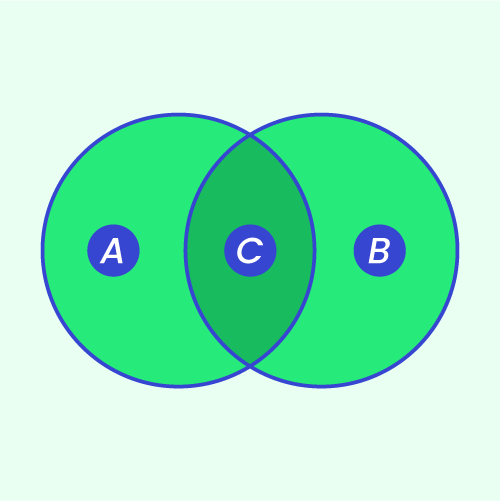
We will also learn about Venn diagrams, which help us visualize sets. A Venn diagram uses circles to represent sets and their relationships. We will learn how to represent the relation of a set and a universal set, as well as the complement of a set, using Venn diagrams.
By the end of this chapter, we will be able to identify and describe universal sets, the complement of a set, and understand how to represent these concepts using Venn diagrams.
• Explain the meaning of set.
• Describe sets using: (i) description, (ii) listing, and (iii) set builder notation.
• Identify whether an object is an element of a set and represent the relation using symbol.
• Determine the number of elements of a set and represent the number of elements using symbol.
• Compare and explain whether two or more sets are equal and hence, make generalisation about the equality of sets.
• Identify and describe universal sets and complement of a set.
• Represent (i) the relation of a set and universal set, and (ii) complement of a set through Venn diagrams.
• Identify and describe the possible subsets of a set.
• Represent subsets using Venn diagrams.
• Represent the relations between sets, subsets, universal sets and complement of a set using Venn diagrams.

There is no chapter or topic to show