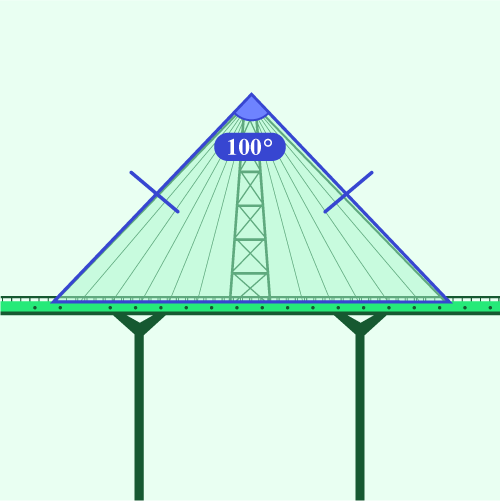
In this chapter, we will be learning about lines and angles. We will learn how to determine and explain the congruency of line segments and angles. We will also learn how to estimate and measure the size of line segments and angles, and understand how the estimation is obtained.
Next, we will study angles related to intersecting lines. We will learn how to identify, explain, and draw vertically opposite angles and adjacent angles at intersecting lines, including perpendicular lines. We will also learn how to determine the values of angles related to intersecting lines, given the values of other angles.
Lastly, we will explore angles related to parallel lines and transversals. We will learn how to recognize, explain, and draw parallel lines and transversals. We will also learn how to recognize, explain, and draw corresponding angles, alternate angles, and interior angles.
By the end of this chapter, we will have a good understanding of lines and angles and be able to apply our knowledge to solve problems involving them.
• Determine and explain the congruency of line segments and angles.
• Estimate and measure the size of line segments and angles, and explain how the estimation is obtained.
• Recognise, compare and explain the properties of angles on a straight line, reflex angles, and one whole turn angles.
• Describe the properties of complementary angles, supplementary angles and conjugate angles.
• Solve problems involving complementary angles, supplementary angles and conjugate angles.
• Construct (i) line segments, (ii) perpendicular bisectors of line segments, (iii) perpendicular line to a straight line, (iv) parallel lines and explain the rationale of construction steps.
• Construct angles and angle bisectors, and explain the rationale of construction steps.
• Identify, explain and draw vertically opposite angles and adjacent angles at intersecting lines, including perpendicular lines.
• Determine the values of angles related to intersecting lines, given the values of other angles.
• Solve problems involving angles related to intersecting lines.
• Recognise, explain and draw parallel lines and transversals.
• Recognise, explain and draw corresponding angles, alternate angles and interior angles.
• Determine whether two straight lines are parallel based on the properties of angles related to transversals.
• Determine the values of angles related to parallel lines and transversals, given the values of other angles.
• Recognise and represent angles of elevation and angles of depression in real-life situations.
• Solve problems involving angles related to parallel lines and transversals.

There is no chapter or topic to show