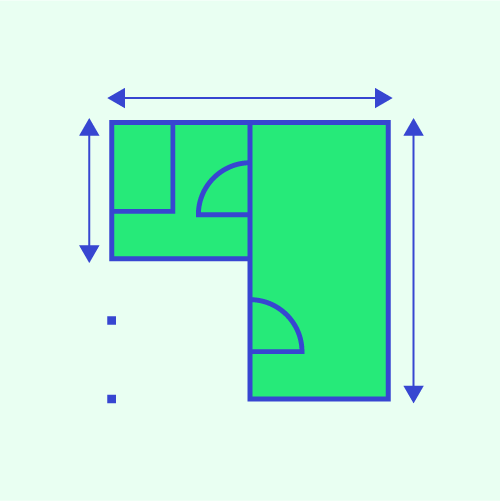
In this chapter, we will be learning about perimeter and area. Perimeter is the distance around a shape, and we will learn how to find the perimeter of different shapes when we know the side lengths or need to measure them. We will also learn how to estimate the perimeter and compare it with the actual measured value.
Next, we will learn about the area of triangles, parallelograms, kites, and trapeziums. We will use different methods to estimate the area of these shapes and derive the formulas based on the area of rectangles.
Lastly, we will explore the relationship between perimeter and area. We will make and verify conjectures about this relationship and solve problems involving the perimeter and area of various shapes like triangles, rectangles, squares, parallelograms, kites, trapeziums, and combinations of these shapes.
• Determine the perimeter of various shapes when the side lengths are given or need to be measured.
• Estimate the perimeter of various shapes, and then evaluate the accuracy of estimation by comparing with the measured value.
• Solve problems involving perimeter.
• Estimate the area of various shapes using various methods.
• Derive the formulae of the area of triangles, parallelograms, kites and trapeziums based on the area of rectangles
• Solve problems involving areas of triangles, parallelograms, kites, trapeziums and the combinations of these shapes.
• Make and verify the conjecture about the relationship between perimeter and area.
• Solve problems involving perimeter and area of triangles, rectangles, squares, parallelograms, kites, trapeziums and the combinations of these shapes.

There is no chapter or topic to show