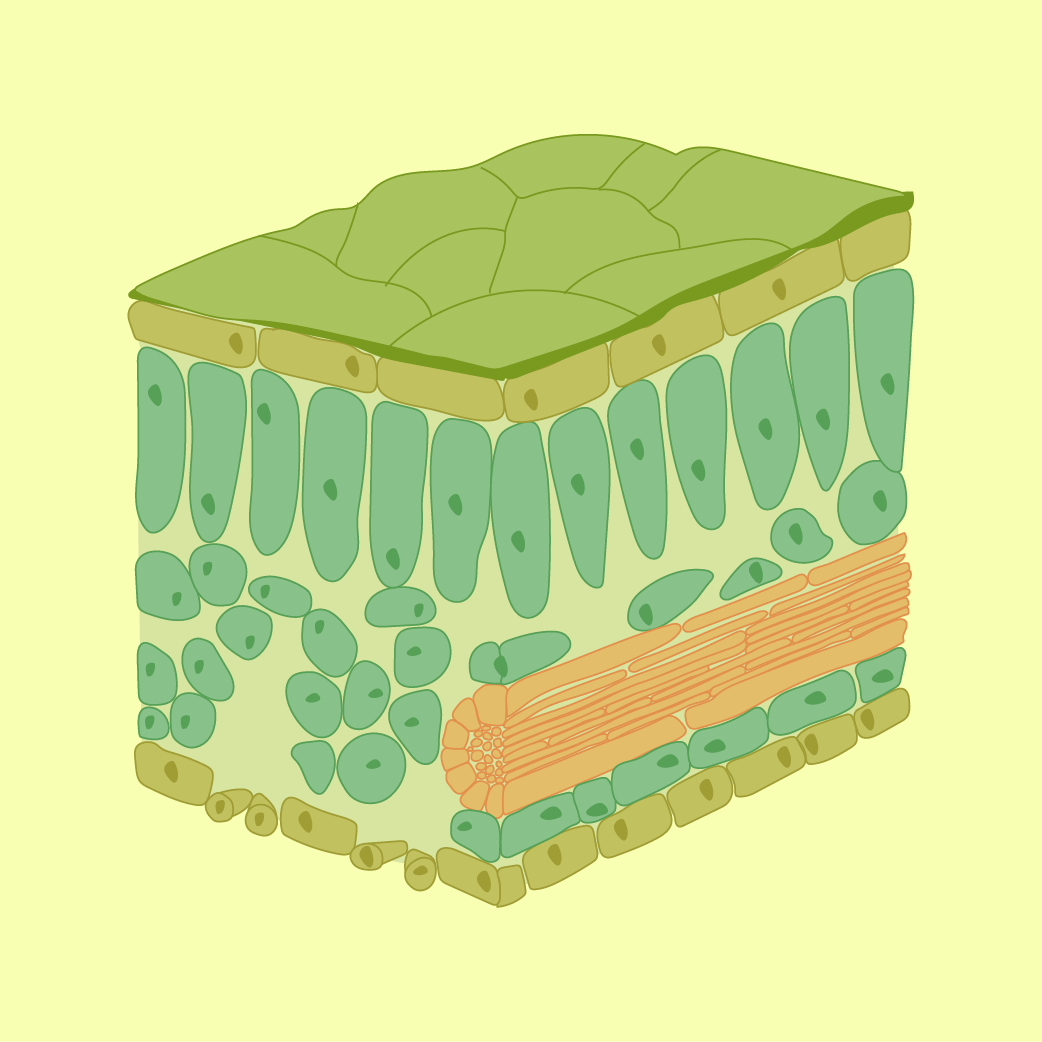
In this chapter, we will be learning about the structure and function of leaves. We will start by understanding the outer structure of leaves, including the lamina and petiole. Then, we will explore the internal structure of the leaf, which includes the upper and lower epidermis, palisade mesophyll, spongy mesophyll, and vascular bundle. Next, we will study the main organ of gaseous exchange in plants. We will discuss why gaseous exchange is necessary for plants and learn about the opening and closing of stomata. This process is influenced by the uptake of potassium ions and changes in sucrose concentration. Moving on, we will explore the main organ of transpiration in plants. We will understand why transpiration is important for plants and examine the environmental factors that affect its rate, such as light intensity, temperature, air movement, and relative air moisture. Lastly, we will delve into the main organs of photosynthesis. We will discuss the importance of photosynthesis for plants and how the internal structures of leaves are adapted to facilitate this process.
• Describes outer leaf structure: (i) lamina, (ii) petiole
• Identify internal structure of leaf laminar: (i) upper epidermis, (ii) palisade mesophyll, (iii) spongy mesophyll, (iv) lower epidermis, (v) vascular bundle
• Justify the necessity of gaseous exchange in plant
• Explain the opening and closing of stoma based on: (i) potassium ions uptake, (ii) changes in sucrose concentration
• Conduct experiments to compare the distribution of stoma on upper epidermis and lower epidermis of monocots leaves and dicots leaves
• Predict the effect lack of water on opening and closing of stoma in plants
• Justify the necessity of transpiration in plants
• Describes the environmental factors that affect the rate of transpiration: (i) light intensity, (ii) temperature, (iii) air movement, (iv) relative air moisture
• Conduct an experiment to study the effect of environmental factors in rate of transpiration by using photometer
• Justify the necessity of photosynthesis in plants
• Correlate the adaptation of internal structures in leaves with photosynthesis
• Identify the structure of chloroplasts: (i) granum, (ii) thylakoid, (iii) stroma
• Correlate the light-dependent reaction and non-light-dependent reaction in photosynthesis
• Write the chemical equation that represents photosynthesis process
• Compare and contrast the light-dependent reactions with non-light dependent reactions in photosynthesis
• Explain the environmental factors that affect rate of photosynthesis: (i) light intesity, (ii) temperature, (iii) carbon dioxide concentration
• Conduct an experiment to study the effect of environmental factors on rate of photosynthesis
• Analyse the effects of changes in light intensity and color on rate of photosynthesis
• Define compensation point
• Compare and contrast between photosynthesis and cell respiration in plants
• Analyse the light intensity and compensation point by using graph
• Predict the effect on the rate of photosynthesis and rate of cell respiration that are constant at compensation point growth in plants

There is no chapter or topic to show