
9.1 Combined Events
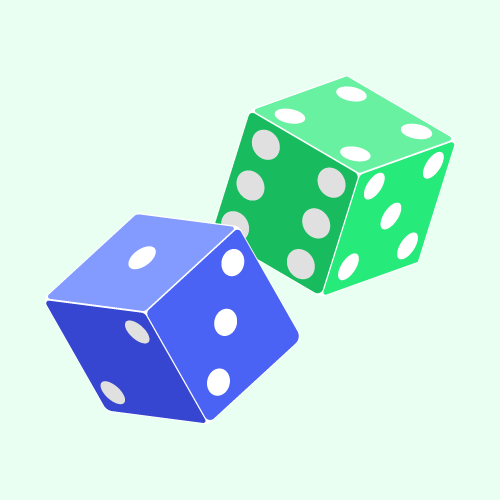
In our daily lives, many decisions involve uncertainties, such as choosing an academic stream or selecting products to sell on school entrepreneurship day. Probability helps evaluate these uncertainties to make sound decisions. A combined event refers to the combination of two or more events in an outcome, resulting from one or more experiments.
Learning Objectives
- Describe combined events and list out the possible combined events.
- Represent the outcomes of combined events using ordered pairs.
- Determine the total number of outcomes in a sample space using the multiplication rule \(n(S) = n(A) \times n(B)\).
- Write the sample space \(S\) for various combined events.
Ordered Pair Representation and Multiplication Rule for Combined Events
See how two single events combine into an ordered pair and how the multiplication rule gives the total number of outcomes.
Event \(A\)
\(n(A)\) outcomes
Combined Event
\((a, b) \in S\)
Event \(B\)
\(n(B)\) outcomes
\[n(S) = n(A) \times n(B)\]
Brief Explanation
What is a Combined Event?
A combined event is the combination of two or more events in an outcome. Combined events can result from one or more experiments.
What is a Sample Space?
A sample space, denoted by \(S\), is a set that contains all the possible outcomes of an experiment.
Representing Outcomes as Ordered Pairs
The outcomes of a combined event can be represented by ordered pairs. For example, \((10, 20)\) means the first pupil chose a \(10\text{ sen}\) coin and the second pupil chose a \(20\text{ sen}\) coin.
| Experiment | Sample space \(S\) | Number of outcomes \(n(S)\) |
|---|---|---|
| Two coins are tossed | \(\{(\text{T}, \text{T}), (\text{T}, \text{H}), (\text{H}, \text{T}), (\text{H}, \text{H})\}\) | \(2 \times 2 = 4\) |
| Two cards drawn without replacement from T, E, K, U, N | \(\{(\text{T}, \text{E}), (\text{T}, \text{K}), \ldots, (\text{N}, \text{U})\}\) | \(5 \times 4 = 20\) |
| Two pupils choose from \(10\text{ sen}\), \(20\text{ sen}\), \(50\text{ sen}\) coins | \(\{(10, 20), (10, 50), (20, 10), (20, 50), (50, 10), (50, 20)\}\) | \(3 \times 2 = 6\) |
Try Answering First
Read the question, answer it in your mind, then press “Check Answer”.
What is the definition of a sample space?
If Event \(A\) has 4 outcomes and Event \(B\) has 3 outcomes, what is the total number of possible outcomes \(n(S)\) for the combined event?
State the sample space when two fair coins are tossed, using H for heads and T for tails.
Common Mistakes
- Treating ordered pairs where order matters as identical, for example assuming \((\text{H}, \text{T})\) is the exact same outcome as \((\text{T}, \text{H})\).
- Forgetting to exclude repeated selections when an experiment is conducted without replacement, e.g. listing \((\text{T}, \text{T})\) when cards are drawn without replacement from a set containing only one 'T'.
- Adding the number of outcomes instead of multiplying them: writing \(n(A) + n(B)\) instead of \(n(A) \times n(B)\).
Misconceptions
Combined events can only happen if two different experiments are carried out simultaneously.
Combined events can result from a single experiment performed repeatedly, such as tossing a coin twice or drawing two cards one by one, or from two separate experiments conducted at the same time, such as rolling a dice and tossing a coin.
Summary
- A combined event is the combination of two or more events in an outcome.
- The sample space \(S\) is the complete set of all possible outcomes.
- Outcomes are represented as ordered pairs: \((x, y)\).
- The total number of outcomes is calculated using the formula: \(n(S) = n(A) \times n(B)\).
Short Activity
Complete all parts first, then press the check answer button.
A. Objective Quiz
1 Which formula correctly calculates the total number of outcomes in a sample space, \(n(S)\), for two events \(A\) and \(B\)?
2 Two fair coins are tossed. What is the total number of outcomes in the sample space?
B. Fill in the Blanks
3 A set that contains all the possible outcomes of an experiment is called the .
4 The outcomes of a combined event can be represented by pairs.
C. Matching: Term or Notation to Description
Drag each term or notation to the correct description. On a phone, tap the answer choice first, then tap the description box.

