
9.4 Application of Probability of Combined Events
This topic covers the practical application of the probability of combined events to solve everyday real-world problems. By representing scenarios through tree diagrams or systematic lists, students can determine the probability of specific outcomes and use these probabilities to make predictions or estimates, such as finding the expected number of times an event will occur over multiple trials.
Learning Objectives
- Solve problems involving probability of combined events.
- Construct and use tree diagrams to determine probabilities of independent and dependent combined events.
- Apply the complement method, \(P(A) = 1 - P(A')\), to calculate probabilities efficiently.
- Calculate the expected frequency or estimated number of occurrences using \(n(A) = P(A) \times N\).
Tree Diagram for Conditional Replacement Experiment
See how branch probabilities change when a marble is replaced or not replaced after the first draw.
Brief Explanation
How to solve real-world problems involving combined events.
What is this topic about?
Applying the probability of combined events allows us to solve everyday problems where multiple events occur together or in sequence. To find the total probability, we use the multiplication rule for consecutive events along a branch and the addition rule to combine mutually exclusive outcomes that satisfy the condition.
Why is the complement method useful?
The complement method, \(P(A) = 1 - P(A')\), is a powerful shortcut, particularly when calculating events involving "at least one" or "marbles of different colours".
Worked Example: Independent Combined Events
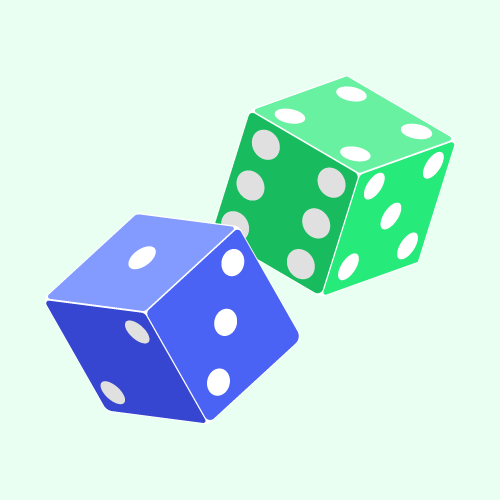
A fair dice is rolled twice consecutively. If this experiment is carried out 540 times, how many times will at least one perfect square be obtained?
Perfect squares on a dice are \(1\) and \(4\), so \(P(K) = \dfrac{2}{6} = \dfrac{1}{3}\) and \(P(K') = \dfrac{2}{3}\).
Expected frequency: \(n = \dfrac{5}{9} \times 540 = 300\) times.
Worked Example: Dependent and Conditional Combined Events
A box contains 7 red marbles, 5 yellow marbles, and 3 blue marbles. Two marbles are chosen randomly one by one. If the first marble is blue, it is returned before the second draw. If the first marble is not blue, it is not returned.
The probability of getting two marbles of different colours is:
Try Answering First
Read the question, answer it in your mind, then press "Check Answer".
A study is carried out on the gender of children from 16 000 families with two children. Estimate the number of families with at least one son in that study. Assume the probability of having a boy or a girl is equal.
A box contains 3 yellow pens, 5 red pens, and 1 black pen. Two pens are chosen at random one by one without replacement. Calculate the probability that both pens chosen are of the same colour.
A lucky wheel has 6 equal sectors: 2 red and 4 yellow. If the pointer stops at red, a voucher is drawn from Box A which contains 20 RM50 vouchers and 10 RM10 vouchers. If it stops at yellow, a voucher is drawn from Box B which contains 5 RM50 vouchers and 20 RM10 vouchers. For 450 customers, calculate the expected number of RM10 vouchers needed.
Common Mistakes
- Forgetting conditional changes in the denominator: failing to reduce the total number in the sample space for second trials when items are not replaced, for example using \(\dfrac{x}{15}\) instead of \(\dfrac{x}{14}\).
- Applying replacement rules incorrectly to different branches: treating all colours as replaced or all as not replaced when only one colour is replaced.
- Adding probabilities instead of multiplying along branches: computing \(P(A \cap B)\) as \(P(A) + P(B)\) instead of \(P(A) \times P(B|A)\).
- Neglecting the complement method for complex combinations: manually adding multiple positive cases and missing an outcome, instead of using \(1 - P(A')\).
Misconceptions
The expected frequency \(n(A) = P(A) \times N\) represents the exact number of times an event will definitely happen in real life.
It represents a mathematical estimate or theoretical expectation based on probability, not a deterministic guarantee.
"At least one" means exactly one outcome.
"At least one" means one or more. For two trials, it includes \((K, K')\), \((K', K)\), and \((K, K)\).
If an item has only 1 unit available, selecting two of that same colour still has a non-zero probability.
If there is only 1 item of that type, the second draw without replacement has a probability of \(\dfrac{0}{N-1} = 0\), so choosing two of that type is impossible.
Summary
- Four problem-solving stages: Understanding the problem \(\rightarrow\) Planning a strategy \(\rightarrow\) Implementing the strategy \(\rightarrow\) Conclusion / Checking answer.
- Combined probability calculation: multiply probabilities along the branches of consecutive events, and add the resulting probabilities of all successful outcomes.
- Complement method: \(P(A) = 1 - P(A')\), exceptionally useful for finding probabilities involving "at least one" or "marbles of different colours".
- Expected frequency formula: \(n(A) = P(A) \times N\), where \(P(A)\) is the probability of event \(A\) and \(N\) is the total number of trials.
Short Activity
Complete all parts first, then press the check answer button.
A. Objective Quiz
1 A fair dice is rolled twice consecutively. What is the probability of obtaining at least one perfect square (\(1\) or \(4\))?
2 In an experiment where event \(E\) has a probability of \(P(E) = \dfrac{5}{9}\), how many times is event \(E\) expected to occur if the experiment is repeated 540 times?
B. Fill in the Blanks
3 If event \(A\) represents getting at least one desired outcome, its complement \(A'\) represents getting desired outcomes.
4 To estimate the expected number of times an event will occur over \(N\) trials, multiply the probability \(P(A)\) by .
C. Drag and Drop: Match the Concept
Drag each concept to the correct description or formula. On a phone, tap the answer choice first, then tap the matching box.

