
6.9Preparation of Salts
A salt is an ionic compound. The method used to prepare a salt depends directly on whether the salt is soluble or insoluble in water at room temperature.
Learning Objectives
- Test the solubility of salt in water and classify them into soluble and insoluble salts through experiment.
- Describe the preparation of a soluble salt through activity.
- Describe the preparation of an insoluble salt through activity.
- Construct an ionic equation using the continuous variation method through experiment.
Salt Preparation Decision Tree & Continuous Variation Method
Choose the correct preparation method based on salt solubility and cation type, then visualise precipitate height trends.
Soluble salt?
Contains Na+, K+ or NH4+?
Yes → Acid-alkali titration
No → Acid + excess metal / metal oxide / metal carbonate
Insoluble salt?
Mix two aqueous soluble salt solutions.
Double decomposition (precipitation)
Continuous variation method
Keep the volume of solution A fixed. Add increasing volumes of solution B in test tubes of the same size. The height of precipitate increases until the stoichiometric point, then remains constant. Plot precipitate height against the volume added and identify the first volume at maximum height. Calculate the moles of each reacting ion, determine the simplest mole ratio, and construct the ionic equation. For example, a 1 : 2 ratio of Pb2+ to I− gives Pb2+(aq) + 2I−(aq) → PbI2(s).
Brief Explanation
Understand the key ideas before preparing salts.
| Type of salt | Solubility in water | Exceptions |
|---|---|---|
| Nitrate salts, NO3− | All soluble | None |
| Sulphate salts, SO42− | All soluble | PbSO4, BaSO4, CaSO4 |
| Chloride salts, Cl− | All soluble | Hg2Cl2, PbCl2, AgCl |
| Carbonate salts, CO32− | Only Na2CO3, K2CO3, (NH4)2CO3 | All other carbonates are insoluble |
| Ammonium, sodium, potassium salts | All soluble | None |
1. Soluble ASaP salts
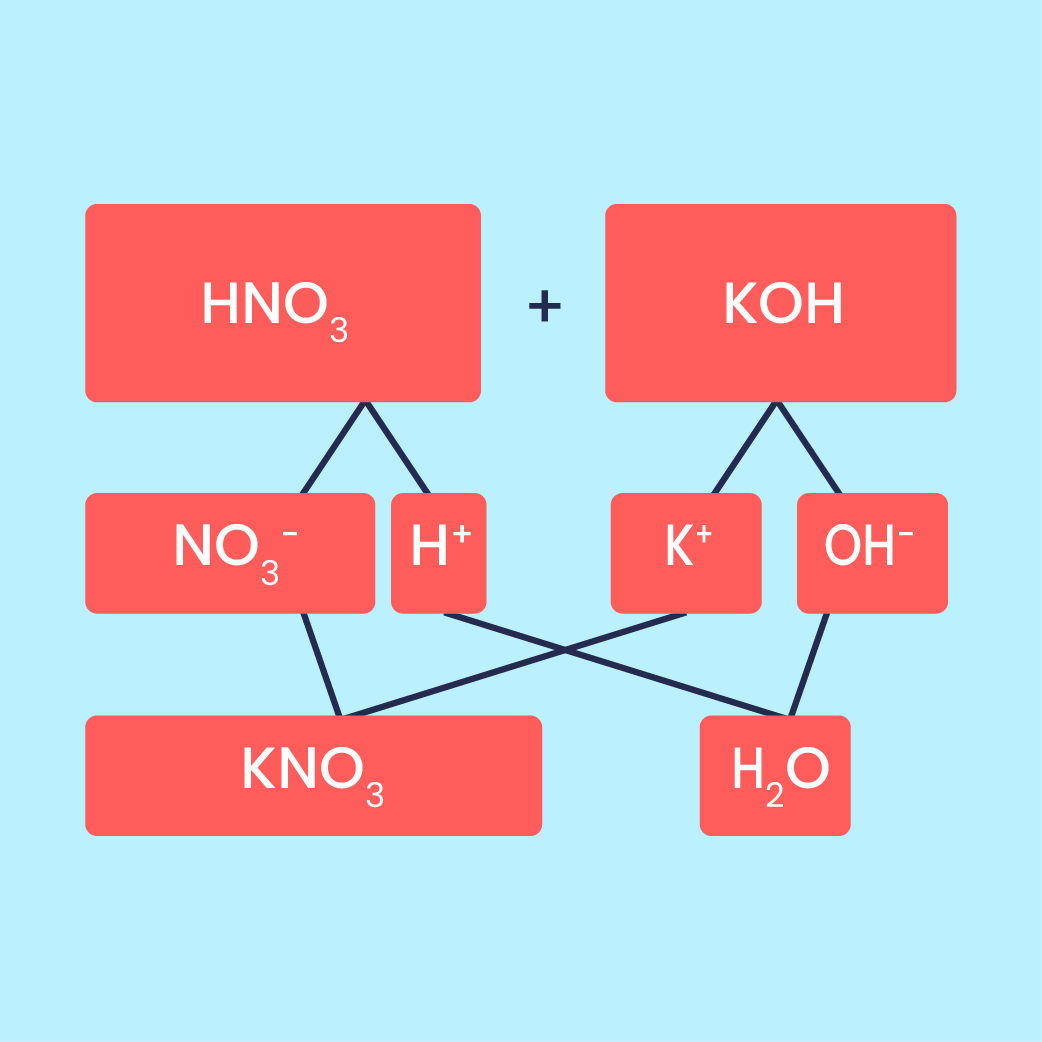
Ammonium, sodium and potassium salts are prepared by titration between an acid and an alkali.
2. Other soluble salts
Prepared by reacting an acid with an excess of a reactive metal, metal oxide or metal carbonate.
3. Insoluble salts
Prepared by double decomposition using two soluble salt solutions.
4. Purification
Soluble salts are purified by recrystallisation. Insoluble salts are filtered and washed with distilled water.
Try to Answer First
Answer mentally, then check the explanation.
State the solubility of calcium sulphate, CaSO4, and lead(II) chloride, PbCl2, in water at room temperature.
Why is copper powder not suitable to prepare copper(II) sulphate by reacting with dilute sulphuric acid?
What is the purpose of adding excess metal oxide powder when preparing a soluble salt from an acid and a metal oxide?
Common Mistakes
Avoid these errors when preparing salts.
Concept Misunderstandings
Compare each misconception with the correct fact.
Lead(II) chloride, PbCl2, and lead(II) iodide, PbI2, are soluble salts because they dissolve in hot water.
Solubility is defined at room temperature, 25°C. At room temperature, PbCl2 and PbI2 are insoluble, so they are classified as insoluble salts.
Any acid and base can prepare any salt.
Only soluble bases (alkalis) like NaOH, KOH and NH3(aq) are used in titration. Insoluble bases like CuO must be added in excess to acid and filtered off.
Recrystallisation can be used to purify insoluble salts.
Recrystallisation requires dissolving the salt in water. Insoluble salts cannot dissolve in water, so they are washed with distilled water instead.
Summary
Key facts to remember.
- Salts are classified as soluble or insoluble at room temperature.
- All nitrates and all ASaP salts are soluble. Chlorides are soluble except HPA; sulphates are soluble except PBC.
- Soluble ASaP salts are made via titration. Other soluble salts are made by reacting an acid with excess metal, oxide or carbonate.
- Insoluble salts are made via double decomposition of two soluble solutions.
- The continuous variation method establishes the stoichiometric mole ratio of the precipitate using constant-size test tubes.
Short Activity
Complete all parts before checking your score.
A. Objective Quiz
Which of the following salts is an insoluble salt at room temperature?
Why must all test tubes used in the continuous variation experiment be of the same size?
B. Fill in the Blanks
Soluble salts that contain sodium, potassium, or ammonium ions are prepared through a neutralisation reaction between an acid and an alkali using the ____________ method.
The method used to purify a soluble salt containing impurities by dissolving it in hot distilled water and cooling the saturated filtrate is called ____________.
C. Match the Salt with the Preparation Method
Drag each salt on desktop. On mobile, tap a salt and then tap the matching box.
Salt to Prepare
Potassium chloride, KCl Copper(II) nitrate, Cu(NO3)2 Barium sulphate, BaSO4 Zinc sulphate, ZnSO4Preparation Method
Keywords
Tap or hover over a term to read its meaning.


