
6.7Neutralisation
Neutralisation is a fundamental chemical reaction between an acid and a base (or alkali) that forms a salt and water only. In this process, the characteristic acidity of the acid and alkalinity of the alkali are eliminated because hydrogen ions, \( \text{H}^+ \), react with hydroxide ions, \( \text{OH}^- \), to produce neutral water molecules, \( \text{H}_2\text{O} \). Neutralisation is widely applied in healthcare, oral hygiene, personal care, and agriculture. Experimentally, neutralisation is analysed using the titration method with acid-base indicators to determine unknown concentrations through stoichiometric mole ratios.
Learning Objectives
- State the meaning of neutralisation.
- Write balanced chemical equations and ionic equations for neutralisation reactions.
- Explain the applications of neutralisation in daily life.
- Describe the titration method used to determine the concentration of an unknown solution.
- Identify the colours of phenolphthalein and methyl orange indicators in acidic, neutral, and alkaline conditions.
- Solve numerical problems involving neutralisation reactions using stoichiometric mole ratios and the formula \( \frac{M_a V_a}{M_b V_b} = \frac{a}{b} \).
Acid-Base Titration Setup and Indicator Transitions
Illustrate the apparatus arrangement for an acid-base titration, highlighting the role of the burette, pipette, conical flask, white tile, and indicator colour changes at the end point.
Titration Apparatus
Indicator Colour Transitions
Brief Explanation
Understand the key ideas behind neutralisation.
Ionic Equation of Neutralisation
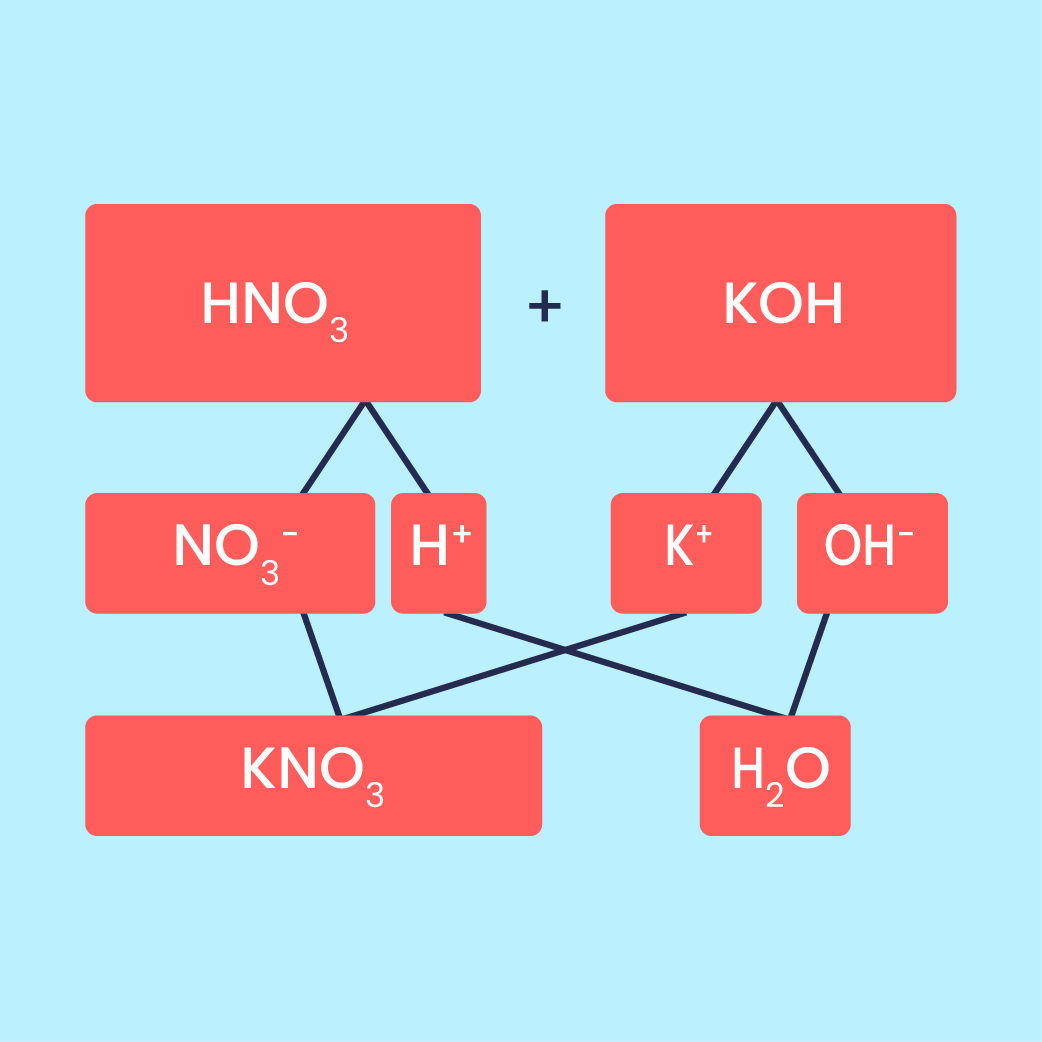
The actual reaction that occurs involves the combination of hydrogen ions, \( \text{H}^+ \), from the acid and hydroxide ions, \( \text{OH}^- \), from the alkali to produce water molecules, \( \text{H}_2\text{O} \):
\( \text{H}^+\text{(aq)} + \text{OH}^-\text{(aq)} \rightarrow \text{H}_2\text{O(l)} \)
Spectator ions such as \( \text{K}^+ \) and \( \text{NO}_3^- \) do not change during the reaction and are cancelled out when forming the ionic equation.
Example Chemical Equation
\[ \text{HNO}_3\text{(aq)} + \text{KOH(aq)} \rightarrow \text{KNO}_3\text{(aq)} + \text{H}_2\text{O(l)} \]
Other examples of balanced neutralisation equations:
- \( 2\text{HCl(aq)} + \text{Ba(OH)}_2\text{(aq)} \rightarrow \text{BaCl}_2\text{(aq)} + 2\text{H}_2\text{O(l)} \)
- \( \text{H}_2\text{SO}_4\text{(aq)} + 2\text{KOH(aq)} \rightarrow \text{K}_2\text{SO}_4\text{(aq)} + 2\text{H}_2\text{O(l)} \)
- \( \text{HNO}_3\text{(aq)} + \text{NaOH(aq)} \rightarrow \text{NaNO}_3\text{(aq)} + \text{H}_2\text{O(l)} \)
| Indicator | Colour in Acidic Medium | Colour in Neutral Medium | Colour in Alkaline Medium |
|---|---|---|---|
| Phenolphthalein | Colourless | Colourless | Pink |
| Methyl orange | Red | Orange | Yellow |
Try These Questions First
Answer mentally, then check the explanation.
What is the general ionic equation for any neutralisation reaction between an aqueous acid and an alkali?
What is the colour change of phenolphthalein indicator at the end point when an alkali in a conical flask is titrated with an acid from a burette?
\( 25\text{ cm}^3 \) of \( 0.2\text{ mol dm}^{-3}\text{ NaOH} \) solution is titrated with \( 0.1\text{ mol dm}^{-3}\text{ H}_2\text{SO}_4 \). Calculate the volume of sulphuric acid needed for complete neutralisation.
Balanced equation: \( \text{H}_2\text{SO}_4 + 2\text{NaOH} \rightarrow \text{Na}_2\text{SO}_4 + 2\text{H}_2\text{O} \) (\( a = 1, b = 2 \))
Formula: \( \frac{M_a V_a}{M_b V_b} = \frac{a}{b} \Rightarrow \frac{0.1 \times V_a}{0.2 \times 25} = \frac{1}{2} \)
\( 0.1 \times V_a = \frac{5.0}{2} = 2.5 \Rightarrow V_a = \frac{2.5}{0.1} = 25\text{ cm}^3 \)
Common Mistakes
Avoid these errors when studying neutralisation and titration.
Common Misconceptions
Compare each misconception with the correct fact.
Adding distilled water to rinse the inner neck of the conical flask during titration alters the result and causes errors.
Adding distilled water dilutes the mixture and changes the concentration, but it does not change the total number of moles of acid and alkali present in the flask. Therefore, the volume of acid needed to reach the end point remains unaffected.
A bee sting and a wasp sting can both be treated with the same household remedy.
A bee sting is acidic and is neutralised by a weak alkali such as baking soda. A wasp sting is alkaline and must be neutralised by a weak acid such as vinegar.
All ions present in the reactants take part in the neutralisation reaction.
Only hydrogen ions (\( \text{H}^+ \)) and hydroxide ions (\( \text{OH}^- \)) react to form water. The metallic cations and acid anions remain unchanged as spectator ions in solution.
Summary
Key facts to remember.
- Neutralisation is the reaction of an acid and a base/alkali forming salt and water only, governed fundamentally by \( \text{H}^+\text{(aq)} + \text{OH}^-\text{(aq)} \rightarrow \text{H}_2\text{O(l)} \).
- Everyday applications span agriculture (slaked lime), medicine (milk of magnesia), dental care (toothpaste), and chemical manufacturing (fertilisers like urea).
- Experimentally, titration accurately measures neutralisation volumes using indicators such as phenolphthalein and methyl orange.
- The formula \( \frac{M_a V_a}{M_b V_b} = \frac{a}{b} \) enables calculation of unknown concentrations based on balanced chemical mole ratios.
Quick Activity
Complete all parts before checking your score.
A. Objective Quiz
Which substance is used in agriculture to treat acidic soil through neutralisation?
What is the colour of methyl orange indicator in a neutral medium?
B. Fill in the Blanks
In a neutralisation reaction, spectator ions are cancelled out to give the ionic equation \( \text{H}^+\text{(aq)} + \text{OH}^-\text{(aq)} \rightarrow \) _______.
In acid-base titration, the point at which the indicator completely changes colour is called the _______ point.
C. Match the Substance with its Function
Drag each substance on desktop. On mobile, tap a substance and then tap the matching box.
Substance / Application
Milk of magnesia, \( \text{Mg(OH)}_2 \) Toothpaste Baking soda VinegarFunction in Daily Life
Keywords
Tap or hover over a term to read its meaning.


