
6.4Chemical Properties of Acids and Alkalis
Acids and alkalis possess distinct physical and chemical properties. While physical properties include sour taste, bitter taste, slippery feel, and effects on litmus paper, chemical properties describe how acids and alkalis react chemically with other substances. In this topic, pupils explore three fundamental chemical reactions of acids and three characteristic reactions of alkalis through laboratory activities and chemical equations.
Learning Objectives
- Summarise the chemical properties of acids by carrying out reactions between acid and base, acid and reactive metal, and acid and metal carbonate.
- Summarise the chemical properties of alkalis by carrying out reactions between alkali and acid, alkali and metal ion, and alkali and ammonium salt.
Summary of Chemical Reactions of Acids and Alkalis
A side-by-side comparative map of the three main reactions of acids versus the three main reactions of alkalis, including gas tests and precipitate observations.
Acid Reactions
- Acid + Base → Salt + Water
- Acid + Reactive metal → Salt + Hydrogen gas ('pop' sound)
- Acid + Metal carbonate → Salt + Water + Carbon dioxide gas (turns limewater cloudy)
Alkali Reactions
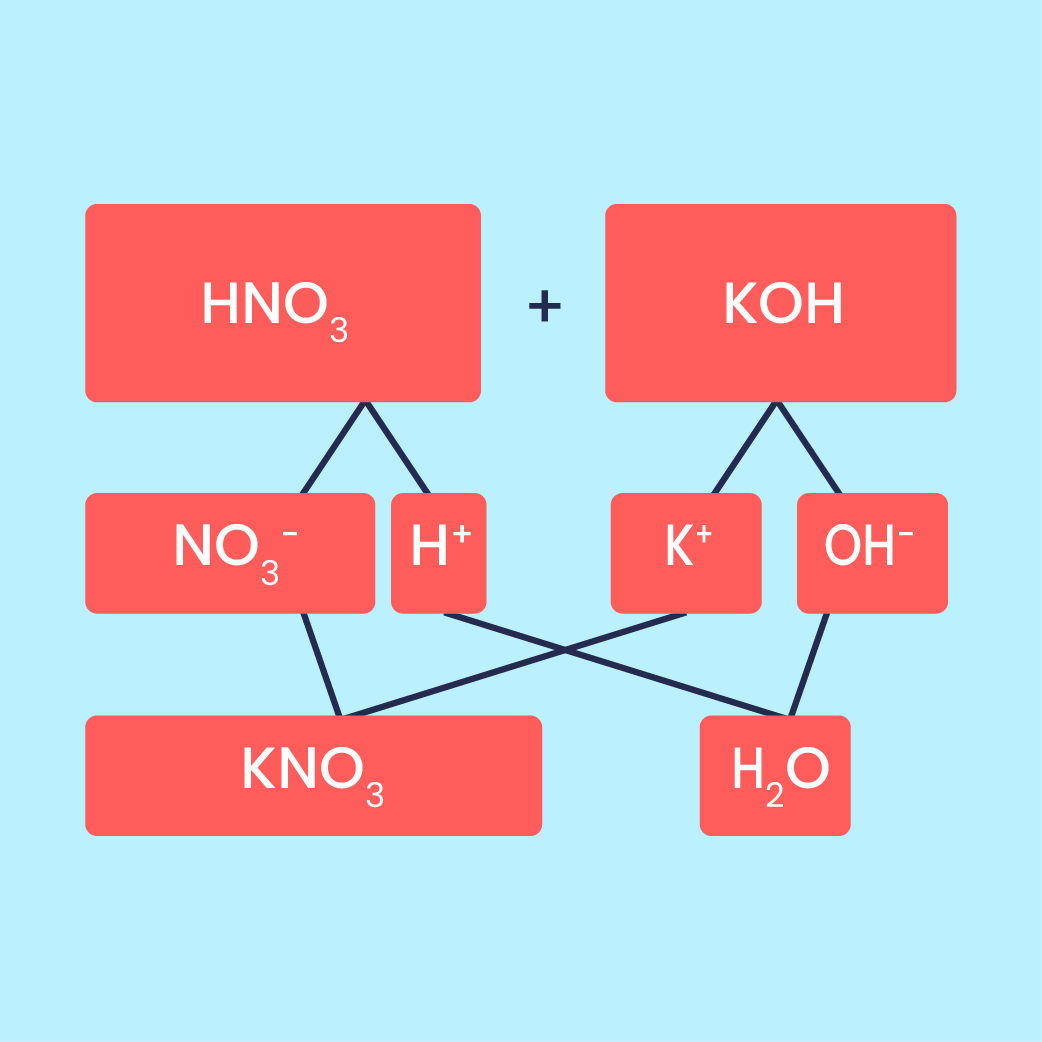
- Alkali + Acid → Salt + Water
- Alkali + Ammonium salt → Salt + Water + Ammonia gas (turns moist red litmus blue)
- Alkali + Metal ion → Insoluble metal hydroxide precipitate (e.g. blue precipitate with Cu²⁺)
Brief Explanation
Understand the characteristic reactions of acids and alkalis.
1. Acid + Base
Acids undergo neutralisation with bases to produce salt and water only.
\( \text{Acid} + \text{Base} \rightarrow \text{Salt} + \text{Water} \)
2. Acid + Reactive Metal
Acids react with reactive metals such as zinc to produce salt and release hydrogen gas, which burns with a 'pop' sound.
\( \text{Acid} + \text{Reactive metal} \rightarrow \text{Salt} + \text{Hydrogen gas} \)
3. Acid + Metal Carbonate
Acids react with metal carbonates such as calcium carbonate to produce salt, water, and carbon dioxide gas, which turns limewater milky/cloudy.
\( \text{Acid} + \text{Metal carbonate} \rightarrow \text{Salt} + \text{Water} + \text{Carbon dioxide gas} \)
Alkali Reactions
Alkalis react with acids to form salt and water. When heated with ammonium salts, they liberate pungent ammonia gas, which turns moist red litmus paper blue. When mixed with aqueous solutions containing metal ions, alkalis precipitate insoluble metal hydroxides, such as blue copper(II) hydroxide precipitate.
| Substance | Reactant Partner | Products Formed | Standard Chemical Equation Example |
|---|---|---|---|
| Acid | Base | Salt + Water | \( 2\text{HNO}_3\text{(aq)} + \text{CuO(s)} \rightarrow \text{Cu(NO}_3)_2\text{(aq)} + \text{H}_2\text{O(l)} \) |
| Acid | Reactive metal | Salt + Hydrogen gas | \( \text{H}_2\text{SO}_4\text{(aq)} + \text{Zn(s)} \rightarrow \text{ZnSO}_4\text{(aq)} + \text{H}_2\text{(g)} \) |
| Acid | Metal carbonate | Salt + Water + Carbon dioxide gas | \( 2\text{HCl(aq)} + \text{CaCO}_3\text{(s)} \rightarrow \text{CaCl}_2\text{(aq)} + \text{H}_2\text{O(l)} + \text{CO}_2\text{(g)} \) |
| Alkali | Acid | Salt + Water | \( 2\text{KOH(aq)} + \text{H}_2\text{SO}_4\text{(aq)} \rightarrow \text{K}_2\text{SO}_4\text{(aq)} + 2\text{H}_2\text{O(l)} \) |
| Alkali | Ammonium salt | Salt + Water + Ammonia gas | \( \text{KOH(aq)} + \text{NH}_4\text{Cl(aq)} \rightarrow \text{KCl(aq)} + \text{H}_2\text{O(l)} + \text{NH}_3\text{(g)} \) |
| Alkali | Metal ion | Insoluble metal hydroxide + Cation from alkali | \( 2\text{NaOH(aq)} + \text{Mg}^{2+}\text{(aq)} \rightarrow \text{Mg(OH)}_2\text{(s)} + 2\text{Na}^+\text{(aq)} \) |
Try These Questions First
Answer mentally, then check the explanation.
What observation indicates that carbon dioxide gas is released when dilute nitric acid reacts with calcium carbonate?
What gas is released when a mixture of sodium hydroxide solution and ammonium chloride powder is heated, and how is it confirmed?
Why is excess copper(II) oxide powder added to warm sulphuric acid during the preparation of copper(II) sulphate salt?
Common Mistakes
Avoid these errors when describing chemical reactions of acids and alkalis.
Common Misconceptions
Compare each misconception with the correct fact.
All reactions of acids produce a gas.
The reaction between an acid and a base (metal oxide or metal hydroxide) produces only a salt and water; no gas is evolved.
Heating is not required when alkalis react with ammonium salts to release ammonia gas.
The mixture of an alkali and an ammonium salt must be heated to liberate ammonia gas effectively.
Adding excess solid reactant (such as CuO or CaCO₃) contaminates the salt crystals.
The excess insoluble solid is completely removed by filtration, leaving a pure filtrate of the salt solution.
Summary
Key facts to remember.
- Acid + Base → Salt + Water (e.g. CuO + H₂SO₄ → CuSO₄ + H₂O)
- Acid + Reactive Metal → Salt + H₂ (Hydrogen produces 'pop' sound with burning wooden splinter)
- Acid + Metal Carbonate → Salt + Water + CO₂ (CO₂ turns limewater cloudy)
- Alkali + Acid → Salt + Water (Neutralisation)
- Alkali + Ammonium Salt → Salt + Water + NH₃ (NH₃ turns moist red litmus blue)
- Alkali + Metal Ion → Insoluble Metal Hydroxide + Cation from alkali (Forms distinctive precipitates)
Quick Activity
Complete all parts before checking your score.
A. Objective Quiz
When zinc powder is added to dilute hydrochloric acid, effervescence occurs. What is observed when a burning wooden splinter is brought near the mouth of the test tube?
Which products are formed when sodium hydroxide solution is heated with ammonium chloride powder?
B. Fill in the Blanks
The reaction between an acid and a metal carbonate produces salt, water, and ________ dioxide gas.
Ammonia gas released from heating an alkali with an ammonium salt turns moist red litmus paper ________.
C. Match the Reaction Partner with its Product or Observation
Drag each choice on desktop. On mobile, tap a choice and then tap the matching box.
Reacting Partners
Acid + Base Acid + Reactive metal Acid + Metal carbonate Alkali + Metal ionProducts / Observations
Keywords
Tap or hover over a term to read its meaning.


