
6.2 Cell Cycle and Mitosis
The cell cycle is an essential biological sequence of events that enables a cell to duplicate its genetic material and divide into two genetically identical daughter cells. It ensures organism growth, tissue repair, asexual reproduction, and regeneration.
Learning Objectives
- Describe the sequence of events in the cell cycle (Interphase: \(\text{G}_1\), \(\text{S}\), \(\text{G}_2\) phases, and \(\text{M}\) phase).
- Explain the stages of mitosis: prophase, metaphase, anaphase, and telophase.
- Compare cytokinesis in animal cells and plant cells.
- Explain the necessity of mitosis in living organisms for growth, repair, asexual reproduction, and regeneration.
- State the applications of mitosis in agriculture and medicine.
The Cell Cycle and the Four Stages of Mitosis
The cell cycle moves through Interphase (\(\text{G}_1 \rightarrow \text{S} \rightarrow \text{G}_2\)) and the M phase. Mitosis then divides the nucleus through prophase, metaphase, anaphase and telophase.
Interphase
The longest phase. The cell grows, produces organelles and proteins, and replicates its DNA. It consists of \(\text{G}_1\), \(\text{S}\) and \(\text{G}_2\).
M Phase
Consists of mitosis (nuclear division) and cytokinesis (cytoplasm division). It produces two genetically identical daughter cells.
Prophase
Chromatin condenses into chromosomes. The nuclear membrane disintegrates and spindle fibres begin to form.
Metaphase
Chromosomes align in a single row along the equatorial plane. Metaphase ends when the centromere begins to divide.
Anaphase
The centromere divides and sister chromatids separate. Spindle fibres shorten and pull chromatids towards opposite poles.
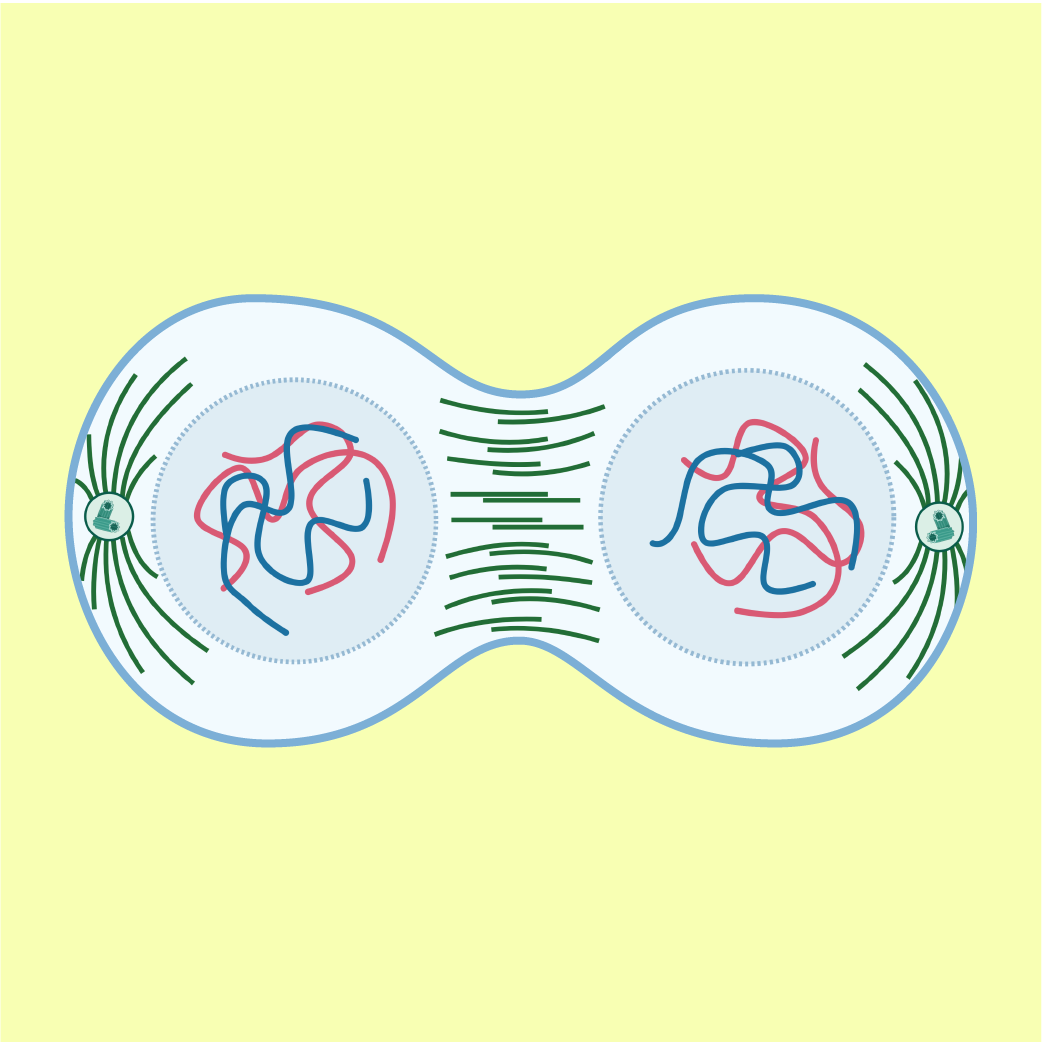
Telophase
Daughter chromosomes reach the poles and uncoil into fine chromatin threads. New nuclear membranes form around each set.
Animal Cell Cytokinesis
The plasma membrane constricts at the equator to form a cleavage furrow. A contractile ring of microfilaments deepens the furrow until the cell splits into two daughter cells.
Plant Cell Cytokinesis
Vesicles combine at the centre of the cell to form a cell plate. The cell plate expands outwards until it fuses with the parent plasma membrane, and cellulose fibres strengthen the new cell walls.
Short Explanation
What is the Cell Cycle?
The cell cycle refers to the sequence of events involving DNA multiplication and cell division to produce two daughter cells. It consists of two main phases: Interphase (the longest phase) and M phase.
\(\text{G}_1\) Phase
Cells grow. Cell components such as mitochondria and endoplasmic reticulum are produced. Proteins used in the cell cycle are synthesised. The nucleus looks big, and chromosomes exist as fine threads called chromatin.
\(\text{S}\) Phase
DNA synthesis occurs; DNA in the nucleus is replicated. Each chromosome multiplies into two identical threads known as sister chromatids. Both chromatids contain the exact same copy of the DNA molecule and are joined at the centromere.
\(\text{G}_2\) Phase
Cells continue to grow and remain metabolically active. Cells gather energy and make final arrangements to enter cell division.
Mitosis
The division of the nucleus of a parent cell into two nuclei. Each nucleus contains the same number of chromosomes and genetic content as the parent cell. It occurs in four stages: prophase, metaphase, anaphase and telophase.
Try to Answer First
Answer in your mind, then press “Check Answer”.
What major event occurs during the \(\text{S}\) phase of the cell cycle?
Predict what will happen if spindle fibres fail to develop during mitosis.
How does cytokinesis differ between animal cells and plant cells?
Common Mistakes
- Confusing chromatin, chromatids, and chromosomes: Chromatin refers to the loose, unwound DNA threads during interphase; sister chromatids are identical duplicated strands joined at a centromere; once separated in anaphase, they are called daughter chromosomes.
- Stating that plant cells cannot form spindle fibres because they lack centrioles: Plant cells do form spindle fibres during mitosis despite lacking centrioles.
- Mixing up the mechanisms of cytokinesis: Thinking plant cells pinch inward or animal cells form a cell plate.
Concept Misunderstandings
Interphase is a dormant or “resting” stage.
Interphase is the most metabolically active phase where the cell rapidly grows, produces proteins and organelles, and replicates all its nuclear DNA.
Somatic cell mitotic defects will be inherited by offspring.
The textbook explicitly states that the failure of mitotic division in somatic cells will not be inherited by the next generation, as somatic cells are not involved in gamete formation.
Summary
- The cell cycle includes Interphase (\(\text{G}_1\), \(\text{S}\), \(\text{G}_2\)) and M phase (mitosis and cytokinesis).
- DNA replication happens strictly during the \(\text{S}\) phase.
- Mitosis divides the nucleus into four stages: Prophase, Metaphase, Anaphase, and Telophase (PMAT).
- Cytokinesis divides the cytoplasm: cleavage furrow in animal cells; cell plate in plant cells.
- Mitosis produces two genetically identical diploid daughter cells essential for growth, tissue repair, regeneration, asexual reproduction, tissue culture, and stem cell therapies.
Short Activity
Objective: test your understanding of mitosis, cytokinesis and the cell cycle.
A. Objective Quiz
Which of the following events takes place during anaphase of mitosis?
How does cytokinesis occur in plant cells?
B. Fill in the Blanks
During the cell cycle, DNA replication occurs specifically during the phase of interphase.
In animal cell cytokinesis, a ring of contracts at the cleavage furrow to split the cell into two daughter cells.
C. Matching / Drag and Drop
Match each stage of mitosis to its correct chromosomal event. On a phone, tap a choice first, then tap the matching box. Tap the Answer Choices area to return a selected item.
C. Match the Stage of Mitosis to Its Chromosomal Event
Write the correct stage of mitosis next to each chromosomal event.
| Chromosomal Event | Stage of Mitosis |
|---|---|
| 1. Chromatin condenses into chromosomes and the nuclear membrane disintegrates. | |
| 2. Chromosomes align in a single row on the equatorial plane. | |
| 3. Centromeres divide and sister chromatids are pulled towards opposite poles. | |
| 4. Daughter chromosomes reach the poles and uncoil into fine chromatin threads. |
Answer choices: Prophase • Metaphase • Anaphase • Telophase

