
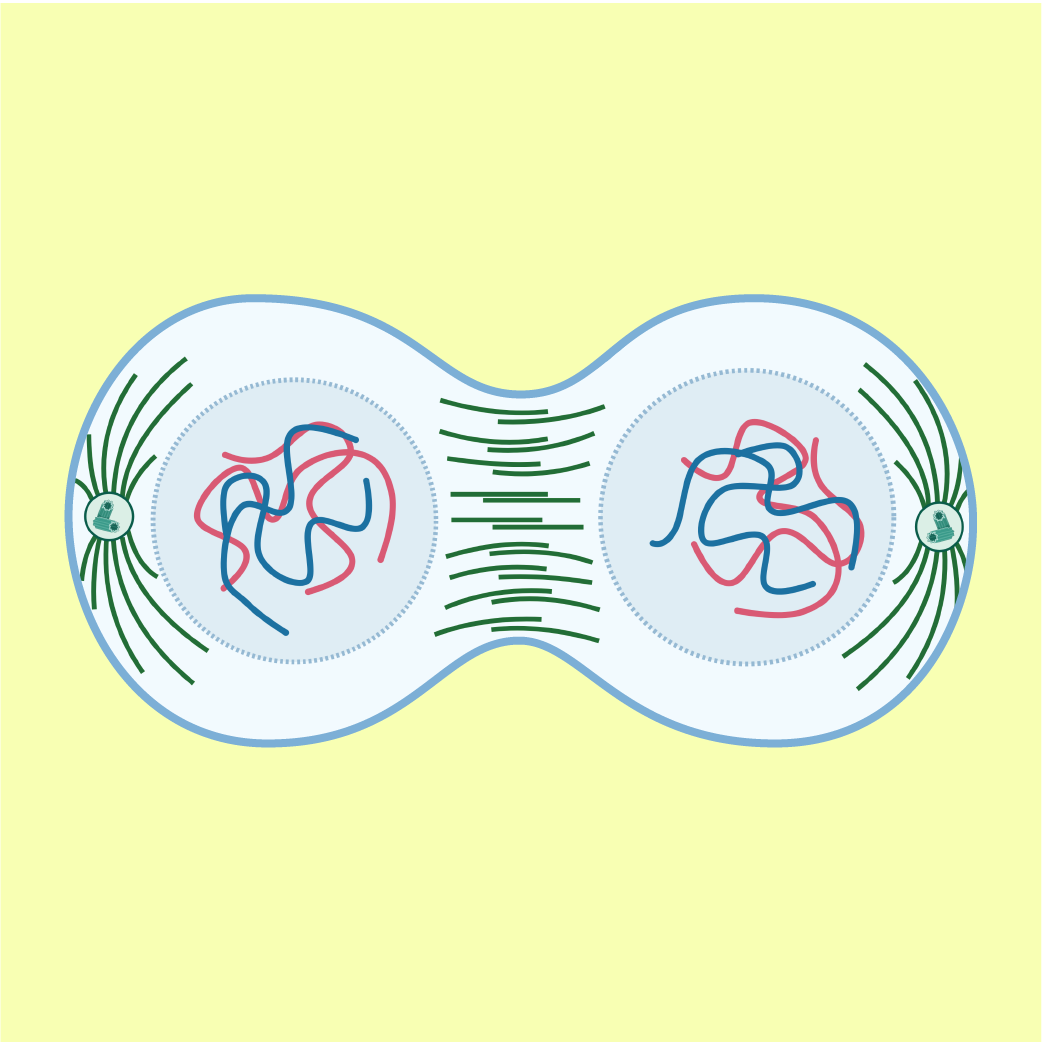
6.1 Cell Division
Cells in the human body continuously grow, divide, and die. To sustain life and ensure dead cells are replaced with new cells, organisms undergo cell division. Cell division consists of nuclear and cytoplasmic divisions and produces body cells classified as either somatic cells or gametes.
Learning Objectives
- State the necessity of cell division in replacing dead cells.
- Define karyokinesis and cytokinesis as the two main stages of cell division.
- Distinguish between somatic cells and gametes based on cell type, division process, and chromosome number.
- Explain the concepts of chromatin, homologous chromosomes, diploid \(2n\), and haploid \(n\) chromosome numbers.
Stages of Cell Division and Comparison of Chromosome Numbers
Cell division occurs in two stages: karyokinesis divides the nucleus, and cytokinesis divides the cytoplasm. The resulting cells are either diploid somatic cells or haploid gametes.
Karyokinesis
Division of the nucleus.
Cytokinesis
Division of the cytoplasm.
Chromosome sets
Diploid \(2n\) in somatic cells; haploid \(n\) in gametes.
Short Explanation
What is cell division?
Cell division is an essential biological process where a cell divides into new cells. It proceeds in two distinct stages: first, karyokinesis divides the genetic material within the nucleus; second, cytokinesis divides the cytoplasm to form separate cells.
Somatic cells
Somatic cells make up the body, excluding reproductive cells. They divide by mitosis and contain a diploid number of chromosomes, \(2n\). In humans, \(2n = 46\).
Gametes
Gametes are reproductive cells produced by meiosis. They contain a haploid number of chromosomes, \(n\). In humans, \(n = 23\).
Homologous chromosomes
In diploid cells, chromosomes exist as homologous pairs. Each pair contains one paternal chromosome and one maternal chromosome, both sharing the same structural characteristics.
Chromatin
When unwound, a chromosome appears as a long thread known as chromatin.
Try to Answer First
Answer in your mind, then press “Check Answer”.
What is the difference between karyokinesis and cytokinesis?
State the type of cell division process and the chromosome number for human somatic cells and gametes.
What are homologous chromosomes?
Common Mistakes
- Confusing karyokinesis with cytokinesis by mistakenly identifying karyokinesis as cytoplasmic division.
- Mixing up the chromosome numbers of somatic cells and gametes, for example stating human gametes have \(2n = 46\) instead of \(n = 23\).
- Stating that somatic cells are produced by meiosis instead of mitosis.
Concept Misunderstandings
Chromatin is a completely different structure from a chromosome.
Chromatin is simply a chromosome in the form of a long thread.
Both chromosomes in a homologous pair come from the same parent.
One chromosome comes from the male parent, paternal, and the other from the female parent, maternal.
Summary
- Cell division replaces dead cells with new cells through karyokinesis, division of the nucleus, and cytokinesis, division of the cytoplasm.
- Somatic cells are diploid \(2n = 46\) in humans, body cells produced by mitosis.
- Gametes are haploid \(n = 23\) in humans, reproductive cells produced by meiosis.
- Homologous chromosomes are pairs of structurally identical chromosomes composed of one paternal and one maternal chromosome.
- Chromatin refers to thread-like chromosomes.
Short Activity
Objective: identify the stages of cell division, chromosome numbers and chromosome concepts.
A. Objective Quiz
Which term refers to the division of the nucleus during cell division?
What is the chromosome number found in human gametes?
B. Fill in the Blanks
The stage of cell division that involves the division of the cytoplasm is called .
A pair of paternal and maternal chromosomes having the same structural characteristics are known as chromosomes.
C. Matching / Drag and Drop
Drag each term to its correct biological description. On a phone, tap a choice first, then tap the matching box. Tap the Answer Choices area to return a selected item.
C. Match the Term to Its Description
Write the correct term next to each description.
| Description | Term |
|---|---|
| 1. The division of the nucleus | |
| 2. The division of the cytoplasm | |
| 3. A chromosome that looks like a long thread | |
| 4. Body cell containing a diploid number of chromosomes \(2n\) |
Answer choices: Karyokinesis • Cytokinesis • Chromatin • Somatic cell

