
4.2 Carbohydrates
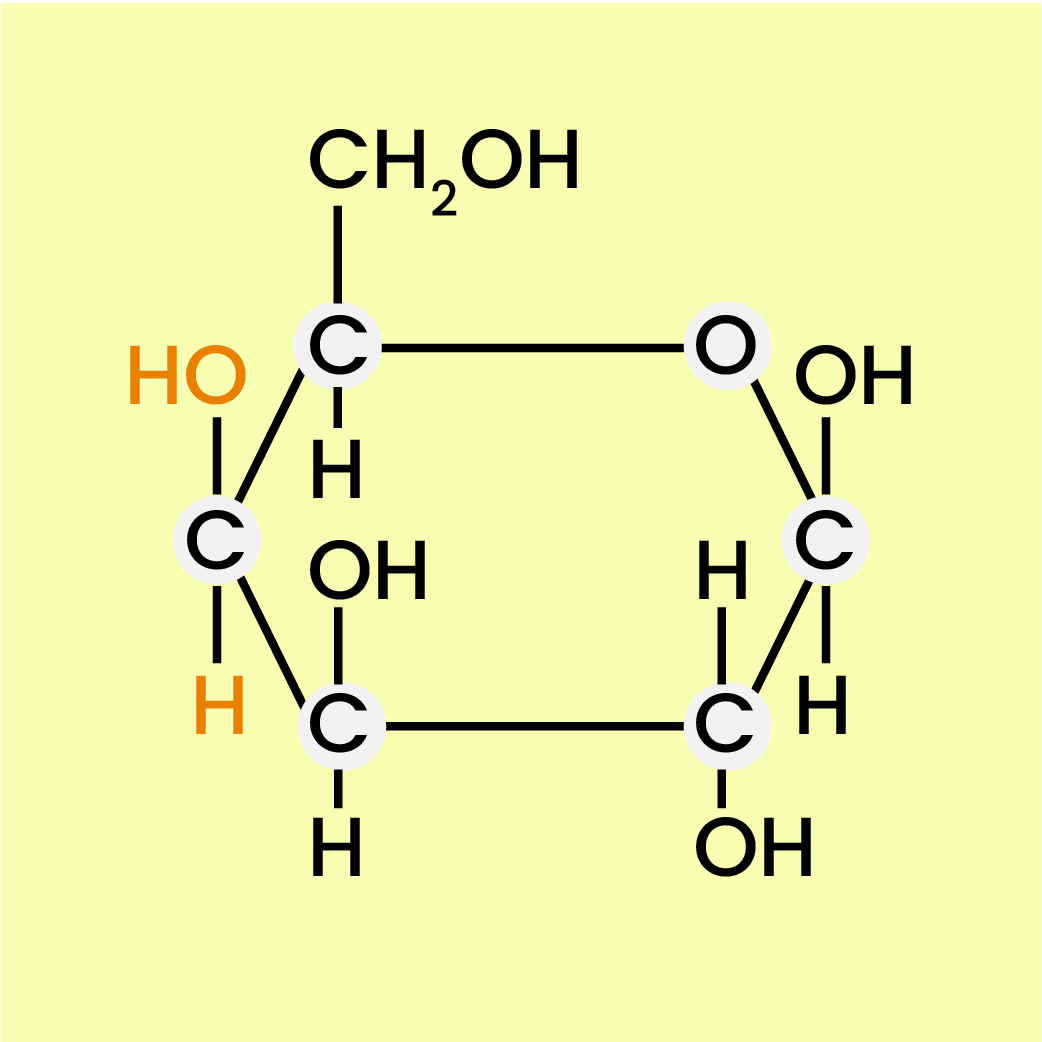
Carbohydrates are organic compounds composed of carbon, hydrogen, and oxygen in a 1:2:1 ratio. They serve as primary energy sources, food reserves, and structural components in living organisms.
Learning Objectives
- State the elemental composition and general chemical formula ratio of carbohydrates.
- Classify carbohydrates into monosaccharides, disaccharides, and polysaccharides.
- Describe the characteristics, examples, and food sources of monosaccharides, disaccharides, and polysaccharides.
- Explain the formation and breakdown of disaccharides through condensation and hydrolysis reactions.
- Explain the reducing power of sugars and the Benedict's test for reducing and non-reducing sugars.
- State the biological importance of carbohydrates in plant and animal cells.
Classification, Reactions, and Examples of Carbohydrates
A visual map linking monosaccharides, disaccharides, and polysaccharides through condensation and hydrolysis reactions.
Monosaccharides
Simple sugars: glucose, fructose, galactose. Sweet, crystalline, soluble in water.
Disaccharides
Two monosaccharides joined by condensation: maltose, sucrose, lactose.
Polysaccharides
Long chains of monosaccharides: starch, glycogen, cellulose, chitin.
Short Explanation
What are carbohydrates?
Carbohydrates are organic compounds composed of carbon (C), hydrogen (H), and oxygen (O) in the ratio 1:2:1. Their general chemical formula is \((\text{CH}_2\text{O})_n\). They serve as a source of energy and as structural components of organisms.
Monosaccharides
Monosaccharides are the simplest carbohydrate units. They taste sweet, form crystals, and dissolve easily in water. Examples include glucose, fructose, and galactose. All monosaccharides are reducing sugars.
Disaccharides
Disaccharides form when two monosaccharides combine through condensation, removing one water molecule. They can be broken down by hydrolysis, which adds one water molecule. Examples include maltose, sucrose, and lactose.
Polysaccharides
Polysaccharides are sugar polymers made of hundreds of monosaccharide monomers. They are insoluble in water, do not taste sweet, and do not crystallise. Examples include starch, glycogen, cellulose, and chitin.
Benedict's test
Reducing sugars reduce blue copper (II) sulphate to an insoluble brick-red precipitate of copper (I) oxide when heated with Benedict's solution. Sucrose is a non-reducing sugar unless first hydrolysed.
Try to Answer First
Answer in your mind, then press “Check Answer”.
Name the chemical elements present in carbohydrates and state their standard ratio.
Differentiate between condensation and hydrolysis in the context of disaccharide formation and breakdown.
Why does sucrose produce a negative result during a direct Benedict's test, and how can it give a positive result?
Common Mistakes
- Calling all disaccharides reducing sugars — sucrose is non-reducing.
- Confusing which water molecule goes where: condensation removes a water molecule, while hydrolysis adds a water molecule.
- Assuming all carbohydrates are water-soluble and taste sweet; polysaccharides are insoluble and do not taste sweet.
- Stating that glycogen is stored in plants; glycogen is the storage polysaccharide of animals (liver and muscle cells), whereas starch is stored in plants.
Concept Misunderstandings
All sugars give a brick-red precipitate when heated with Benedict's solution.
Only reducing sugars (all monosaccharides, plus maltose and lactose) reduce copper (II) sulphate directly. Sucrose will not give a brick-red precipitate unless hydrolysed beforehand.
Polysaccharides are permanent structures that cannot be broken down once formed.
Polysaccharides can be hydrolysed back into monosaccharides through the action of enzymes, dilute acids, or boiling.
Summary
- Carbohydrates are organic molecules with the formula \((\text{CH}_2\text{O})_n\) and an elemental ratio of \(1\text{ C} : 2\text{ H} : 1\text{ O}\).
- Monosaccharides: Glucose, fructose, galactose; soluble, crystalline, sweet, and all are reducing sugars.
- Disaccharides: Formed by condensation (loss of \(\text{H}_2\text{O}\)); broken by hydrolysis (addition of \(\text{H}_2\text{O}\)).
- Glucose + Glucose \(\rightarrow\) Maltose + \(\text{H}_2\text{O}\) (reducing); Glucose + Fructose \(\rightarrow\) Sucrose + \(\text{H}_2\text{O}\) (non-reducing); Glucose + Galactose \(\rightarrow\) Lactose + \(\text{H}_2\text{O}\) (reducing).
- Polysaccharides: Insoluble polymers of glucose; include starch (plant storage), glycogen (animal storage), cellulose (plant cell wall structure), and chitin (surgical thread).
- Cellular functions: Energy supply, carbohydrate storage, and structural support.
Short Activity
Objective: test your understanding of carbohydrate classification, reactions, and biological roles.
A. Objective Quiz
Which of the following carbohydrates is classified as a non-reducing sugar?
Which polysaccharide acts as the main carbohydrate storage in animal muscle and liver cells?
B. Fill in the Blanks
Two monosaccharides combine to form a disaccharide through a reaction with the removal of one water molecule.
When heated with Benedict's solution, a reducing sugar reduces blue copper (II) sulphate to an insoluble brick-red precipitate of oxide.
C. Matching / Drag and Drop
Match each carbohydrate to its correct role, structure, or natural source. On a phone, tap a choice first, then tap the matching box. Tap the Answer Choices area to return a selected item.
C. Match the Carbohydrate to Its Description
Write the correct carbohydrate next to each description.
| Description / Source | Carbohydrate |
|---|---|
| 1. Monosaccharide found in rice, wheat, and grapes; basic unit of most polysaccharides | |
| 2. Disaccharide found naturally in milk formed from glucose and galactose | |
| 3. Polysaccharide that forms the main structural component of plant cell walls | |
| 4. Main storage polysaccharide in plants found in chloroplasts, potatoes, and grains |
Answer choices: Glucose • Lactose • Cellulose • Starch

