

| 8.1 | Discovery of Radioactivity |
The figures involved in the discovery of radioactivity:
|
Figures |
Discovery |
|
Willhelm Roentgen |
Discovered X-rays in 1895 |
|
Henri Becquerel |
Discovered radioactivity when he discovered uranium salts could darken photo plates in 1896 |
|
Pierre Curie |
Awarded the Nobel Prize in Physics in 1903, along with henri Becquerel and Marie Curie in radioactivity research |
|
Marie Curie |
|
The radioactivity:
-
Radioactivity is a decay process that occurs spontaneously when an unstable nucleus emits radioactive radiation
-
Examples of radioactive materials are carbon-14 (C-14), radon-222 (Rn-222), and uranium-235 (U-235)
-
The radioactivity of a substance is measured in Becquerel units, Bq or in curie units, Ci
The radioactive radiation detection:

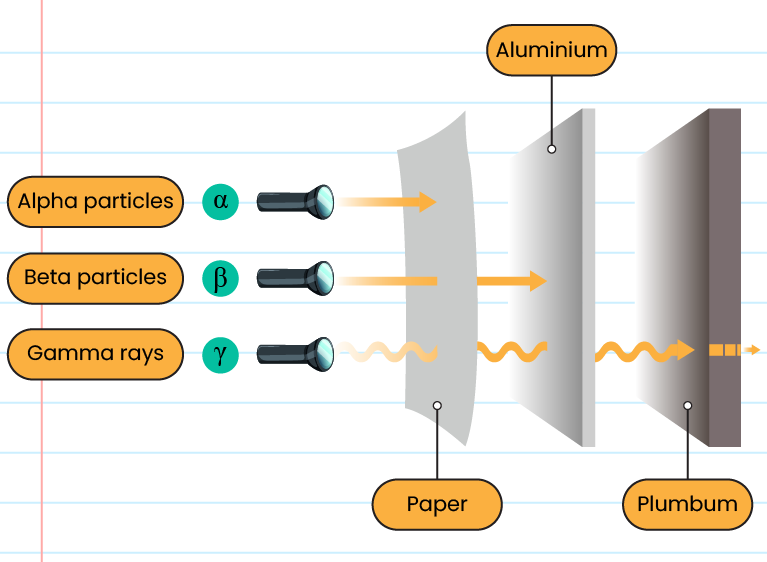
- The three main types of radioactive radiation are alpha (α) radiation, beta radiation (β), and gamma radiation (γ)
The half-life of radioactive decay:
-
Radioactive decay involves the exchange of unstable nucleus to more stable mucus accompanied by radiation of radioactive radiation
-
The half-life of radioactive decay is the time taken for the number of an unstable nucleus in a sample of radioactive material to remain half of its original number
| Radioactive substances | Half-life |
| Iodin-123 | 13 hours |
| Polonium-210 | 138 days |
| Radium-228 | 5.75 years |
| Amerisium-241 | 432.6 years |
| Carbon-14 | 5730 years |
| Uranium-235 | 703.8 million years |
