


1.1 Science is Part of Daily Life
Understand the meaning of science, its importance in everyday life, the fields of science, science-related careers and innovation in technology.
Learning Objectives
- Relate daily activities to science.
- Generalise the meaning of science.
- Summarise the importance of science in everyday life.
- Describe the fields of science.
- Communicate about careers related to science.
- Relate subjects to be studied in science to careers of interest.
- Describe innovation in technology.
Science in Everyday Life
Learn the meaning of science and how scientific knowledge is used around us.
Short Explanation
Understand the meaning of science, its importance and how science leads to innovation in technology.
What is Science?
Science is a discipline that involves systematic observations and experiments of natural phenomena.
The Importance of Science in Everyday Life
Science helps people solve problems, improve health, communicate effectively and develop modern technology.
Tall Buildings
Science contributes to engineering, such as the construction of tall buildings.
TV Satellite
The invention of satellites has made communication more effective and faster.
Hydroponic Method
Crop yields can be increased through fertilisers, pesticides and the hydroponic method.
Vaccines and Antibiotics
The discovery of vaccines and antibiotics helps control infectious diseases and reduce death rates.
Innovation in Technology
Most machines and inventions used every day are scientific innovations that help us solve problems in life.
Vehicles
Cars and aeroplanes make transportation faster and more efficient.
Communication
Telephones and computers make it easier to share information.
Robots
Robots can carry out repetitive, dangerous or highly precise tasks.
Medicine
Medical technology helps detect, prevent and treat diseases.
Explore the Fields of Science
Select each card to discover what the field studies and examples of related careers.
Fields of Science Reference
| Field | What is studied | Examples of careers |
|---|---|---|
| Physics | Energy and its influence on matter | Physicist, Engineer |
| Biology | Living things | Medical Doctor, Botanist |
| Chemistry | Matter and its reactions | Chemist, Pharmacist |
| Geology | Rocks, soil and minerals | Geologist |
| Astronomy | Planets, stars and other objects in the universe | Astronomer |
| Meteorology | Weather and climate change | Meteorologist |
Try to Answer First
Answer in your mind, then press “Check Answer”.
What is science?
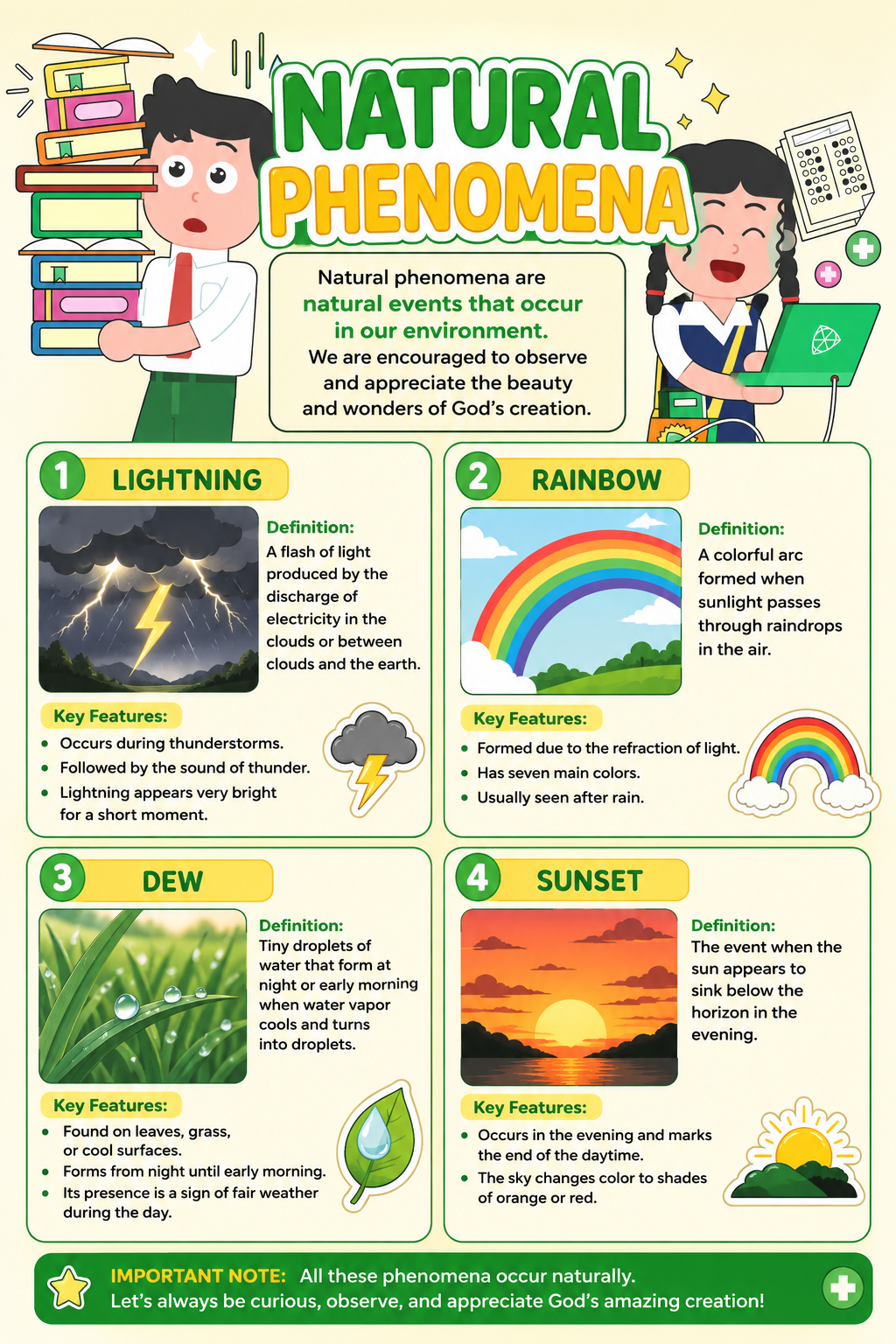
State two examples of natural phenomena.
Which field of science studies living things?
Common Mistakes
- Thinking that science only takes place in a laboratory — science is also involved in daily activities such as cooking and gardening.
- Confusing Biology with Chemistry. Biology studies living things, whereas Chemistry studies matter and its reactions.
- Thinking that the discovery of new medicine is a natural phenomenon. It is actually an application of science by scientists.
- Failing to relate technologies such as telephones, computers and robots to the development of science.
Concept Misunderstandings
Science is only about experiments in a laboratory.
Science also involves observations of natural phenomena and applications in everyday life.
Technology is not related to science.
Technology is developed by applying scientific knowledge to solve problems in life.
Summary
- Science involves the systematic study of natural phenomena.
- Science involves systematic observations and experiments.
- Science is important in communication, health, agriculture, construction and technology.
- The fields of science include Physics, Biology, Chemistry, Geology, Astronomy and Meteorology.
- Innovation in technology produces or improves tools and methods to solve problems and make life easier.
Short Activity
A. Objective Quiz
1 Science is a systematic study of .
2 The field of science that studies living things is .
B. Fill in the Blanks
3 Science involves systematic observations and .
4 The field of science that studies weather and climate change is .
C. Drag and Drop: Match the Fields of Science
Drag each field of science to the correct area of study. On a phone, tap an answer first, then tap a matching box. Tap the Answer Choices area to return a selected item.
C. Match the Fields of Science
Match each area of study with the correct field of science.
| Area of Study | Field of Science |
|---|---|
| 1. Energy and its influence on matter | |
| 2. Living things | |
| 3. Matter and its reactions | |
| 4. Weather and climate change |
Answer choices: Biology • Physics • Chemistry • Meteorology

