
3.1 Current and Potential Difference
Electricity plays a vital role in our daily lives, from natural phenomena like lightning to everyday electrostatic effects such as a charged comb bending a stream of water or attracting pieces of paper. This topic introduces the concept of an electric field, how charged particles behave within it, the definition and calculation of electric field strength, as well as the fundamental concepts of electric current and electric potential difference.
Learning Objectives
- Explain the concept and pattern of an electric field for various electrode configurations.
- Define electric field strength, \(E\), and solve problems using \(E = \frac{F}{q}\) and \(E = \frac{V}{d}\) for uniform fields between parallel plates.
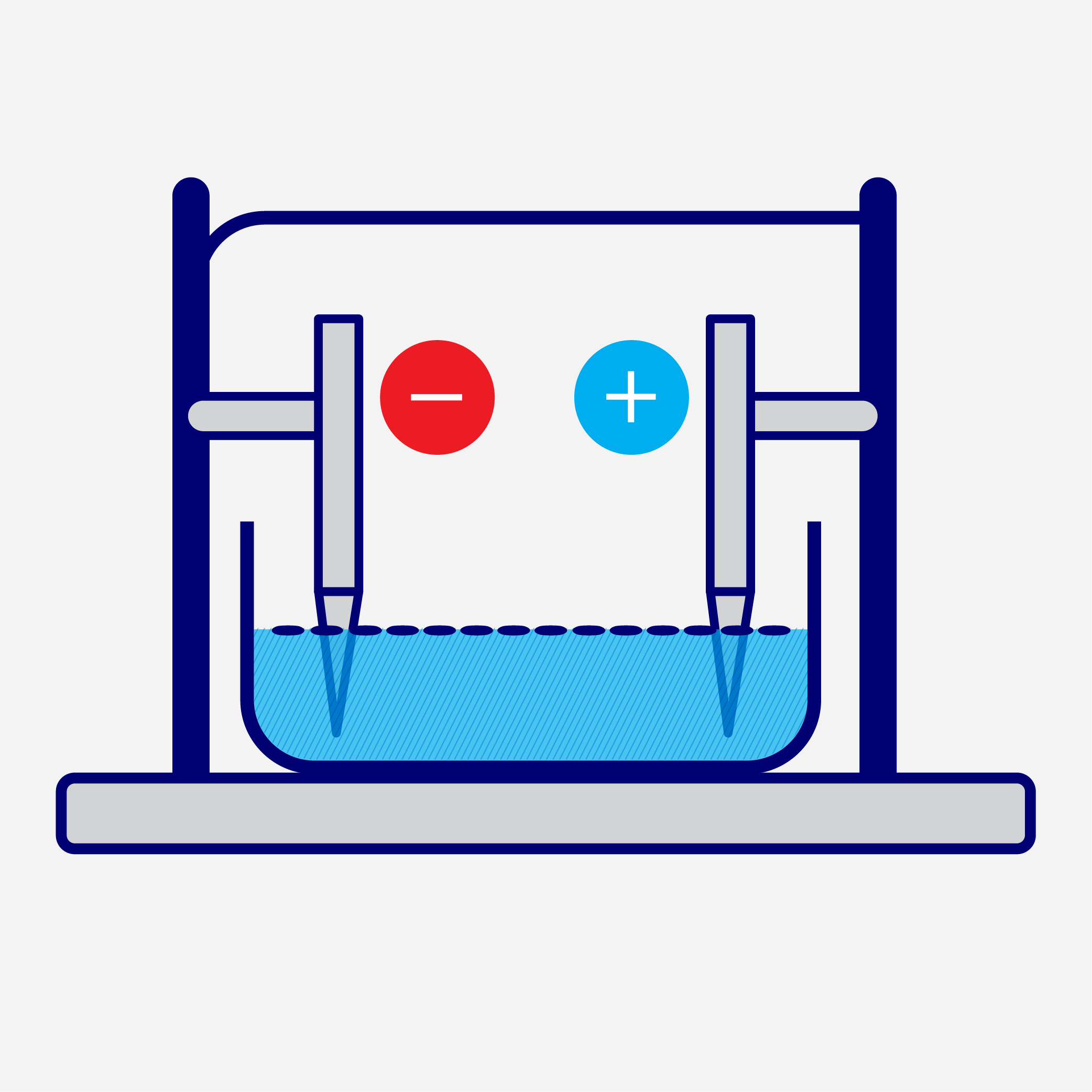
- Describe the behaviour of charged particles in an electric field using a metal-coated polystyrene ball and a candle flame.
- Define electric current, \(I\), and solve related problems using \(I = \frac{Q}{t}\).
- Define electric potential difference, \(V\), and solve related problems using \(V = \frac{W}{Q}\).
Electric Field Behaviour and Key Formulae Summary
See how electric fields form around charges and parallel plates, how charged particles behave, and the core relationships for field strength, current and potential difference.
Electric Field Patterns
Charged Particle Behaviour
Short Explanation
What is an Electric Field?
An electric field is the region around a charged particle where any electric charge in the region will experience an electric force.
Electric Field Lines
Field lines begin on a positive charge and end on a negative charge. They never cross each other. Around an isolated positive charge they point outward; around a negative charge they point inward.
Electric Field Strength
Electric field strength, \(E\), is the electric force acting on a unit positive charge placed at that point.
Uniform Field Between Parallel Plates
For two parallel charged plates, the field is uniform, straight, parallel and equally spaced. Its strength is given by \(E = \frac{V}{d}\).
General electric field strength
\(E = \dfrac{F}{q}\)\(E\) = electric field strength (N C⁻¹), \(F\) = electric force (N), \(q\) = quantity of electric charge (C).
Uniform electric field between two parallel charged plates
\(E = \dfrac{V}{d}\)\(V\) = potential difference between two parallel plates (V), \(d\) = distance between two parallel plates (m). S.I. unit: volt per metre (V m⁻¹). Note: 1 V m⁻¹ = 1 N C⁻¹.
Electric current
\(I = \dfrac{Q}{t}\)\(I\) = current (A), \(Q\) = total charge (C), \(t\) = time (s). S.I. unit: coulomb per second (C s⁻¹) or ampere (A).
Potential difference
\(V = \dfrac{W}{Q}\)\(V\) = potential difference (V), \(W\) = work done (J), \(Q\) = amount of charges flowing (C). S.I. unit: joule per coulomb (J C⁻¹) or volt (V).
| Quantity | Symbol | Formula | SI unit |
|---|---|---|---|
| Electric field strength | \(E\) | \(E = \frac{F}{q}\) or \(E = \frac{V}{d}\) | N C⁻¹ or V m⁻¹ |
| Electric current | \(I\) | \(I = \frac{Q}{t}\) | A or C s⁻¹ |
| Potential difference | \(V\) | \(V = \frac{W}{Q}\) | V or J C⁻¹ |
Try to Answer First
Answer in your mind, then press “Check Answer”.
What is the definition of electric field strength?
Check Answer
Why does a candle flame spread more towards the negatively charged plate when placed in a uniform electric field?
Check Answer
A current of 0.2 A flows through a light bulb for 1 hour. Calculate the electric charge that flows through the bulb.
Check Answer
Common Mistakes
- Forgetting to convert time in minutes or hours to seconds when calculating charge using \(Q = It\).
- Confusing the two units of electric field strength, N C⁻¹ and V m⁻¹, or thinking they represent different physical quantities.
- Stating that the candle flame spreads equally to both plates, neglecting that positive ions are heavier and larger, creating an asymmetrical spread.
- Reversing the direction of electric field lines by drawing lines pointing towards positive charges instead of away from them.
Concept Misunderstandings
A neutral metal-coated ball placed centrally between two parallel plates will start oscillating spontaneously as soon as the power is turned on.
The ball is electrically neutral initially and experiences equal opposing forces; it must be displaced to touch one plate first to acquire an initial charge before oscillation begins.
Electric field lines can cross each other where electric forces are strong.
Electric field lines never cross each other because the resultant electric force at any single point has only one unique direction.
Potential difference and electric current are the same thing.
Current is the rate of flow of charge, \(I = \frac{Q}{t}\), whereas potential difference is the work done per unit charge to move charges between two points, \(V = \frac{W}{Q}\).
Summary
- An electric field is a region where an electric charge experiences an electric force; lines run from positive to negative and do not cross.
- Electric field strength is defined as \(E = \frac{F}{q}\) (unit: N C⁻¹) and for parallel plates, \(E = \frac{V}{d}\) (unit: V m⁻¹).
- Charged particles in a uniform field experience electrostatic forces: a metal-coated polystyrene ball continuously transfers charge and oscillates between opposite plates; a candle flame ionises into positive and negative ions and spreads wider towards the negative plate due to the greater mass and size of positive ions.
- Electric current is the rate of charge flow: \(I = \frac{Q}{t}\) (unit: A or C s⁻¹).
- Potential difference is the work done per unit charge: \(V = \frac{W}{Q}\) (unit: V or J C⁻¹).
Short Activity
Objective: Check your understanding of electric field strength, current and potential difference.
A. Objective Quiz
1 What will happen to the electric field strength between two parallel plates if the distance between them is halved while the potential difference remains constant?
2 Why does the spread of a candle flame in an electric field skew more towards the negative plate than towards the positive plate?
B. Fill in the Blanks
3 The potential difference between two points is defined as the work done in moving one of charge from one point to another.
4 Electric field lines always point from a positive charge and inward toward a negative charge.
C. Matching / Drag and Drop
Drag each quantity to the correct formula or definition. If using a phone, tap the answer first, then tap the matching box.

