

1.4 Elasticity
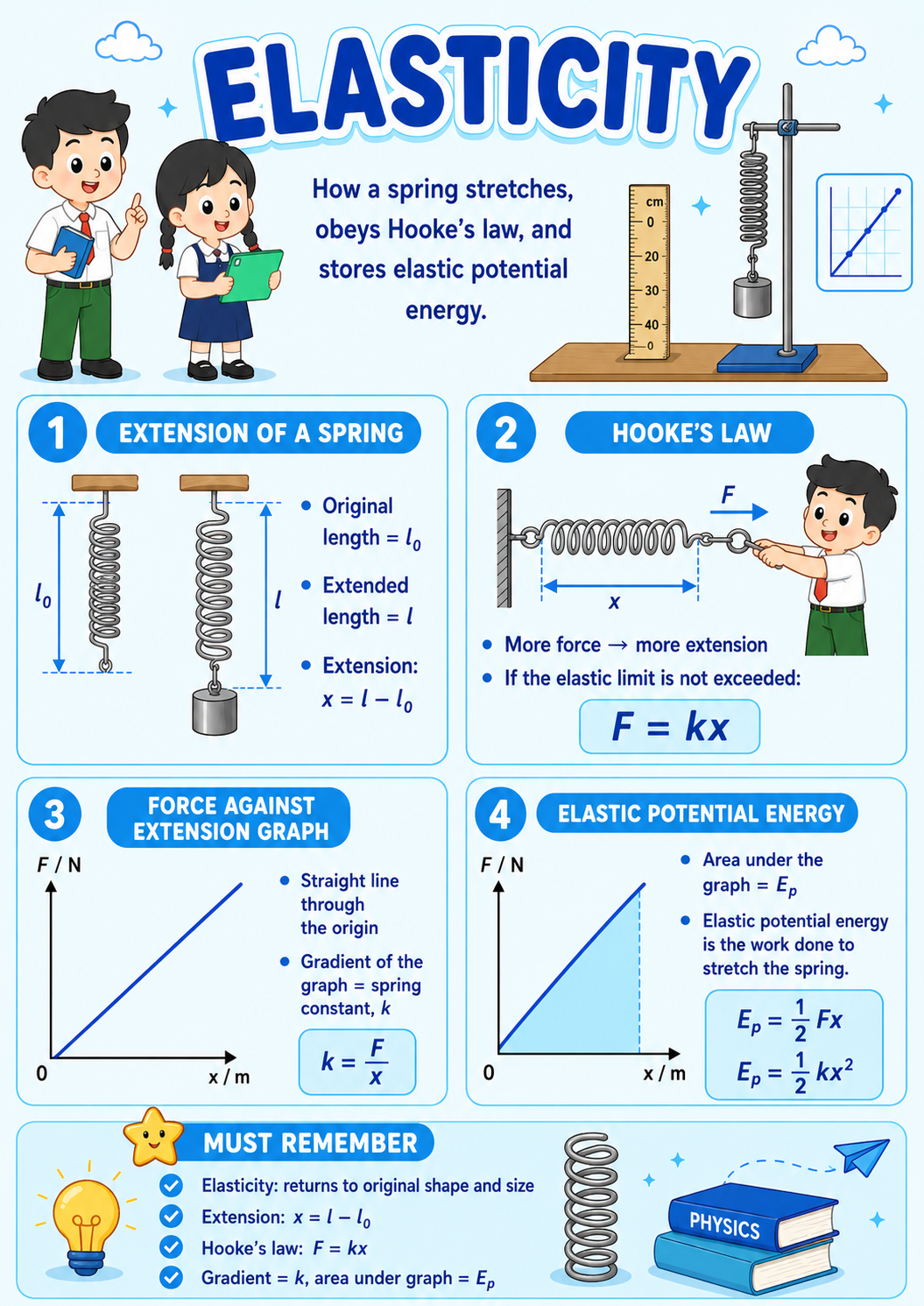
Learn how elastic materials return to their original shape and size, how force affects the extension of a spring, and how elastic potential energy is stored in a stretched spring.
Learning Objectives
- State the meaning of elasticity.
- Explain the relationship between force and extension of a spring.
- Use Hooke’s law, F = kx.
- Determine spring constant and elastic potential energy.
- Compare spring arrangements in series and in parallel.
How a Spring Stretches and Stores Energy
See how force changes the extension of a spring, how Hooke’s law is used, and how the graph shows spring constant and elastic potential energy.
Stretch the Spring
Move the force slider. Compare the spring and graph side by side.
Fixed values: k = 100 N m⁻¹, l₀ = 0.20 m.
Safe elastic region
More force makes the spring extend more. The spring can still return to its original length.
Short Explanation
What is Elasticity?
Elasticity is the property of a material that enables an object to return to its original shape and size after the force applied on it is removed.
Elastic and Non-Elastic Examples
A spring, sponge and elastic cord can return to their original shape or length. Plasticine changes shape but does not return to its original shape.
Hooke’s Law
The extension of a spring is directly proportional to the force applied on the spring, provided that the elastic limit is not exceeded. F = kx
Elastic Potential Energy
Elastic potential energy is the work done to stretch the spring. It is equal to the area under the graph of force against extension.
| Factor | Change in Factor | Effect on Spring Constant |
|---|---|---|
| Material of spring | Different material | Changes according to the type of material |
| Length of spring | Shorter spring | Higher spring constant |
| Length of spring | Longer spring | Lower spring constant |
| Diameter of spring | Smaller diameter | Higher spring constant |
| Diameter of spring | Larger diameter | Lower spring constant |
| Thickness of spring wire | Wire with smaller diameter | Lower spring constant |
| Thickness of spring wire | Wire with larger diameter | Higher spring constant |
Try to Answer First
Answer in your mind, then press “Check Answer”.
What is the meaning of elasticity?
Check Answer
State Hooke’s law.
Check Answer
A spring extends by 6 mm when stretched by a force of 12 N. Calculate the spring constant.
Check Answer
Common Mistakes
- Thinking that all materials are elastic.
- Saying that plasticine is elastic because its shape can be changed.
- Mixing up original length, extended length and extension.
- Forgetting that the gradient of the F against x graph gives the spring constant.
- Thinking that elastic potential energy is the gradient of the graph instead of the area under the graph.
Concept Misunderstandings
Any object that changes shape is elastic.
An object is elastic only if it returns to its original shape and size after the force is removed.
Spring constant is the area under the graph.
Spring constant is the gradient of the graph of force, F, against extension, x.
Elastic potential energy is the gradient of the graph.
Elastic potential energy is the area under the graph of force, F, against extension, x.
Summary
- Elasticity is the ability of a material to return to its original shape and size after the force is removed.
- Hooke’s law states that extension is directly proportional to force if the elastic limit is not exceeded.
- The spring constant can be calculated using \(k = \dfrac{F}{x}\) or from the gradient of the graph of F against x.
- Elastic potential energy is the area under the graph of F against x.
- The spring constant is affected by material, spring length, spring diameter and thickness of spring wire.
Short Activity
Objective: Identify elasticity, Hooke’s law, spring constant and elastic potential energy.
A. Objective Quiz
1 Which material does not return to its original shape after the force is removed?
2 Hooke’s law can be written as:
B. Fill in the Blanks
3 The extension of a spring is the increase in of the spring.
4 Elastic potential energy is equal to the under the graph of F against x.
C. Matching / Drag and Drop
Drag each term to the correct meaning. If using a phone, tap the answer first, then tap the matching box.

