
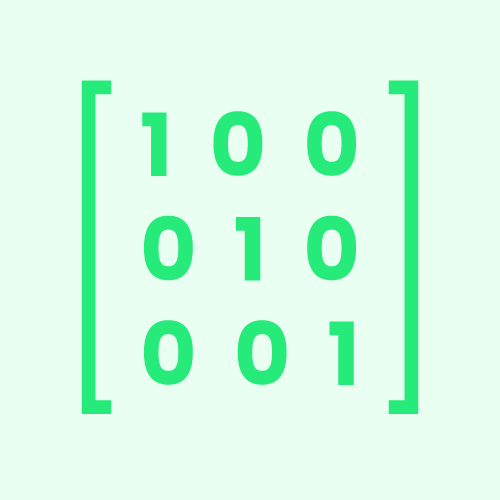
2.1 Matrices
A matrix is a powerful mathematical tool used to organise, display, and manipulate data systematically. In everyday situations, such as sales tracking, sports medals tally, and examination marks, data arranged in tables can be converted into rectangular or square arrays of numbers called matrices.
Learning Objectives
- Represent information from real-world situations in the form of matrices.
- Determine the order of a matrix.
- Identify specific elements in a matrix using row and column notations (\(a_{ij}\)).
- Determine whether two matrices are equal based on order and corresponding elements.
Anatomy of a Matrix: Order and Elements
See how rows, columns, matrix order (\(m \times n\)), and element positions (\(a_{ij}\)) are identified.
Brief Explanation
What is a Matrix?
A matrix is a set of numbers arranged in rows (horizontal) and columns (vertical) to form a rectangular or a square array. It is usually denoted by a capital letter and enclosed in brackets \([ \ ]\) or parentheses \(( \ )\).
Historical Fact
James Joseph Sylvester (1814–1897) first used the term "matrix" in 1850. Cuthbert Edmund Cullis (1875–1954) introduced brackets for matrices in 1913 and used the notation \(A = [a_{ij}]\).
| Type of matrix | Description | Example order |
|---|---|---|
| Row matrix | Only one row | \(1 \times n\) |
| Column matrix | Only one column | \(m \times 1\) |
| Square matrix | Same number of rows and columns | \(2 \times 2\), \(3 \times 3\), \([6]\) |
| Rectangular matrix | Different number of rows and columns | \(2 \times 3\), \(3 \times 2\) |
Try Answering First
Read the question, answer it in your mind, then press “Check Answer”.
State the order of matrix \(K = \begin{bmatrix} 12 & 9 & 1 \\ 5 & 10 & 7 \end{bmatrix}\).
Given matrix \(B = \begin{bmatrix} 1 & -16 \\ 20 & 4 \end{bmatrix}\), find the value of \(b_{12} + b_{21}\).
Given that \(\begin{bmatrix} 6 & 0 \\ 3 & y \\ 2z - 3 & -5 \end{bmatrix} = \begin{bmatrix} x & 0 \\ 3 & 2 \\ -2 & -5 \end{bmatrix}\), determine the values of \(x\), \(y\), and \(z\).
Common Mistakes
- Writing the matrix order as column × row instead of row × column.
- Reading \(a_{21}\) as “\(a\) twenty-one” instead of the individual indices “\(a\) two one” (row 2, column 1).
- Assuming two matrices are equal just because they contain the exact same numbers, even though their orders differ or the positions of the numbers are swapped.
Misconceptions
A single-element matrix like \([6]\) is not a square matrix.
\([6]\) is a square matrix because it has 1 row and 1 column (\(1 \times 1\)), so the number of rows equals the number of columns.
Matrices with the same total number of elements are equal or interchangeable.
Even if both matrices have 6 elements, a \(2 \times 3\) matrix and a \(3 \times 2\) matrix have different orders and cannot be equal.
Summary
- A matrix is an arrangement of numbers in rows and columns enclosed in \([ \ ]\) or \(( \ )\).
- Order of a matrix with \(m\) rows and \(n\) columns is written as \(m \times n\).
- The element at row \(i\) and column \(j\) is denoted as \(a_{ij}\).
- Two matrices are equal (\(A = B\)) if and only if both have the same order and all corresponding elements are equal.
Short Activity
Complete all parts first, then press the check answer button.
A. Objective Quiz
1 What is the order of the matrix \(\begin{bmatrix} 4 & -1 & 7 \\ 8 & 0 & 2 \\ 5 & 11 & 3 \end{bmatrix}\)?
2 Given matrix \(P = \begin{bmatrix} 3 & -7 & 9 \end{bmatrix}\), what is the element \(p_{13}\)?
B. Fill in the Blanks
3 A matrix that has only one column is known as a matrix.
4 If \(\begin{bmatrix} 10 \\ 6y + 5 \end{bmatrix} = \begin{bmatrix} 5x \\ 2y - 9 \end{bmatrix}\), the value of \(x\) is .
C. Drag and Drop: Match the Matrix Form to Its Classification
Drag each matrix form to the correct classification. On a phone, tap the answer choice first, then tap the classification box.

