
3.2Heat of Reaction
Heat of reaction is the heat change when a reaction occurs according to its balanced equation, usually determined by measuring temperature changes in experiments. Reactions are categorised by type into heat of precipitation, heat of displacement, heat of neutralisation, and heat of combustion.
Learning Objectives
- Determine heat of precipitation through activity.
- Determine heat of displacement through activity.
- Compare heat of neutralisation through experiments for reactions between strong and weak acids and alkalis.
- Compare heat of combustion for various types of alcohol through experiment.
Summary of the Four Types of Heat of Reaction and Their Per-Mole Basis
Each type of heat of reaction is defined per mole of a specific substance formed or burnt.
Heat of Precipitation
Heat change when 1 mole of precipitate is formed from its ions in aqueous solution.
Heat of Displacement
Heat change when 1 mole of metal is displaced from its salt solution by a more electropositive metal.
Heat of Neutralisation
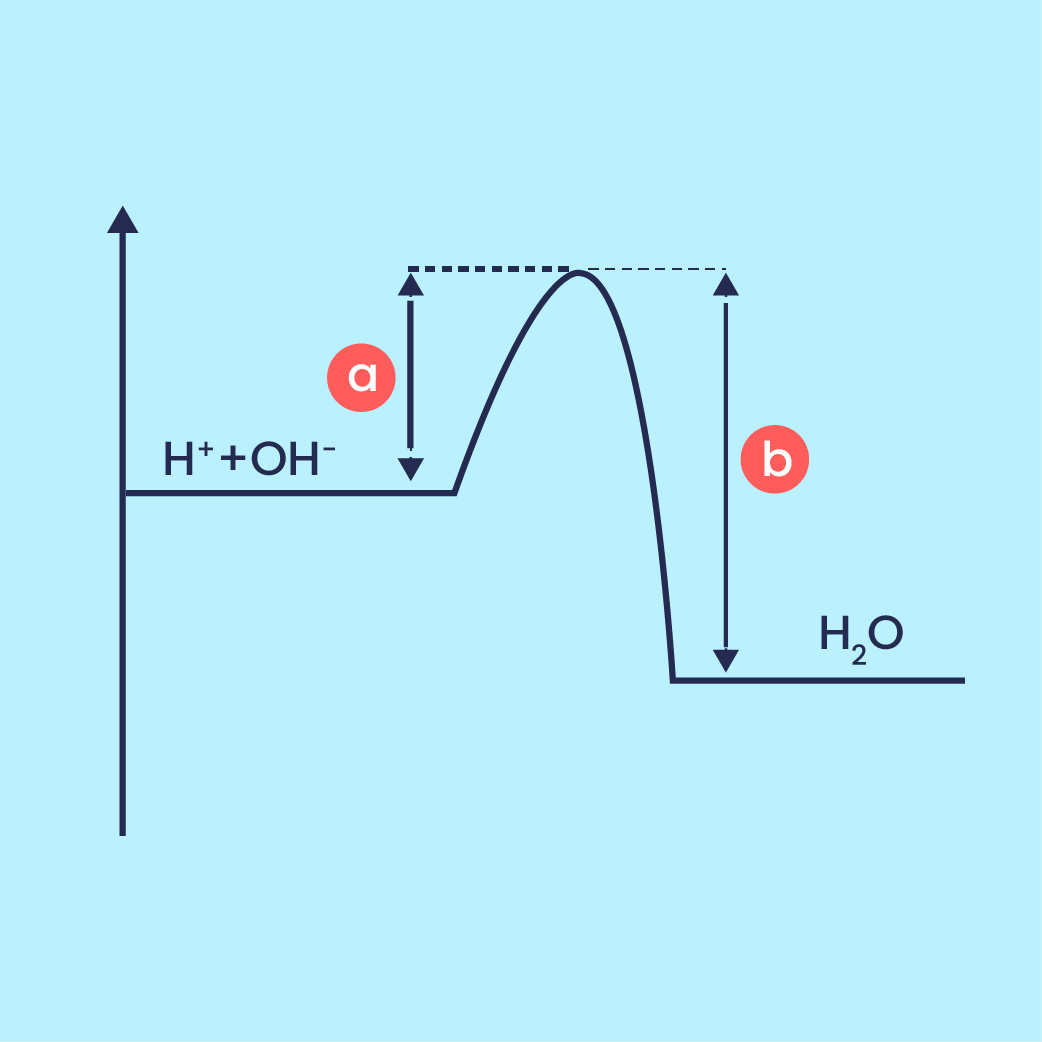
Heat change when 1 mole of water is formed from the reaction between an acid and an alkali.
Heat of Combustion
Heat released when 1 mole of fuel is completely burnt in excess oxygen.
Brief Explanation
Understand the four main categories of heat of reaction and how to calculate them.
1. Heat of Precipitation
The heat change when 1 mole of precipitate is formed from their ions in an aqueous solution.
Example: \(\text{Ba}^{2+}(\text{aq}) + \text{SO}_4^{2-}(\text{aq}) \rightarrow \text{BaSO}_4(\text{s}) \quad \Delta H = -42\text{ kJ mol}^{-1}\)
2. Heat of Displacement
The heat change when one mole of a metal is displaced from its salt solution by a more electropositive metal.
Textbook example, p. 125: \(\text{Fe}(\text{s}) + \text{Cu}^{2+}(\text{aq}) \rightarrow \text{Fe}^{2+}(\text{aq}) + \text{Cu}(\text{s}) \quad \Delta H = -250\text{ kJ mol}^{-1}\)
3. Heat of Neutralisation
The heat change when one mole of water is formed from the reaction between an acid and an alkali.
\(\text{H}^+(\text{aq}) + \text{OH}^-(\text{aq}) \rightarrow \text{H}_2\text{O}(\text{l})\)
4. Heat of Combustion
The heat released when 1 mole of a substance is completely burnt in excess oxygen, \(\text{O}_2\).
Example: \(\text{CH}_4(\text{g}) + 2\text{O}_2(\text{g}) \rightarrow \text{CO}_2(\text{g}) + 2\text{H}_2\text{O}(\text{l}) \quad \Delta H = -890\text{ kJ mol}^{-1}\)
| Type of heat of reaction | What \(n\) represents in Step 1 |
|---|---|
| Heat of precipitation | Moles of precipitate formed |
| Heat of displacement | Moles of metal displaced |
| Heat of neutralisation | Moles of water formed |
| Heat of combustion | Moles of fuel burnt |
- Determine the number of moles, \(n\), of the reactant or product formed.
- Calculate the heat change using \(Q = mc\theta\).
- Convert \(Q\) from J to kJ by dividing by \(1000\), then calculate the heat change for 1 mole: \(\dfrac{Q}{1000n}\).
- State \(\Delta H = \pm X\text{ kJ mol}^{-1}\) with the correct sign.
- Density of solution = \(1\text{ g cm}^{-3}\).
- Specific heat capacity, \(c = 4.2\text{ J g}^{-1}\text{ }^\circ\text{C}^{-1}\).
- No heat is lost to the surroundings.
- No heat is absorbed by the apparatus.
Textbook Worked Calculations
Heat of Precipitation
\(100\text{ cm}^3\) of \(1.0\text{ mol dm}^{-3}\) \(\text{Pb(NO}_3)_2\) solution is mixed with \(100\text{ cm}^3\) of \(1.0\text{ mol dm}^{-3}\) \(\text{Na}_2\text{SO}_4\) solution. The temperature rises from \(30.0^\circ\text{C}\) to \(33.0^\circ\text{C}\).
- \(n(\text{PbSO}_4)=\dfrac{1.0\times100}{1000}=0.100\text{ mol}\), from the \(1:1:1\) ionic ratio.
- \(m=(100+100)(1)=200\text{ g}\); \(\theta=33.0-30.0=3.0^\circ\text{C}\).
- \(Q=200\times4.2\times3.0=2520\text{ J}=2.52\text{ kJ}\).
- Heat released per mole \(=\dfrac{2.52}{0.100}=25.2\text{ kJ mol}^{-1}\). As the reaction is exothermic, \(\Delta H=-25.2\text{ kJ mol}^{-1}\).
Heat of Displacement
Excess Mg powder is added to \(50\text{ cm}^3\) of \(0.25\text{ mol dm}^{-3}\) \(\text{FeSO}_4\) solution. The temperature rises by \(4.0^\circ\text{C}\).
- \(n(\text{Fe})=n(\text{FeSO}_4)=\dfrac{0.25\times50}{1000}=0.0125\text{ mol}\).
- \(m=50(1)=50\text{ g}\); the mass of Mg powder is not included.
- \(Q=50\times4.2\times4.0=840\text{ J}=0.840\text{ kJ}\).
- Heat released per mole \(=\dfrac{0.840}{0.0125}=67.2\text{ kJ mol}^{-1}\). As the reaction is exothermic, \(\Delta H=-67.2\text{ kJ mol}^{-1}\).
Heat of Neutralisation
\(60\text{ cm}^3\) of \(2.0\text{ mol dm}^{-3}\) NaOH is mixed with \(60\text{ cm}^3\) of \(2.0\text{ mol dm}^{-3}\) ethanoic acid. Both initial temperatures are \(28.0^\circ\text{C}\) and the highest mixture temperature is \(40.5^\circ\text{C}\).
- \(n(\text{H}_2\text{O})=\dfrac{2.0\times60}{1000}=0.120\text{ mol}\), from the \(1:1:1\) ratio.
- \(m=(60+60)(1)=120\text{ g}\); \(\theta=40.5-28.0=12.5^\circ\text{C}\).
- \(Q=120\times4.2\times12.5=6300\text{ J}=6.30\text{ kJ}\).
- Heat released per mole of water \(=\dfrac{6.30}{0.120}=52.5\text{ kJ mol}^{-1}\). As neutralisation is exothermic, \(\Delta H=-52.5\text{ kJ mol}^{-1}\).
Heat of Combustion
\(\text{C}_2\text{H}_5\text{OH}(l)+3\text{O}_2(g)\rightarrow2\text{CO}_2(g)+3\text{H}_2\text{O}(l)\quad\Delta H=-1376\text{ kJ mol}^{-1}\). Calculate the mass of ethanol needed to raise the temperature of \(200\text{ cm}^3\) of water by \(50.0^\circ\text{C}\), assuming no heat loss.
- \(m=200(1)=200\text{ g}\).
- \(Q=200\times4.2\times50.0=42\,000\text{ J}=42.0\text{ kJ}\).
- \(n(\text{ethanol})=\dfrac{42.0}{1376}\approx0.03\text{ mol}\), using the rounded mole value as in the textbook.
- Mass of ethanol \(=0.03\times46=1.38\text{ g}\).
Essential Practical Procedures
Determining Heat of Precipitation
Materials and apparatus: \(0.5\text{ mol dm}^{-3}\) \(\text{AgNO}_3\) and NaCl solutions; two polystyrene cups with lids, measuring cylinder and thermometer. Silver nitrate solution may cause dark stains on skin and clothes.
- Measure \(25\text{ cm}^3\) of each solution into separate cups. Leave a thermometer in each solution for two minutes and record the initial temperatures.
- Pour NaCl quickly and carefully into \(\text{AgNO}_3\), cover the cup and stir with the thermometer.
- Record the highest mixture temperature. Repeat with \(\text{Mg(NO}_3)_2\) and \(\text{Na}_2\text{CO}_3\), recording the highest or lowest temperature as appropriate.
- Use total volume, temperature change and stoichiometry to calculate \(\Delta H\); do not invent observational data.
Determining Heat of Displacement
Materials and apparatus: \(0.5\text{ mol dm}^{-3}\) \(\text{CuSO}_4\) solution, excess Zn and Mg powders; polystyrene cup with lid, thermometer, measuring cylinder and spatula.
- Plan the procedure and precautions using the apparatus, then discuss the plan with the teacher before starting.
- Measure the chosen solution volume, record its initial temperature, add excess metal powder, cover and stir.
- Record the highest temperature. Repeat with the other metal using the same solution volume and concentration.
- Compare temperature changes and calculate heat of displacement per mole of Cu displaced. Excess metal ensures all \(\text{Cu}^{2+}\) ions are displaced.
Comparing Heat of Neutralisation
Materials and apparatus: \(1.0\text{ mol dm}^{-3}\) HCl, ethanoic acid, NaOH and ammonia; polystyrene cups with lids, thermometer and measuring cylinder.
- Measure \(50\text{ cm}^3\) of acid and \(50\text{ cm}^3\) of alkali into separate cups and record both initial temperatures.
- Mix quickly and carefully, stir and record the highest temperature.
- Repeat for HCl + NaOH, ethanoic acid + NaOH, HCl + ammonia and ethanoic acid + ammonia with equivalent volumes and concentrations.
- Calculate heat of neutralisation per mole of water for each mixture and compare the effects of acid and alkali strength.
Comparing Heat of Combustion of Alcohols
Materials and apparatus: Methanol, ethanol, propanol and butanol; \(200\text{ cm}^3\) water, copper can, spirit lamp, balance, thermometer, tripod stand, wind shield and wooden block. Alcohols are volatile and highly flammable.
- Record the initial water temperature and the mass of the lamp with its lid and alcohol. Place the lamp below the copper can and light the wick.
- Adjust its position so the flame touches the bottom of the can and stir the water throughout heating.
- Extinguish the flame when the water temperature rises by \(30^\circ\text{C}\), record the highest temperature and immediately reweigh the lamp with its lid and contents.
- Repeat for each alcohol using the same water volume. Use the mass loss to find moles of alcohol and \(Q=mc\theta\) to calculate heat of combustion.
Try to Answer First
Answer mentally, then check the explanation.
Why is the heat of neutralisation between ethanoic acid and sodium hydroxide lower than that between hydrochloric acid and sodium hydroxide?
Why is excess zinc powder added to copper(II) sulphate solution when determining the heat of displacement?
In an experiment to determine the heat of combustion of ethanol, soot is observed at the bottom of the copper can. What is the soot and why does it form?
Common Mistakes
Avoid these errors when calculating heat of reaction.
Concept Misunderstandings
Compare each misconception with the correct fact.
Heat of neutralisation of sulphuric acid (\(\text{H}_2\text{SO}_4\)) is double (\(-114\text{ kJ mol}^{-1}\)) that of hydrochloric acid (\(-57\text{ kJ mol}^{-1}\)).
The total heat released when \(1\text{ mole}\) of \(\text{H}_2\text{SO}_4\) is neutralised is double (\(114\text{ kJ}\)) because \(2\text{ moles}\) of water are produced, but the heat of neutralisation is defined per mole of water formed, so its value is still \(-57\text{ kJ mol}^{-1}\).
The temperature change in endothermic precipitation reactions cannot be used with \(Q = mc\theta\).
\(Q = mc\theta\) applies to all temperature changes; \(\theta\) represents the magnitude of temperature change regardless of whether temperature rises or drops. If temperature drops, \(\Delta H\) takes a positive sign (\(+\)).
Heat of displacement depends only on the metal added, not the salt solution.
Heat of displacement is defined per mole of metal displaced from its salt solution, and its magnitude depends on the difference in electropositivity between the displacing metal and the displaced metal.
Summary
Key facts to remember.
- Heat of reaction is the heat change when molar quantities of reactants react as represented by a chemical equation.
- Standard formula: \(Q = mc\theta\), where \(m = \text{volume of solution} \times 1\text{ g cm}^{-3}\), \(c = 4.2\text{ J g}^{-1}\text{ }^\circ\text{C}^{-1}\), and \(\theta = \Delta T\).
- \(\Delta H = \pm \dfrac{Q}{1000n}\) when \(Q\) is in joules, where \(n\) represents precipitate formed, metal displaced, water formed, or fuel burnt.
- Neutralisation involving weak acids or weak alkalis produces less heat than strong pairs because energy is absorbed for complete ionisation.
- Complete combustion of alcohols increases in heat release with the number of carbon atoms because more carbon dioxide and water molecules are produced.
Short Activity
Complete all parts before checking your score.
A. Objective Quiz
Which of the following neutralisation reactions produces the lowest heat of neutralisation?
Why is a copper can used instead of a glass beaker in the experiment to determine the heat of combustion of alcohols?
B. Fill in the Blanks
Heat of neutralisation is the heat change when one mole of ______ is formed from the reaction between an acid and an alkali.
In calculating heat change using \(Q = mc\theta\) for aqueous solutions, the density of the solution is assumed to be ______ g cm−3.
C. Match the Type of Heat of Reaction with What \(n\) Represents
Drag each choice on desktop. On mobile, tap a choice and then tap the matching box.
Answer Choices
Heat of precipitation Heat of displacement Heat of neutralisation Heat of combustionWhat \(n\) Represents
Keywords
Tap or hover over a term to read its meaning.


