
2.4Isomers and Naming Based on IUPAC Nomenclature
Learn the meaning of isomers, the types of structural isomerism, how to construct structural formulae of isomers and how to name carbon compounds using the IUPAC system.
Learning Objectives
- Describe structural isomerism.
- Construct structural formulae for isomers.
- Name carbon compounds according to the IUPAC nomenclature system.
Structural Isomerism
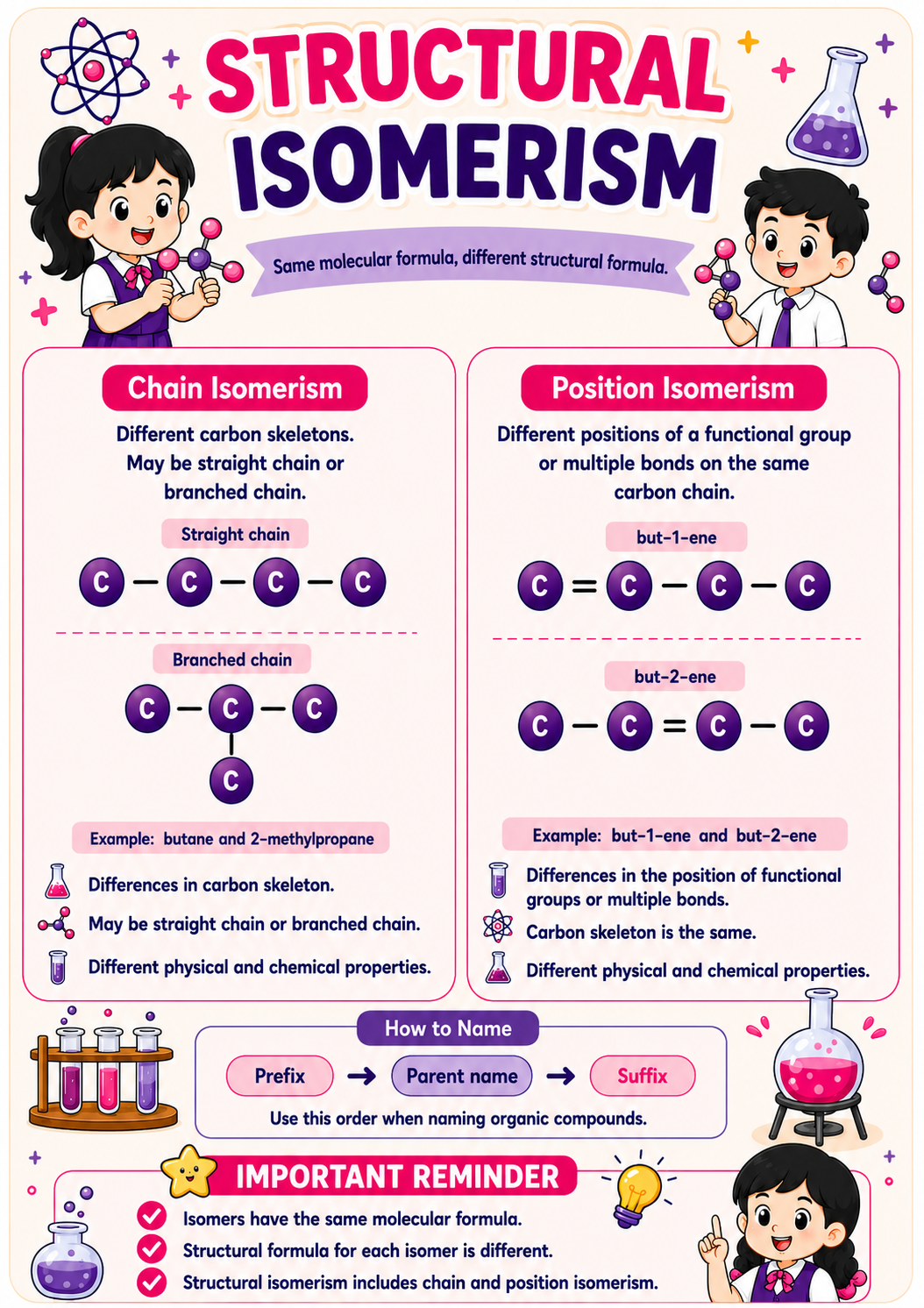
The same molecular formula can form different structural formulae.
Brief Explanation
Understand the key ideas before naming the compounds.
1. Chain Isomerism
The isomers have different arrangements of the carbon skeleton, such as a straight chain or a branched chain.
2. Position Isomerism
The isomers have the same carbon skeleton but the functional group, double bond or triple bond is located at a different position.
| Part of an IUPAC name | Meaning | Example |
|---|---|---|
| Prefix | Shows the substituent or branch group. | Methyl, ethyl, propyl |
| Root name | Shows the number of carbon atoms in the longest carbon chain. | Meth, eth, prop, but, pent |
| Suffix | Shows the homologous series or functional group. | -ane, -ene, -yne, -ol |
Interactive: Naming Carbon Compounds
Choose a homologous series, browse the examples and open each naming step.
| Compound | Molecular formula | Key naming idea |
|---|---|---|
| 2-Methylpropane | C₄H₁₀ | Three-carbon parent chain with a methyl group on carbon 2. |
| But-1-ene | C₄H₈ | Four-carbon chain with the double bond starting at carbon 1. |
| Propan-2-ol | C₃H₇OH | Three-carbon chain with the hydroxyl group on carbon 2. |
Try These Questions First
Answer mentally, then check the explanation.
What are isomers?
What are the two types of structural isomerism covered in this topic?
What are the three main parts of an IUPAC name?
Common Mistakes
Avoid these errors when drawing and naming isomers.
Common Misconceptions
Compare each misconception with the correct fact.
Isomers have different molecular formulae.
Isomers have the same molecular formula but different structural formulae.
All alcohols have structural isomers.
Isomerism in the alcohol homologous series starts with molecules containing at least three carbon atoms.
The root name is determined by the branch.
The root name is determined by the number of carbon atoms in the selected parent chain.
Summary
Key facts to remember.
- Isomers have the same molecular formula but different structural formulae.
- Structural isomerism includes chain isomerism and position isomerism.
- An IUPAC name is built from a prefix, root name and suffix.
- The parent chain must be selected and numbered correctly before the full name is written.
- Functional groups and multiple bonds must receive the lowest possible locant.
Quick Activity
Complete all parts before checking your score.
A. Objective Quiz
Isomers are molecules with the same molecular formula but different ______ formulae.
Which part of an IUPAC name shows the homologous series?
B. Fill in the Blanks
______ isomerism occurs when the carbon skeleton is arranged differently.
The suffix for the alkyne homologous series is ______.
C. Match the Homologous Series with the Suffix
Drag each suffix on desktop. On mobile, tap a suffix and then tap the matching box.
Answer Choices
-ane -ene -yne -olSuffix Matching
Keywords
Tap or hover over a term to read its meaning.


