
1.1Oxidation and Reduction
A redox reaction is a chemical reaction in which oxidation and reduction occur simultaneously. The term "redox" is derived from the combination of Reduction and Oxidation. While early chemistry defined redox reactions solely based on the gain or loss of oxygen, modern chemistry classifies redox reactions across four distinct perspectives: gain or loss of oxygen, gain or loss of hydrogen, transfer of electrons, and changes in oxidation number. These reactions govern many chemical processes around us, from the thrust-generating combustion of rocket fuels to displacement reactions of metals and halogens.
Learning Objectives
- Describe redox reactions through activities based on gain or loss of oxygen, gain or loss of hydrogen, transfer of electrons, and change in oxidation number.
- Identify the oxidised substance, reduced substance, oxidising agent, and reducing agent in various chemical reactions.
- Construct and balance half-equations and overall ionic equations for redox processes.
- Determine the oxidation number of an element in an uncombined state, simple ion, neutral compound, or polyatomic ion.
- Apply IUPAC nomenclature using Roman numerals for compounds containing transition elements or metals with multiple oxidation numbers.
- Investigate displacement reactions of metals from their salt solutions based on the electrochemical series.
- Investigate displacement reactions of halogens from their halide solutions based on Group 17 reactivity.
The Four Concepts of Redox and Electron Transfer at a Distance
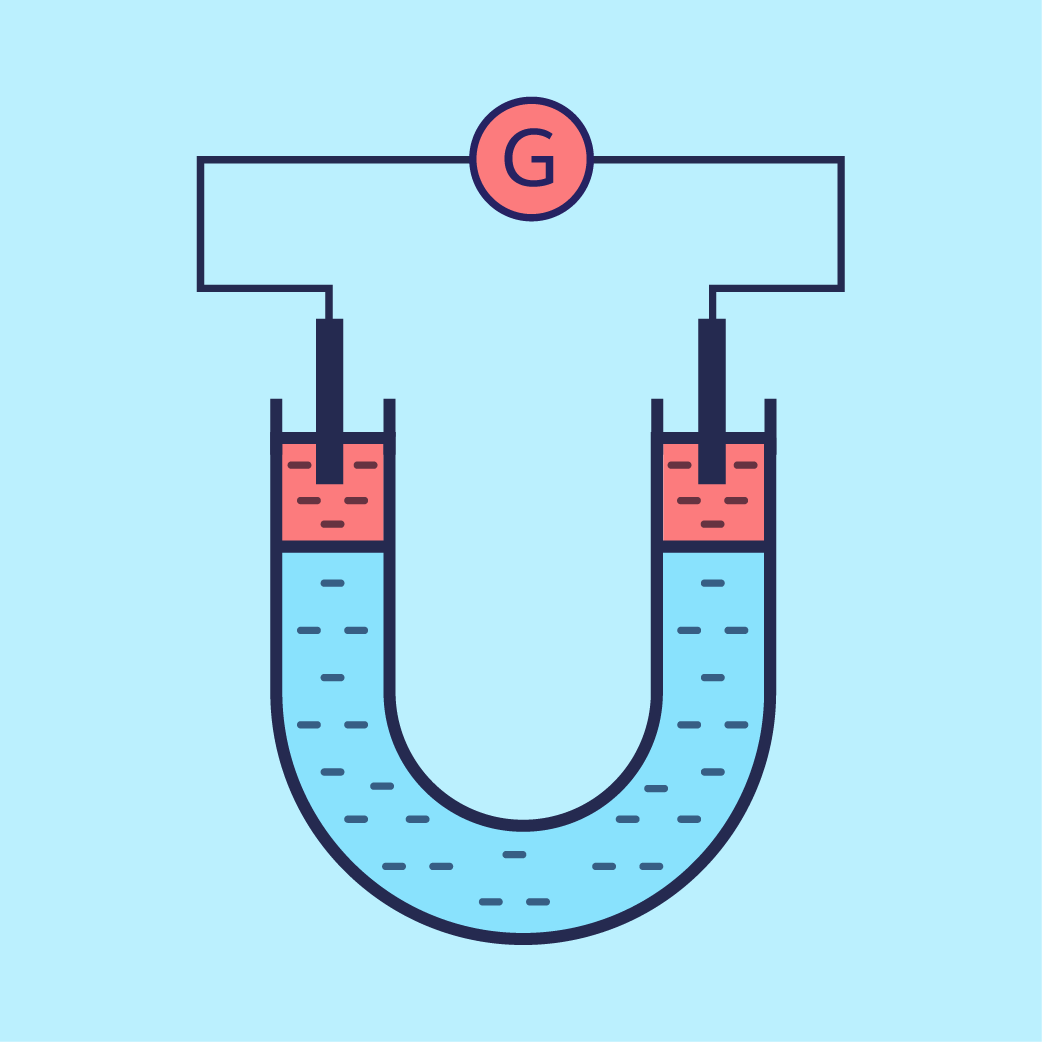
A single comparison framework summarising oxidation vs. reduction across the four definitions, supported by a schematic of the U-tube apparatus demonstrating electron movement at a distance.
Brief Explanation
Understand the four definitions of oxidation and reduction step by step.
| Basis of Definition | Oxidation Reaction | Reduction Reaction |
|---|---|---|
| Oxygen | Reactant gains oxygen | Reactant loses oxygen |
| Hydrogen | Reactant loses hydrogen | Reactant gains hydrogen |
| Electron Transfer | Reactant loses electron(s) | Reactant gains electron(s) |
| Oxidation Number | Oxidation number of an element increases | Oxidation number of an element decreases |
Oxidising Agent
A substance that oxidises other substances and is itself reduced in a redox reaction. It is an electron acceptor, causes loss of hydrogen, supplies oxygen, or decreases in oxidation number.
Reducing Agent
A substance that reduces other substances and is itself oxidised in a redox reaction. It is an electron donor, supplies hydrogen, removes oxygen, or increases in oxidation number.
Redox in Terms of Oxygen
Reaction between magnesium, Mg and carbon dioxide, CO2:
\[2\text{Mg}(s) + \text{CO}_2(g) \rightarrow 2\text{MgO}(s) + \text{C}(s)\]
Mg gains oxygen to form MgO, so Mg is the oxidised substance and the reducing agent. CO2 loses oxygen to form C, so CO2 is the reduced substance and the oxidising agent.
Redox in Terms of Hydrogen
Reaction between hydrogen sulphide, H2S and chlorine, Cl2:
\[\text{H}_2\text{S}(g) + \text{Cl}_2(g) \rightarrow \text{S}(s) + 2\text{HCl}(g)\]
H2S loses hydrogen to form S, so H2S is the oxidised substance and the reducing agent. Cl2 gains hydrogen to form HCl, so Cl2 is the reduced substance and the oxidising agent.
Combustion of magnesium: \[2\text{Mg}(s) + \text{O}_2(g) \rightarrow 2\text{MgO}(s)\]
- Oxidation half-equation: \(\text{Mg} \rightarrow \text{Mg}^{2+} + 2e^-\) — Mg loses electrons; electron donor / reducing agent.
- Reduction half-equation: \(\text{O}_2 + 4e^- \rightarrow 2\text{O}^{2-}\) — O2 gains electrons; electron acceptor / oxidising agent.
Laboratory Activity 1A: Transfer of Electrons at a Distance
Apparatus: U-tube clamped vertically, carbon electrodes dipped into solutions, connecting wires, galvanometer.
Chemicals:
- Arm X: Freshly prepared 0.2 mol dm−3 iron(II) sulphate, FeSO4 solution.
- Arm Y: 0.1 mol dm−3 acidified potassium manganate(VII), KMnO4 solution.
- Electrolyte separating both arms: 1.0 mol dm−3 sulphuric acid, H2SO4.
Key Observations and Inferences:
- Galvanometer needle: Deflects, showing electron flow through the external wire from reducing agent to oxidising agent.
- Electrode X (Negative terminal): Iron(II) ion, Fe2+ releases electrons to become iron(III) ion, Fe3+. Solution turns from green to brown. Confirmed by adding NaOH(aq), which produces a brown precipitate of iron(III) hydroxide.
Oxidation half-equation: \(\text{Fe}^{2+}(aq) \rightarrow \text{Fe}^{3+}(aq) + e^-\) - Electrode Y (Positive terminal): Acidified manganate(VII) ion, MnO4− receives electrons to become manganese(II) ion, Mn2+. Solution turns from purple to colourless.
Reduction half-equation: \(\text{MnO}_4^-(aq) + 8\text{H}^+(aq) + 5e^- \rightarrow \text{Mn}^{2+}(aq) + 4\text{H}_2\text{O}(l)\) - Overall Ionic Equation: \[5\text{Fe}^{2+}(aq) + \text{MnO}_4^-(aq) + 8\text{H}^+(aq) \rightarrow 5\text{Fe}^{3+}(aq) + \text{Mn}^{2+}(aq) + 4\text{H}_2\text{O}(l)\]
Note on Set-up: The carbon electrode must not touch the layer of sulphuric acid to prevent premature mixing or bypassing the specific half-cell solutions. The acid acts as an electrolyte allowing movement of ions to complete the internal circuit.
| Common Oxidising Agents | Half-equation |
|---|---|
| Acidified KMnO4 | \(\text{MnO}_4^- + 8\text{H}^+ + 5e^- \rightarrow \text{Mn}^{2+} + 4\text{H}_2\text{O}\) |
| Acidified K2Cr2O7 | \(\text{Cr}_2\text{O}_7^{2-} + 14\text{H}^+ + 6e^- \rightarrow 2\text{Cr}^{3+} + 7\text{H}_2\text{O}\) |
| Chlorine water, Cl2 | \(\text{Cl}_2 + 2e^- \rightarrow 2\text{Cl}^-\) |
| Bromine water, Br2 | \(\text{Br}_2 + 2e^- \rightarrow 2\text{Br}^-\) |
| Iron(III) chloride, FeCl3 | \(\text{Fe}^{3+} + e^- \rightarrow \text{Fe}^{2+}\) |
| Acidified hydrogen peroxide, H2O2 | \(\text{H}_2\text{O}_2 + 2\text{H}^+ + 2e^- \rightarrow 2\text{H}_2\text{O}\) |
| Common Reducing Agents | Half-equation |
|---|---|
| Potassium iodide, KI | \(2\text{I}^- \rightarrow \text{I}_2 + 2e^-\) |
| Potassium bromide, KBr | \(2\text{Br}^- \rightarrow \text{Br}_2 + 2e^-\) |
| Iron(II) sulphate, FeSO4 | \(\text{Fe}^{2+} \rightarrow \text{Fe}^{3+} + e^-\) |
| Reactive metals (e.g. Zn) | \(\text{Zn} \rightarrow \text{Zn}^{2+} + 2e^-\) |
| Sulphur dioxide, SO2 | \(\text{SO}_2 + 2\text{H}_2\text{O} \rightarrow \text{SO}_4^{2-} + 4\text{H}^+ + 2e^-\) |
Redox in Terms of Change in Oxidation Number
Oxidation number is the charge of the element in a compound if electron transfer occurs completely.
Rules to Determine Oxidation Number:
- All uncombined elements have an oxidation number of 0 (e.g. Na, C, He, O2, Cl2, S8).
- For monoatomic ions, oxidation number equals ionic charge (e.g. Cu2+ = +2, Cl− = −1).
- Group 1, Group 2, and Group 13 elements in compounds are always +1, +2, and +3 respectively.
- Sum of oxidation numbers in a neutral compound equals 0.
- Sum of oxidation numbers in a polyatomic ion equals the charge of the ion (e.g. CO32− = −2).
- Hydrogen is usually +1, except in metal hydrides (e.g. NaH, AlH3) where it is −1.
- Oxygen is usually −2, except in peroxides (e.g. H2O2) where it is −1.
- Group 17 elements are normally −1 (fluorine is always −1; Cl, Br, I have positive values when combined with more electronegative elements like oxygen, e.g. in KClO, Cl = +1; in BrO3−, Br = +5).
Naming via IUPAC Nomenclature
Roman numerals denote oxidation numbers of elements with variable oxidation states (mostly transition metals).
- Fe(NO3)2 is Iron(II) nitrate; Fe(NO3)3 is Iron(III) nitrate.
- MnO2 = Manganese(IV) oxide; KMnO4 = Potassium manganate(VII).
- Metals with a single oxidation state do not need Roman numerals (e.g. Mg(NO3)2 is simply magnesium nitrate; Al2O3 is aluminium oxide).
Conversion of Fe2+ to Fe3+ (Oxidation)
Reactant: Freshly prepared FeSO4 solution (green).
Reagent added: Bromine water, Br2 (orange/brown oxidising agent, reduced to colourless Br−).
Half-equations:
- \(\text{Fe}^{2+} \rightarrow \text{Fe}^{3+} + e^-\) (Oxidation number of Fe increases from +2 to +3).
- \(\text{Br}_2 + 2e^- \rightarrow 2\text{Br}^-\)
Confirmatory test: Add NaOH(aq) → brown precipitate of Fe(OH)3 forms.
Conversion of Fe3+ to Fe2+ (Reduction)
Reactant: FeCl3 solution (brown).
Reagent added: Zinc powder, Zn (reducing agent, oxidised to Zn2+), followed by gentle heating and filtration.
Half-equations:
- \(\text{Fe}^{3+} + e^- \rightarrow \text{Fe}^{2+}\) (Oxidation number of Fe decreases from +3 to +2).
- \(\text{Zn} \rightarrow \text{Zn}^{2+} + 2e^-\)
Confirmatory test: Add NaOH(aq) → green precipitate of Fe(OH)2 forms.
Displacement Reactions of Metals from Salt Solutions
A more electropositive metal (higher in the Electrochemical Series / more negative E0) displaces a less electropositive metal from its aqueous salt solution.
Example: Zinc plate in copper(II) nitrate, Cu(NO3)2 solution:
- Zinc plate dissolves and becomes thinner: \(\text{Zn}(s) \rightarrow \text{Zn}^{2+}(aq) + 2e^-\) (Oxidation).
- Blue colour of copper(II) nitrate fades as Cu2+ ions are consumed.
- Brown solid deposited: \(\text{Cu}^{2+}(aq) + 2e^- \rightarrow \text{Cu}(s)\) (Reduction).
- Overall ionic equation: \(\text{Zn}(s) + \text{Cu}^{2+}(aq) \rightarrow \text{Zn}^{2+}(aq) + \text{Cu}(s)\).
Displacement Reactions of Halogens from Halide Solutions
A more reactive halogen (higher in Group 17, stronger oxidising agent) displaces a less reactive halogen from its halide solution.
Reactivity decreases down Group 17 (F2 > Cl2 > Br2 > I2 > At2).
Identifying Halogens using 1,1,1-trichloroethane (CH3CCl3):
- Chlorine (Cl2): Pale yellow in water; colourless/pale yellow in CH3CCl3.
- Bromine (Br2): Brown / yellowish brown in water; brown / reddish brown in CH3CCl3.
- Iodine (I2): Brown in water; purple in CH3CCl3.
Example: Chlorine water added to potassium bromide, KBr:
- Reaction: \(\text{Cl}_2(aq) + 2\text{KBr}(aq) \rightarrow 2\text{KCl}(aq) + \text{Br}_2(aq)\).
- Ionic equation: \(\text{Cl}_2(aq) + 2\text{Br}^-(aq) \rightarrow 2\text{Cl}^-(aq) + \text{Br}_2(aq)\).
- Br− loses electrons (oxidised; reducing agent).
- Cl2 gains electrons (reduced; oxidising agent).
Try to Answer First
Answer mentally, then check the explanation.
In the reaction \(2\text{NH}_3(g) + 3\text{CuO}(s) \rightarrow \text{N}_2(g) + 3\text{Cu}(s) + 3\text{H}_2\text{O}(l)\), identify the oxidised substance and the reducing agent in terms of hydrogen transfer.
What is the oxidation number of manganese in the permanganate ion, MnO4−?
Explain why no reaction is observed when an iodine solution is added to a test tube containing potassium bromide solution.
Common Mistakes
Avoid these errors when identifying redox substances and agents.
Concept Misunderstandings
Compare each misconception with the correct fact.
Oxidation and reduction can occur independently in separate containers.
Oxidation and reduction must occur simultaneously. Even in the U-tube experiment, electron loss at one electrode cannot proceed without simultaneous electron acceptance at the other electrode, linked via the electrolyte and external conductor.
Oxidising agents are oxidised during a redox reaction.
An oxidising agent causes another substance to be oxidised while it itself undergoes reduction (it receives electrons).
A displacement reaction occurs whenever any metal is placed into any salt solution.
Displacement occurs only if the solid metal is more electropositive (higher in the electrochemical series) than the metal cation in the salt solution.
Summary
Key facts to remember.
- A redox reaction is a chemical reaction where oxidation and reduction take place simultaneously.
- Oxidation involves: gain of oxygen, loss of hydrogen, loss of electrons, or an increase in oxidation number.
- Reduction involves: loss of oxygen, gain of hydrogen, gain of electrons, or a decrease in oxidation number.
- Agents: An oxidising agent gains electrons and is reduced; a reducing agent loses electrons and is oxidised.
- Transfer of electrons at a distance uses an electrolyte barrier (e.g. H2SO4) in a U-tube where electrons flow externally from the reducing agent (negative terminal) to the oxidising agent (positive terminal).
- Oxidation numbers follow specific IUPAC assignment rules; Roman numerals are used for elements showing variable oxidation states.
- Displacement reactions depend directly on relative positions: higher metals in the electrochemical series displace lower metal ions; higher halogens in Group 17 displace lower halide ions.
Short Activity
Complete all parts before checking your score.
A. Objective Quiz
In the reaction between magnesium and carbon dioxide: \[2\text{Mg}(s) + \text{CO}_2(g) \rightarrow 2\text{MgO}(s) + \text{C}(s)\] Which statement correctly identifies the substance and its role?
During an experiment investigating the transfer of electrons at a distance using a U-tube with FeSO4 solution and acidified KMnO4 solution:
B. Fill in the Blanks
The oxidation number of chromium in the dichromate ion, Cr2O72−, is ________.
In a displacement reaction of halogens, chlorine can displace bromine from potassium bromide solution because chlorine is a stronger ________ agent than bromine.
C. Match the Redox Concept with the Description
Drag each concept on desktop. On mobile, tap a concept and then tap the matching box.
Answer Choices
Negative Terminal in U-tube Reducing Agent 1,1,1-trichloroethane layer turns purple Brown precipitate with NaOH(aq)Correct Description
Keywords
Tap or hover over a term to read its meaning.


