
5.7Properties of Ionic Compounds and Covalent Compounds
Ionic compounds and covalent compounds exhibit distinctly different physical properties due to the types of chemical bonds and forces holding their particles together. These differences determine their electrical conductivity, solubility, melting and boiling points, and their specific applications in daily life.
Learning Objectives
- Compare the properties of ionic compounds and covalent compounds through experiment.
- Explain the difference in physical properties based on structure and bonding.
- Compare simple molecular structures and giant molecular structures of covalent compounds.
- Explain with examples the uses of ionic compounds and covalent compounds in daily life.
Comparison of Ionic and Simple Covalent Structures
Why ionic compounds conduct electricity only when molten or dissolved, while simple covalent molecules remain neutral and are separated by weak Van der Waals forces.
Brief Explanation
Physical properties depend on the particles present and the forces holding them.
Experiment 5.1: Investigating Differences in Properties
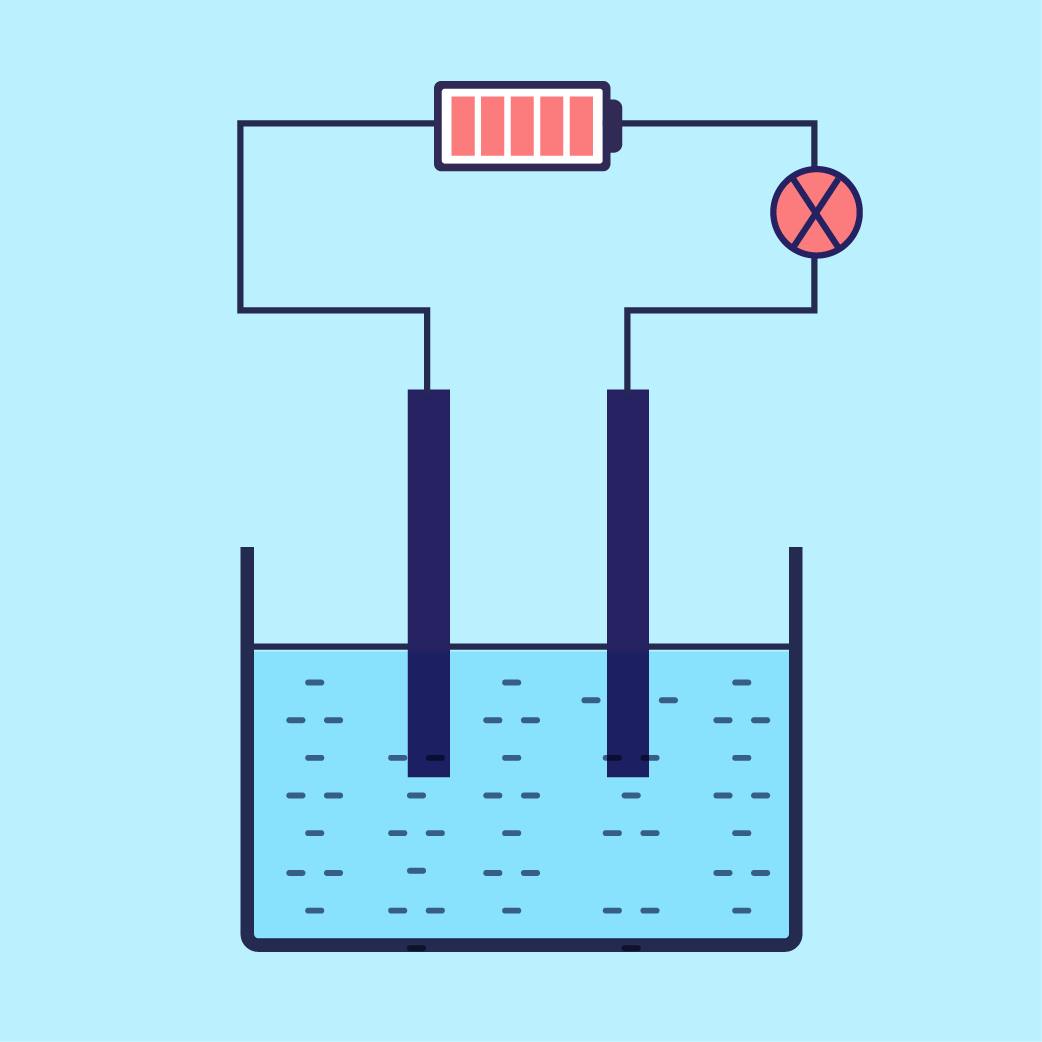
Electrical conductivity: Connect carbon electrodes, a bulb and a battery. Test solid lead(II) bromide, PbBr2, then heat it until molten and test again. Repeat using naphthalene, C10H8. Record whether the bulb lights in each state.
Solubility: Shake magnesium chloride, MgCl2, and naphthalene separately in distilled water and cyclohexane. Record the solubility of each substance.
Melting point: Heat magnesium chloride and naphthalene in separate test tubes using a water bath. Observe changes in physical state and infer their melting points.
Safety: Naphthalene is flammable and heating lead(II) bromide produces toxic bromine gas; follow laboratory precautions and use a fume cupboard when heating lead(II) bromide.
1. Electrical Conductivity
Conduction of electricity requires mobile charge carriers. Ionic compounds possess ions, but in the solid state these ions are locked in place. When melted or dissolved, ions become free to move. Covalent substances consist of neutral molecules without free ions or mobile electrons, so they cannot conduct electricity in any state.
2. Melting and Boiling
Melting and boiling involve overcoming the forces binding the units together. In ionic solids, strong electrostatic attractions across the crystal lattice must be overcome, requiring high temperatures. In simple covalent molecules, melting only requires breaking weak Van der Waals forces between molecules, leaving the strong internal covalent bonds intact; hence, melting points are low.
| Property | Ionic compounds | Simple covalent compounds |
|---|---|---|
| Electrical conductivity | Conduct in molten state and aqueous solution; do not conduct in solid state. | Do not conduct in any state. |
| Solubility in water | Usually soluble. | Usually insoluble. |
| Solubility in organic solvents | Usually insoluble. | Usually soluble. |
| Melting and boiling points | High; not easily volatile. | Low; easily volatile. |
Simple Molecular Structure
Examples: water, H2O; carbon dioxide, CO2; methane, CH4. Strong covalent bonds exist within molecules, but weak Van der Waals attraction forces exist between molecules. Low melting and boiling points because only little heat is needed to overcome the weak Van der Waals forces.
Giant Molecular Structure
Examples: silicon dioxide, SiO2; diamond. Very large three-dimensional network structure containing only strong covalent bonds linking atoms throughout the entire structure. High melting and boiling points because a large amount of heat energy is required to break the strong covalent bonds. Generally does not conduct electricity as there are no free-moving charged particles.
| Sector | Ionic compound | Covalent compound |
|---|---|---|
| Industrial | Lithium iodide, LiI, is used in batteries. | Paint containing pigments and turpentine solvent. |
| Agricultural | Ammonium nitrate, NH4NO3, and potassium chloride, KCl, are used in fertilisers. | Pesticides such as bromoethane, C2H5Br, and chloropicrin, CCl3NO2, used to kill weeds and insects. |
| Medical | Sodium bicarbonate, NaHCO3, used in antacids to relieve gastric pain. | Paracetamol, C8H9NO2, used to treat fevers and irritation. |
| Domestic | Sodium chlorate(V), NaClO3, used in detergents for domestic cleaning. | Glycerol, C3H5(OH)3, added to skincare products to moisturise and prevent dry skin. |
Try These Questions First
Answer mentally, then check the explanation.
Why does solid lead(II) bromide, PbBr2, fail to conduct electricity, but molten lead(II) bromide conducts electricity?
Explain why methane, CH4, has a significantly lower boiling point than sodium chloride, NaCl.
Why does silicon dioxide, SiO2, have a very high melting point even though it is a covalent compound?
Common Mistakes
Avoid these errors when comparing ionic and covalent compounds.
Common Misconceptions
Compare each misconception with the correct fact.
Heating solid NaCl breaks the covalent bonds between sodium and chlorine.
NaCl is an ionic compound held by ionic bonds, which are electrostatic attraction forces between Na+ and Cl− ions, not covalent bonds.
Water dissolves ionic compounds because water is an acid.
Water dissolves ionic compounds because it is a polar molecule with partial negative charges on oxygen and partial positive charges on hydrogen. Its attractions with ions are strong enough to overcome the ionic lattice forces.
Giant covalent structures like diamond conduct electricity like metals.
Diamond is a covalent structure made of neutral carbon atoms with no free-moving ions or delocalised electrons; therefore, it does not conduct electricity.
Summary
Key facts to remember.
- Ionic compounds conduct electricity in the molten state and aqueous solution, but not in the solid state.
- Ionic compounds are usually soluble in water, insoluble in organic solvents, and have high melting and boiling points.
- Simple covalent compounds do not conduct electricity in any state, are usually insoluble in water, soluble in organic solvents, and have low melting and boiling points.
- Giant covalent compounds have extremely high melting and boiling points and generally do not conduct electricity because they have no freely moving charged particles.
- Ionic compounds are used in batteries, fertilisers, antacids and detergents; covalent compounds are used in paints, pesticides, medicines and skincare products.
Quick Activity
Complete all parts before checking your score.
A. Objective Quiz
Which of the following compounds can conduct electricity in the molten state but cannot conduct electricity in the solid state?
Why does carbon dioxide, CO2, exist as a gas at room temperature while silicon dioxide, SiO2, is a hard solid with a very high melting point?
B. Fill in the Blanks
Solid ionic compounds cannot conduct electricity because the ions are held in fixed positions by strong ________ forces.
In agriculture, the ionic compound ammonium nitrate, NH4NO3, is widely used as a ________.
C. Match the Compound with Its Everyday Application
Drag each compound on desktop. On mobile, tap a compound and then tap the matching box.
Compounds
Lithium iodide, LiI Sodium bicarbonate, NaHCO3 Glycerol, C3H5(OH)3 Sodium chlorate(V), NaClO3Everyday Applications
Keywords
Tap or hover over a term to read its meaning.


