
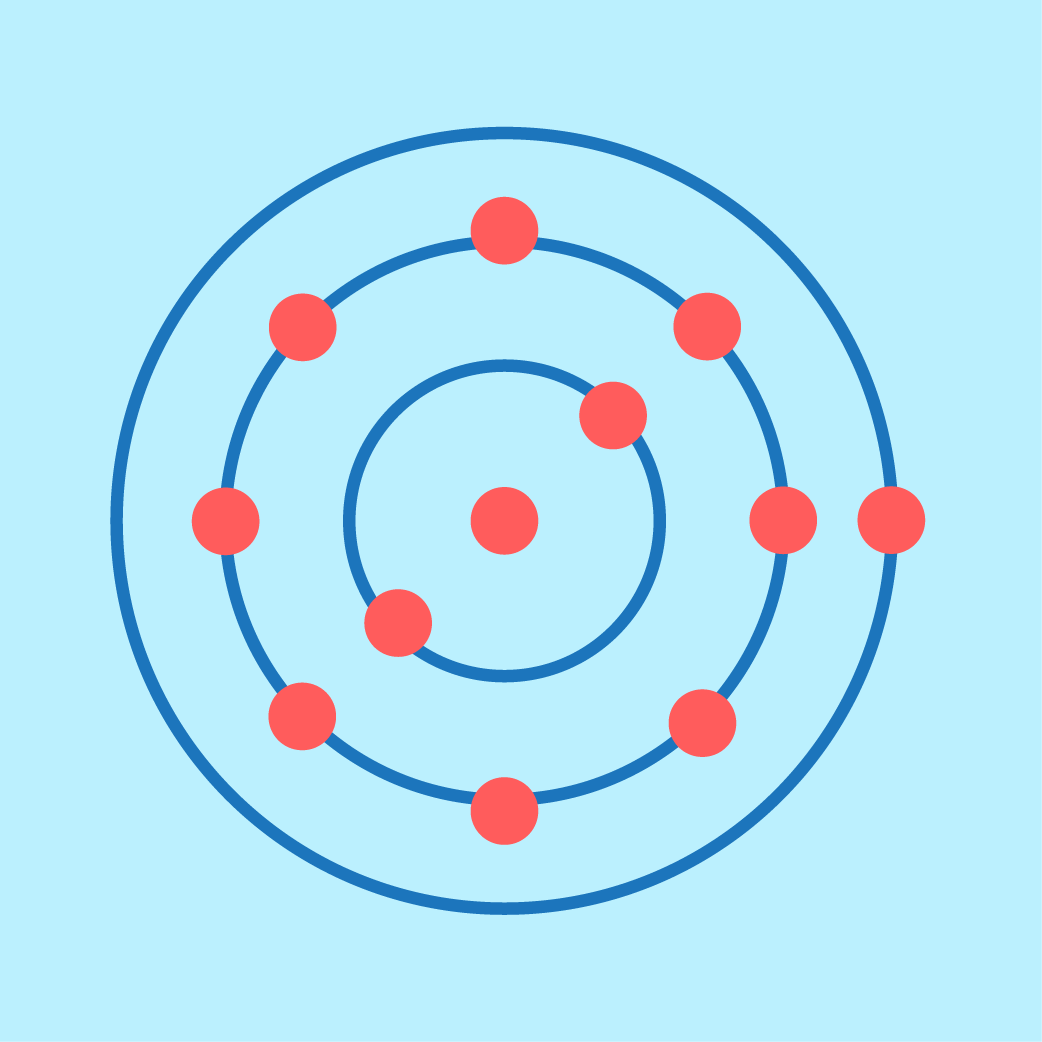
4.6Elements in Period 3
Period 3 consists of eight elements: sodium, magnesium, aluminium, silicon, phosphorus, sulphur, chlorine, and argon. Going across the period from left to right, elements exhibit systematic changes in atomic radius, electronegativity, physical state, and metallic character, as well as shifts in the chemical properties of their oxides from basic to amphoteric and acidic.
Learning Objectives
- Describe the trends in physical properties of elements across Period 3 (atomic radius, electronegativity, and physical state).
- Explain the changes in the metallic character and properties of elements across Period 3 (metal, semi-metal/metalloid, non-metal).
- Describe the changes in the chemical properties of oxides across Period 3 through their reactions with water, acids, and alkalis.
- Describe briefly the uses of semi-metals (metalloids) such as silicon in the microelectronic industry.
Trends Across Period 3 Elements and Their Oxides
Atomic radius decreases, electronegativity increases, and oxides change from basic to amphoteric to acidic.
Brief Explanation
Understand the key trends before exploring the oxides.
1. Atomic Radius Trend
The number of protons increases across Period 3, which increases the nuclear charge. This increases the nuclear attraction force towards the electrons, pulling the electron shells closer to the nucleus and decreasing atomic radius.
2. Electronegativity Trend
Electronegativity increases because the nuclear attraction force towards electrons increases. Argon has no electronegativity value because it has a stable octet configuration.
| Element | Atomic radius (nm) | Electronegativity | Physical state | Classification |
|---|---|---|---|---|
| Na | 0.186 | 0.9 | Solid | Metal |
| Mg | 0.160 | 1.2 | Solid | Metal |
| Al | 0.143 | 1.5 | Solid | Metal |
| Si | 0.118 | 1.8 | Solid | Semi-metal / Metalloid |
| P | 0.110 | 2.1 | Solid | Non-metal |
| S | 0.104 | 2.5 | Solid | Non-metal |
| Cl | 0.100 | 3.0 | Gas | Non-metal |
| Ar | 0.094 | – | Gas | Non-metal |
3. Reactions of Oxides
The basic oxides Na₂O and MgO that dissolve in water produce alkaline solutions. Basic oxides react with acids to form salt and water:
\( \mathrm{Na_2O(s) + H_2O(l) \rightarrow 2NaOH(aq)} \)
\( \mathrm{MgO(s) + 2HNO_3(aq) \rightarrow Mg(NO_3)_2(aq) + H_2O(l)} \)
Acidic oxides that dissolve in water produce acidic solutions and react with alkalis to form salt and water:
\( \mathrm{SO_2(g) + H_2O(l) \rightleftharpoons H_2SO_3(aq)} \)
\( \mathrm{SO_2(g) + 2NaOH(aq) \rightarrow Na_2SO_3(aq) + H_2O(l)} \)
The amphoteric oxide Al₂O₃ reacts with both acids and alkalis to form salt and water.
Try These Questions First
Answer mentally, then check the explanation.
Why does the atomic radius decrease from sodium to chlorine across Period 3?
What is meant by an amphoteric oxide, and which Period 3 oxide exhibits this property?
Why are metalloids such as silicon widely used in the manufacture of microchips?
Common Mistakes
Avoid these errors when studying Period 3 trends.
Common Misconceptions
Compare each misconception with the correct fact.
Adding more electrons across Period 3 adds new electron shells.
All elements in Period 3 have their valence electrons filling the third shell; the number of occupied shells remains three, meaning shielding/screening remains relatively constant while nuclear charge increases.
Basic oxides react with alkalis to form salt and water.
Basic oxides react only with acids. Only acidic oxides react with alkalis, while amphoteric oxides can react with both acids and alkalis.
Metalloids conduct electricity better at low temperatures like metals.
Metalloids are poor/weak electrical conductors at room temperature, but their conductivity increases at high temperatures, which makes them useful as semiconductors.
Summary
Key facts to remember.
- Period 3 contains eight elements: \(\text{Na}\), \(\text{Mg}\), \(\text{Al}\) (metals), \(\text{Si}\) (metalloid), \(\text{P}\), \(\text{S}\), \(\text{Cl}\), \(\text{Ar}\) (non-metals).
- Across Period 3 from left to right: number of protons increases → nuclear charge increases → nuclear attraction force on electrons increases.
- Atomic radius decreases from \(0.186\text{ nm}\) down to \(0.094\text{ nm}\).
- Electronegativity increases from \(0.9\) up to \(3.0\).
- Physical states shift from solid to gas.
- Oxide properties transition: basic oxides \(\text{Na}_2\text{O}\), \(\text{MgO}\); amphoteric oxide \(\text{Al}_2\text{O}_3\); acidic oxides \(\text{SiO}_2\), \(\text{P}_4\text{O}_{10}\), \(\text{SO}_2\), \(\text{Cl}_2\text{O}_7\).
- Silicon (\(\text{Si}\)) is a semi-metal used as a semiconductor in microchips because it conducts electricity well at high temperatures.
Quick Activity
Complete all parts before checking your score.
A. Objective Quiz
Which of the following correctly describes the trend in atomic radius across Period 3 from sodium to chlorine?
Which oxide in Period 3 reacts with both nitric acid, \(\text{HNO}_3\), and sodium hydroxide solution, \(\text{NaOH}\)?
B. Fill in the Blanks
Across Period 3 from left to right, electronegativity increases because the nuclear attraction force towards the ________ increases.
Silicon is classified as a semi-metal or metalloid, and is used as a ________ in the manufacture of electronic microchips.
C. Match the Period 3 Oxide with Its Property
Drag each oxide on desktop. On mobile, tap an oxide and then tap the matching box.
Period 3 Oxide
Magnesium oxide, \(\text{MgO}\) Aluminium oxide, \(\text{Al}_2\text{O}_3\) Silicon(IV) oxide, \(\text{SiO}_2\) Sulphur dioxide, \(\text{SO}_2\)Property of Oxide
Keywords
Tap or hover over a term to read its meaning.


