
4.4Elements in Group 1
Group 1 of the Periodic Table consists of lithium (Li), sodium (Na), potassium (K), rubidium (Rb), caesium (Cs), and francium (Fr). These elements are known as alkali metals. They have one valence electron, low melting and boiling points compared to other metals, and low densities. Chemically, they are highly reactive, readily donating their single valence electron to form ions with a +1 charge. Their reactivity increases down the group as the atomic size expands and the valence electron is lost more easily.
Learning Objectives
- Generalise the changes in physical properties of elements when going down Group 1.
- Investigate through experiment the chemical properties of Group 1 elements with water, oxygen gas, and chlorine gas.
- Generalise the changes in the reactivity of elements when going down Group 1.
- Reason out the physical and chemical properties of the other elements in Group 1.
Trend of Atomic Size and Reactivity Down Group 1
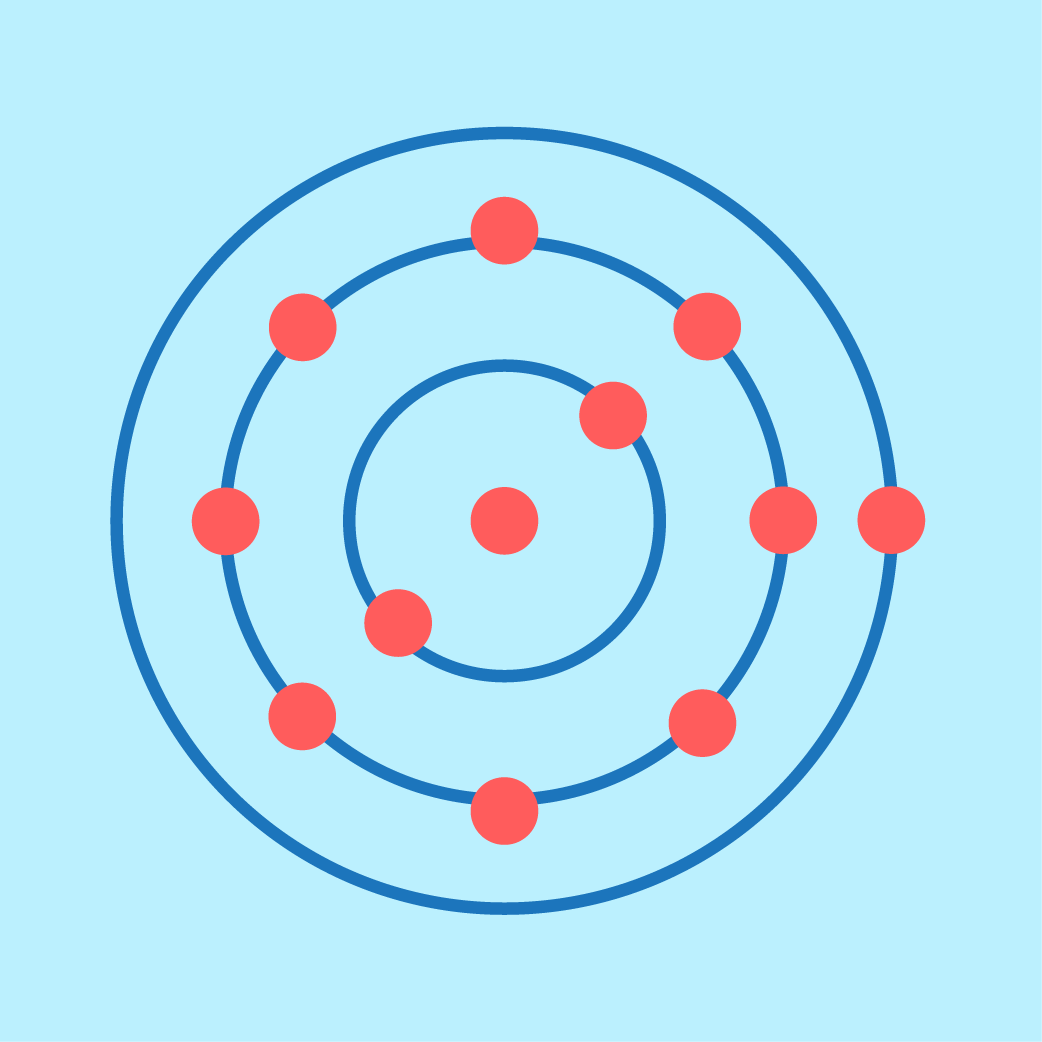
More electron shells mean a larger atomic radius, weaker nuclear attraction on the valence electron, and higher reactivity.
Brief Explanation
Understand the key ideas about Group 1 alkali metals.
1. Physical Trend
The metallic bonding between the atoms weakens as the atomic size expands. Less thermal energy is required to separate the atoms, leading to lower melting and boiling points down the group.
2. Chemical Trend
The outermost valence electron experiences a weaker electrostatic pull from the nucleus due to the increased distance. Consequently, the atom donates its valence electron much more readily, resulting in increased reactivity when reacting with water, oxygen, and chlorine gas down Group 1.
| Property | Li | Na | K |
|---|---|---|---|
| Atomic radius (nm) | 0.133 | 0.186 | 0.203 |
| Melting point (°C) | 186 | 98 | 64 |
| Boiling point (°C) | 1 342 | 880 | 760 |
Reaction with Water
Alkali metals react with water to produce an alkaline metal hydroxide solution and hydrogen gas. The resulting solution turns red litmus paper blue.
\(2\text{Li}(\text{s}) + 2\text{H}_2\text{O}(\text{l}) \rightarrow 2\text{LiOH}(\text{aq}) + \text{H}_2(\text{g})\)
Reaction with Oxygen Gas
Alkali metals burn in oxygen gas to produce a white solid metal oxide. The oxide dissolves in water to form an alkaline metal hydroxide solution.
\(4\text{Li}(\text{s}) + \text{O}_2(\text{g}) \rightarrow 2\text{Li}_2\text{O}(\text{s})\)
\(\text{Li}_2\text{O}(\text{s}) + \text{H}_2\text{O}(\text{l}) \rightarrow 2\text{LiOH}(\text{aq})\)
- The number of shells filled with electrons increases going down the group, causing the atomic size to increase.
- The single valence electron is placed further away from the nucleus.
- The nuclear attraction force towards the valence electron weakens.
- Hence, the single valence electron is more easily donated to achieve a stable octet or duplet electron arrangement.
Try to Answer First
Answer mentally, then check the explanation.
Why does the melting point of alkali metals decrease down Group 1?
What are the products formed when sodium metal reacts with water?
Why is potassium more reactive than sodium?
Common Mistakes
Avoid these errors when studying Group 1 elements.
Concept Misunderstandings
Compare each misconception with the correct fact.
Alkali metals have high melting points because they are metals.
Unlike dense transition metals (e.g., iron with a melting point of \(1\,540\ ^\circ\text{C}\)), alkali metals have relatively weak metallic bonds and large atomic radii, giving them characteristically low melting points (\(186\ ^\circ\text{C}\) for Li, down to \(64\ ^\circ\text{C}\) for K).
Reactivity decreases down Group 1 because the nucleus has more protons to attract electrons.
Group 1 metals react by donating electrons, not attracting them. Even though proton number increases, the increased number of inner shells shields the valence electron and moves it further away, making it easier to lose the single valence electron.
Summary
Key facts to remember.
- Group 1 alkali metals (\(\text{Li}\), \(\text{Na}\), \(\text{K}\), \(\text{Rb}\), \(\text{Cs}\), \(\text{Fr}\)) are soft, low-density metals with one valence electron.
- Down the group, atomic radius increases, causing the melting and boiling points to decrease due to weaker attraction forces between atoms.
- Reactivity increases down the group because the valence electron is further from the nucleus, experiencing weaker nuclear attraction and thus being donated more readily.
- They react with water to produce metal hydroxides and hydrogen gas, with oxygen gas to yield metal oxides (which dissolve in water to form alkaline solutions), and with chlorine gas to form metal chlorides.
Short Activity
Complete all parts before checking your score.
A. Objective Quiz
Which of the following statements correctly explains why potassium is more reactive than sodium?
What product is formed when lithium oxide dissolves in water?
B. Fill in the Blanks
Down Group 1, the melting point of elements decreases because the increase in atomic size will weaken the attraction force between the metal ________.
When potassium burns in chlorine gas, a white solid called potassium ________ is formed.
C. Match the Element with Its Description
Drag each element on desktop. On mobile, tap an element and then tap the matching box.
Element / Term
Lithium Sodium Potassium FranciumDescription / Application
Keywords
Tap or hover over a term to read its meaning.


