
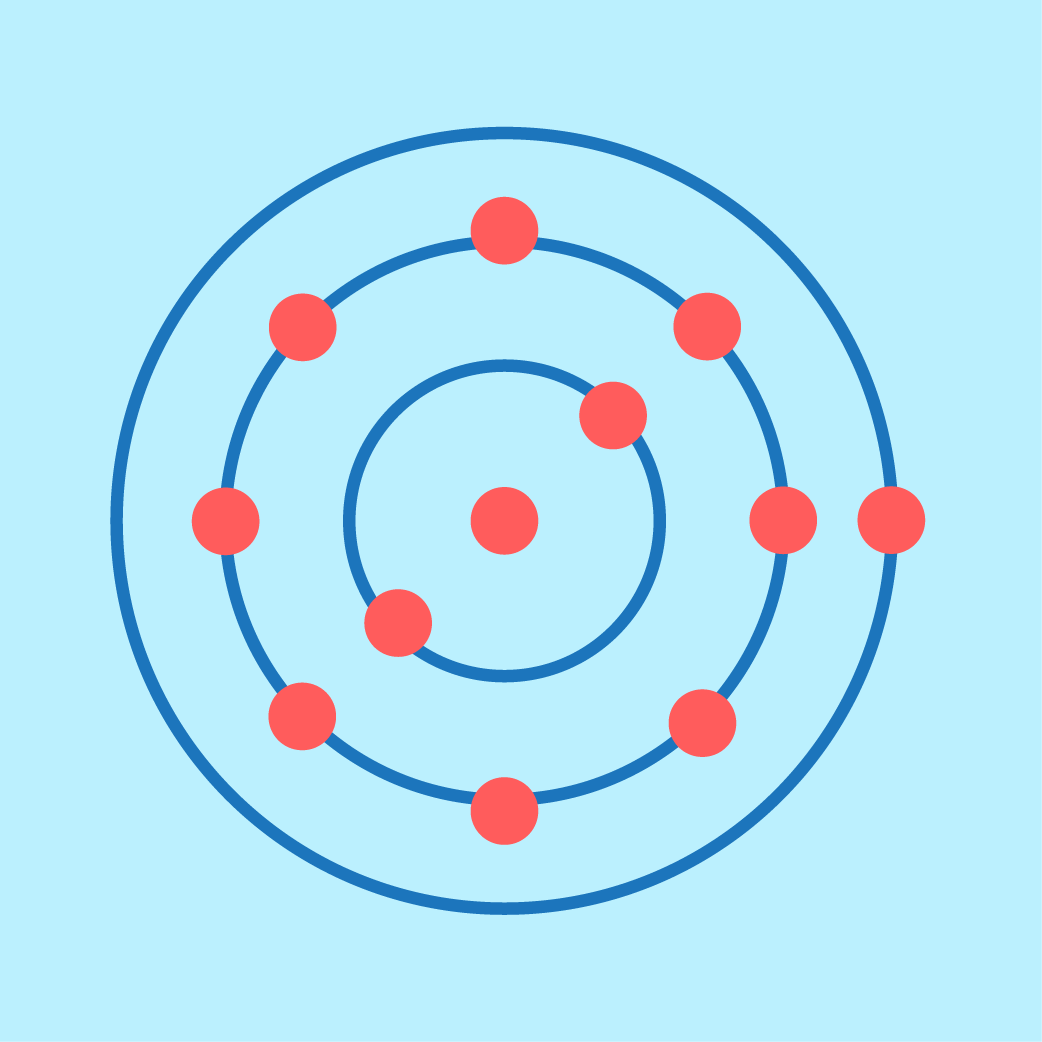
4.3Elements in Group 18
Group 18 of the Periodic Table consists of helium (He), neon (Ne), argon (Ar), krypton (Kr), xenon (Xe), radon (Rn), and oganesson (Og). These elements are known as noble gases or inert gases. They are chemically unreactive, exist as monoatomic gases, and exhibit distinct physical trends and practical applications across various industries.
Learning Objectives
- Relate the inert nature of Group 18 elements to their electron arrangement stability.
- Generalise the changes in physical properties of elements when going down Group 18.
- Describe briefly the uses of Group 18 elements in daily life.
Electron Arrangements and Trends Down Group 18
Why noble gases are inert, and how their physical properties change down the group.
Helium — Duplet
Helium has a stable duplet electron arrangement with 2 valence electrons.
Neon — Octet
Neon has a stable octet electron arrangement with 8 valence electrons.
Argon — Octet
Argon has a stable octet electron arrangement with 8 valence electrons.
Trends Down Group 18
Brief Explanation
Understand why noble gases are inert and how their properties change down the group.
Chemical Inertness
Noble gas atoms have achieved a stable duplet or octet electron arrangement, so they do not donate, accept, nor share electrons with atoms of other elements.
Physical Trends
Going down Group 18, atomic radius, melting point, boiling point and density all increase as the number of electron-filled shells increases.
| Element | Atomic radius (nm) | Melting point (°C) | Boiling point (°C) | Density (g cm⁻³) |
|---|---|---|---|---|
| Helium | 0.050 | -270 | -269 | 0.00017 |
| Neon | 0.070 | -248 | -246 | 0.00080 |
| Argon | 0.094 | -189 | -186 | 0.00170 |
| Krypton | 0.109 | -156 | -152 | 0.00350 |
| Xenon | 0.130 | -122 | -108 | 0.00550 |
| Radon | — | -71 | -62 | — |
Try These Questions First
Answer mentally, then check the explanation.
Why are noble gases chemically unreactive?
Explain why the boiling points of elements increase when going down Group 18.
State two uses of argon in daily life.
Common Mistakes
Avoid these errors when learning about Group 18 elements.
Common Misconceptions
Compare each misconception with the correct fact.
Noble gases have high melting and boiling points because their atoms have strong chemical bonds.
Noble gases exist as individual monoatoms held together only by weak attraction forces between atoms, which is why they have very low melting and boiling points (helium to radon are gases at room temperature).
Atoms of noble gases form compounds easily because their valence shells are full.
A fully filled valence shell (duplet or octet) confers chemical stability; therefore, noble gas atoms do not donate, accept, or share electrons under standard conditions.
Summary
Key facts to remember.
- Group 18 consists of helium, neon, argon, krypton, xenon, radon, and oganesson.
- Noble gases have fully filled valence shells (duplet for helium, octet for others) and exist as monoatoms.
- They are chemically inert because they do not donate, accept, or share electrons.
- Going down Group 18, atomic radius, melting point, boiling point and density increase.
- Noble gases have diverse uses: weather balloons and divers' tanks (He), advertising lights (Ne), electric bulbs and welding atmosphere (Ar), flashlights and eye retina laser treatment (Kr), lighthouse lamps and anesthesia (Xe), and cancer treatment (Rn).
Quick Activity
Complete all parts before checking your score.
A. Objective Quiz
Why do Group 18 elements exist as monoatoms?
Which of the following explains why the melting points and boiling points increase down Group 18?
B. Fill in the Blanks
Helium achieves a stable __________ electron arrangement with two valence electrons in its filled shell.
Argon is used in electric bulbs and to provide an __________ atmosphere for high-temperature welding.
C. Match the Noble Gas with Its Use
Drag each noble gas on desktop. On mobile, tap a noble gas and then tap the matching box.
Answer Choices
Helium Neon Krypton RadonApplication in Daily Life
Keywords
Tap or hover over a term to read its meaning.

