
3.3Chemical Formula
Chemical formulas are the universal language of chemistry. They show the exact elements present in a substance and the proportions in which their atoms combine.
Learning Objectives
- State the meaning of chemical formula, empirical formula, and molecular formula.
- Determine the empirical formula of magnesium oxide, MgO, through an activity.
- Determine the empirical formula of copper(II) oxide, CuO, through an activity.
- Solve numerical problems involving empirical formula and molecular formula.
- Construct and write the chemical formulae of ionic compounds and name chemical compounds systematically according to IUPAC nomenclature.
Two Methods for Determining Empirical Formulae
Magnesium oxide vs. copper(II) oxide — contrasting setups, precautions and rationale based on metal reactivity.
Method 1: Direct Heating in Air
For reactive metals such as magnesium.
- Clean the magnesium ribbon with sandpaper to remove the oxide layer.
- Heat the crucible without the lid initially.
- Cover with the lid when burning begins to prevent white fumes of MgO from escaping.
- Lift the lid slightly from time to time to allow oxygen to enter for complete combustion.
- Heat strongly for 1–2 minutes after burning stops.
- Repeat heating, cooling and weighing until a constant mass is obtained.
Method 2: Reduction by Hydrogen Gas
For less reactive metals such as copper.
- Copper(II) oxide is reduced by dry hydrogen gas.
- Reaction: CuO + H2 → Cu + H2O
- Hydrogen is produced from zinc granules and dilute hydrochloric acid.
- Let hydrogen flow for about 10 seconds before heating to expel all air and prevent an explosion.
- Heat black copper(II) oxide until it turns completely brown.
- Keep hydrogen flowing while cooling to prevent hot copper from reoxidising.
- Repeat heating, cooling and weighing until a constant mass is obtained.
Brief Explanation
Chemical formula, empirical formula, molecular formula and naming rules.
Empirical Formula
Shows the simplest whole-number ratio of atoms of each element in a compound. It is calculated experimentally from mass data by converting grams to moles and simplifying the ratio.
Molecular Formula
Shows the actual number of atoms of each element found in a molecule of a compound. It is an integer multiple of the empirical formula:
\[ \text{Molecular formula} = (\text{Empirical formula})_n \]
| Compound | Molecular formula | Empirical formula | Value of n |
|---|---|---|---|
| Water | H2O | H2O | 1 |
| Ammonia | NH3 | NH3 | 1 |
| Hydrazine | N2H4 | NH2 | 2 |
| Propene | C3H6 | CH2 | 3 |
| Benzene | C6H6 | CH | 6 |
| Glucose | C6H12O6 | CH2O | 6 |
| Hexane | C6H14 | C3H7 | 2 |
Steps to Determine Empirical Formula
- Determine the mass of each element.
- Calculate the number of moles of atoms of each element: \(\text{mole} = \dfrac{\text{mass}}{\text{RAM}}\).
- Divide each mole value by the smallest mole value to find the mole ratio.
- Convert the ratio to the simplest whole number ratio.
Worked Example
1.35 g of Al combines with 1.2 g of O.
Moles of Al \(= \dfrac{1.35}{27} = 0.05\)
Moles of O \(= \dfrac{1.2}{16} = 0.075\)
Ratio Al : O \(= \dfrac{0.05}{0.05} : \dfrac{0.075}{0.05} = 1 : 1.5\)
Multiply by 2 → Al : O \(= 2 : 3\) → Al2O3
Ionic Compounds
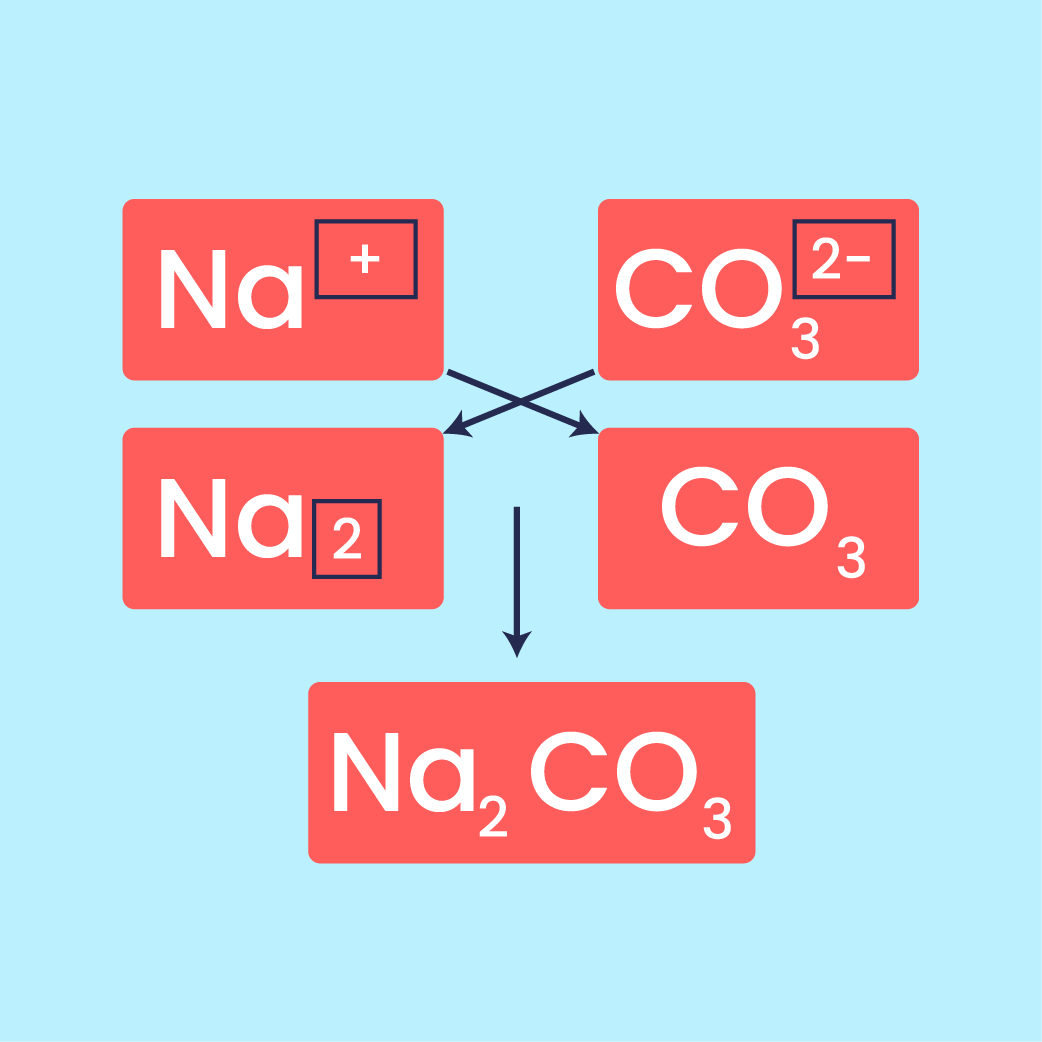
Composed of cations (positively charged) and anions (negatively charged). Use the criss-cross method to balance charges.
Example: Aluminium sulphate — Al3+ and SO42− → Al2(SO4)3
Naming Compounds
Ionic: cation first, then anion. Metals with multiple oxidation states use Roman numerals, e.g. FeO = iron(II) oxide, Fe2O3 = iron(III) oxide.
Covalent: more electropositive element first, more electronegative element second with suffix -ide. Greek prefixes: mono-, di-, tri-, tetra-, penta-, hexa-, hepta-.
Examples: CO = carbon monoxide, NO2 = nitrogen dioxide, SO3 = sulphur trioxide.
Try to Answer First
Answer mentally, then check the explanation.
A sample contains 6.24 g of potassium and 12.8 g of bromine. Determine the empirical formula of this compound. [Relative atomic mass: K = 39, Br = 80]
Why must the hydrogen gas be allowed to flow continuously while the glass tube cools down to room temperature in the determination of the empirical formula of copper(II) oxide?
Construct the chemical formula for aluminium sulphate and iron(III) oxide using the criss-cross method.
Common Mistakes
Avoid these errors when working with chemical formulae.
Concept Misunderstandings
Compare each misconception with the correct fact.
All compounds have different empirical and molecular formulas.
Compounds whose molecular formula is already in the simplest whole number ratio (such as H2O, NH3, CO2) have identical empirical and molecular formulas (n = 1).
The empirical formula of copper(II) oxide can be determined by heating copper ribbon in a crucible like magnesium.
Copper is much less reactive towards oxygen than magnesium and will not burn readily or react completely to form copper(II) oxide in a crucible. It must be determined by reducing copper(II) oxide using dry hydrogen gas.
The subscript 1 must always be written in a chemical formula.
By IUPAC convention, the subscript number 1 is omitted (e.g. NaCl, not Na1Cl1).
Summary
Key facts to remember.
- A chemical formula represents a substance using element symbols and subscript numbers. Subscript 1 is omitted.
- Empirical formula is the simplest whole-number ratio of atoms of each element in a compound.
- Molecular formula represents the actual number of atoms of each element in a molecule: \(\text{Molecular formula} = (\text{Empirical formula})_n\).
- Magnesium oxide determination involves heating Mg in a crucible with a lid, lifting the lid intermittently to supply O2, closing to retain white fumes (MgO), and heating to constant mass.
- Copper(II) oxide determination involves reducing CuO with dry H2 gas; requires expelling air before heating to avoid explosion and cooling under H2 gas to prevent reoxidation.
- Ionic formulas balance cation and anion charges using the criss-cross method.
- Naming: ionic compounds use cation + anion (with Roman numerals for variable oxidation states). Simple covalent compounds use Greek numerical prefixes and end with '-ide'.
Short Activity
Complete all parts before checking your score.
A. Objective Quiz
In an experiment to determine the empirical formula of magnesium oxide, why must the crucible lid be lifted slightly from time to time during heating?
A compound has the empirical formula CH2 and a relative molecular mass (RMM) of 56. What is the molecular formula of the compound? [Relative atomic mass: H = 1, C = 12]
B. Fill in the Blanks
Before heating copper(II) oxide in Activity 3.13, hydrogen gas must flow through the apparatus for about 10 seconds to expel all ______ from the glass tube to prevent an explosion.
The chemical formula that shows the simplest whole number ratio of atoms of each element in a compound is known as the ______ formula.
C. Match the Item with Its Description
Drag each item on desktop. On mobile, tap an item and then tap the matching box.
Item / Chemical Term
Heating to a constant mass Sandpapering magnesium ribbon Carbon monoxide Iron(III) oxideCorrect Description / Rationale
Keywords
Tap or hover over a term to read its meaning.

