
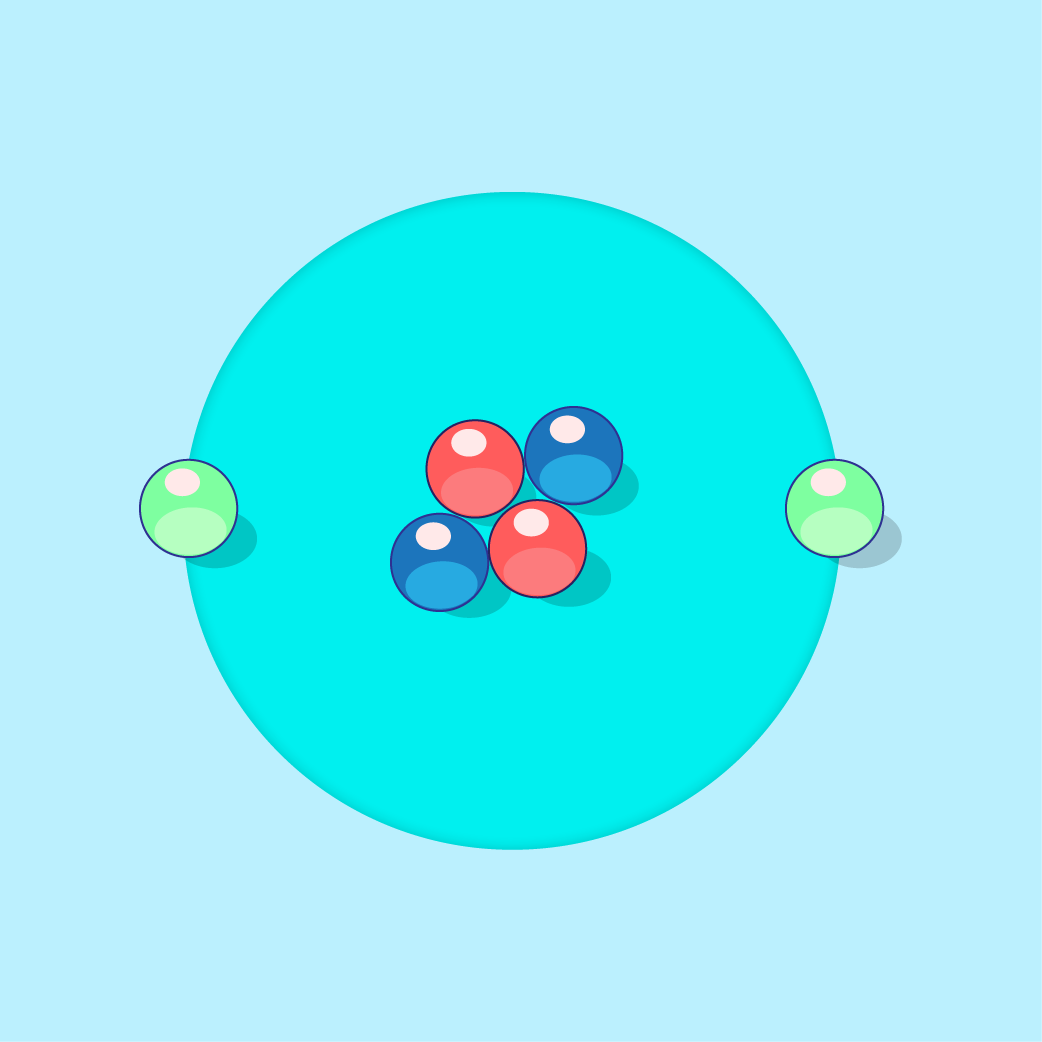
2.4Isotopes and Its Uses
Isotopes are atoms of the same element that share identical chemical properties due to having the same proton number, but possess different masses because of differing numbers of neutrons. In nature, most elements exist as mixtures of isotopes. Understanding isotopes allows us to calculate an element's relative atomic mass based on natural abundance and harness their unique properties in medicine, agriculture, industry, archaeology, and nuclear energy.
Learning Objectives
- Deduce the meaning of isotopes.
- Calculate the relative atomic mass of isotopes.
- Justify the usage of isotopes in various fields.
Subatomic Comparison and Uses of Isotopes
Same protons, different neutrons — and a wide range of practical applications.
Brief Explanation
Understand the meaning of isotopes and how their natural abundance determines relative atomic mass.
Hydrogen Isotopes
Hydrogen exists as three isotopes: \(^{1}_{1}\text{H}\), \(^{2}_{1}\text{H}\), and \(^{3}_{1}\text{H}\). All three have the same proton number (1) but different nucleon numbers (1, 2, and 3).
Other Examples
Silicon: \(^{28}_{14}\text{Si}\), \(^{29}_{14}\text{Si}\), \(^{30}_{14}\text{Si}\)
Magnesium: \(^{24}_{12}\text{Mg}\), \(^{25}_{12}\text{Mg}\), \(^{26}_{12}\text{Mg}\)
Phosphorus: \(^{31}_{15}\text{P}\), \(^{32}_{15}\text{P}\)
| Isotope | Protons | Neutrons | Electrons |
|---|---|---|---|
| Chlorine-35 (\(^{35}_{17}\text{Cl}\)) | 17 | 18 | 17 |
| Chlorine-37 (\(^{37}_{17}\text{Cl}\)) | 17 | 20 | 17 |
\[\text{Relative atomic mass} = \frac{\sum(\% \text{ isotope} \times \text{mass of isotope})}{100}\]
Worked Example
Chlorine consists of two isotopes: \(^{35}_{17}\text{Cl}\) (75%) and \(^{37}_{17}\text{Cl}\) (25%).
\[\text{Relative atomic mass of chlorine} = \frac{(75 \times 35) + (25 \times 37)}{100} = \frac{2625 + 925}{100} = \frac{3550}{100} = 35.5\]
Uses and Justification of Isotope Applications
Uranium-235 is used in nuclear power generators to generate electrical energy. Lead-210 is used to determine the age of sand and earth layers up to 80 years.
Using isotopes benefits medicine, agriculture, industry and other fields, but may also have negative effects on the environment and society. Their use must therefore be managed responsibly.
Check Understanding
Answer the questions, then check your answers.
What is meant by isotopes?
State the isotope used in detecting leakages in underground pipes.
An element has two isotopes: isotope-X with a mass of 10 and an abundance of 20%, and isotope-Y with a mass of 11 and an abundance of 80%. What is the relative atomic mass of this element?
Common Mistakes
Avoid these errors when working with isotopes.
Common Misconceptions
Compare each misconception with the correct fact.
Isotopes are different elements because their nucleon numbers are different.
Isotopes belong to the same element because the identity of an element is determined solely by its proton number, which remains identical among isotopes.
Relative atomic mass is just a simple average of the mass numbers of an element's isotopes.
Relative atomic mass is a weighted average that depends directly on the percentage natural abundance of each isotope present in a natural sample.
Summary
Key facts to remember.
- Isotopes: Atoms of the same element with the same number of protons but different numbers of neutrons.
- Natural Abundance: Percentage of each isotope naturally present in an element sample.
- Relative Atomic Mass Formula: \(\text{RAM} = \frac{\sum(\% \text{ isotope} \times \text{mass of isotope})}{100}\).
- Key Isotope Uses: Medicine (Cobalt-60, Iodine-131), Agriculture (Phosphorus-32), Nuclear (Uranium-235), Archaeology (Carbon-14, Lead-210), Industry (Hydrogen-3), Engineering (Sodium-24).
Quick Activity
Complete all parts before checking your score.
A. Objective Quiz
Which of the following pairs of subatomic particles is identical in two isotopes of the same element?
Which isotope is correctly matched to its use in archaeology?
B. Fill in the Blanks
The percentage of isotopes present in a natural sample of an element is known as natural __________.
In medicine, the isotope __________ is used in radiotherapy to kill cancer cells without surgery and to sterilise surgical tools.
C. Match the Isotope with Its Application
Drag each isotope on desktop. On mobile, tap an isotope and then tap the matching box.
Isotope
Iodine-131 Phosphorus-32 Sodium-24 Hydrogen-3Application
Keywords
Tap or hover over a term to read its meaning.


