
2.3Atomic Structure
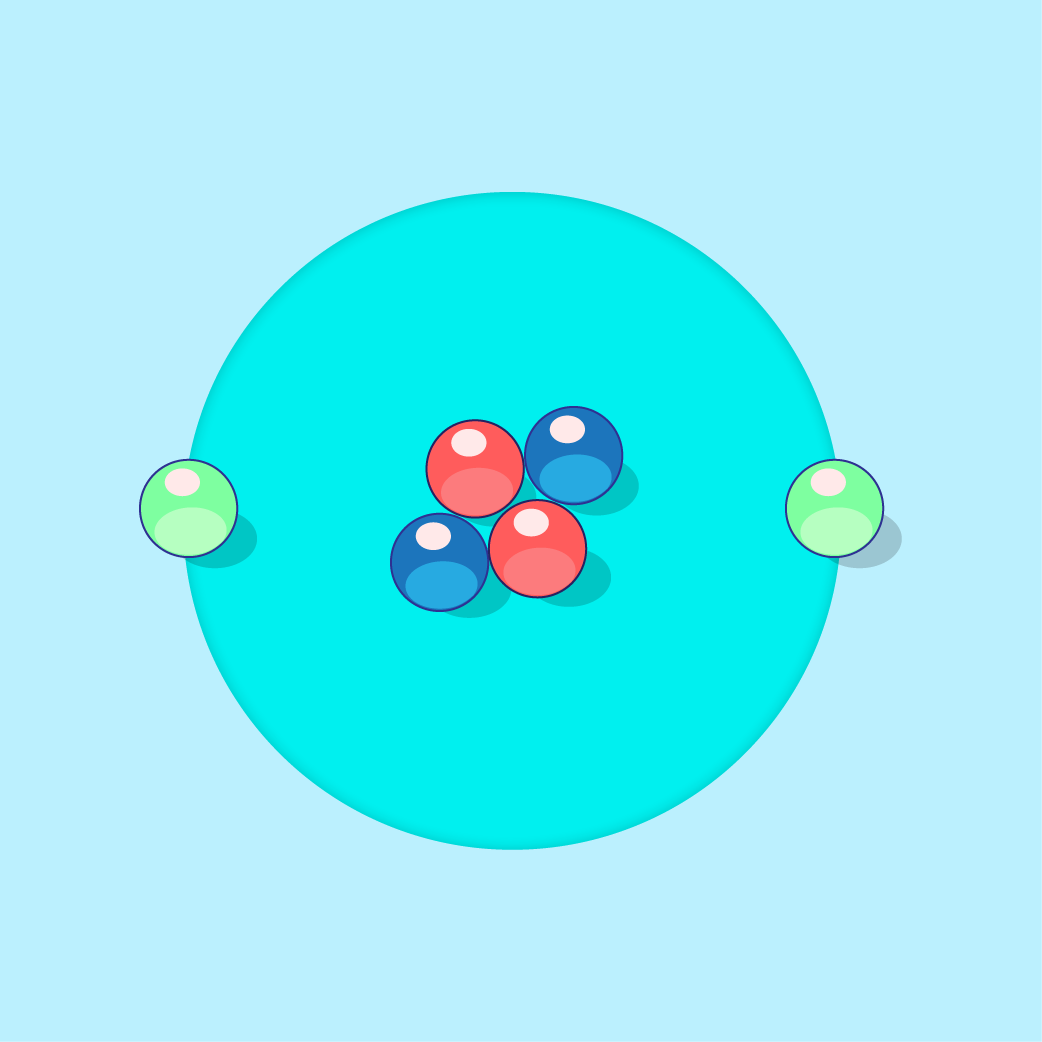
Every atom is composed of subatomic particles: protons, neutrons, and electrons. This topic covers the definitions of proton number and nucleon number, how to write the standard representation of an atom, how electrons are arranged in shells around the nucleus, and how to construct atomic structure diagrams and electron arrangement diagrams.
Learning Objectives
- Define proton number and nucleon number.
- Determine the nucleon number, proton number, and number of electrons in an atom.
- Write the standard representation of an atom.
- Construct an atomic structure diagram and electron arrangement.
Standard Representation, Electron Arrangement, and Atomic Structure Diagrams
Clarify the difference between nucleon number (A) and proton number (Z), and contrast the electron arrangement diagram with the atomic structure diagram.
Standard Representation
An atom is represented as \(^A_Z\text{X}\), where \(A\) is the nucleon number and \(Z\) is the proton number.
\(^{23}_{11}\text{Na}\)
Electron Arrangement vs Atomic Structure
Electron arrangement diagram: shows the element symbol in the centre and only the electrons in shells.
Atomic structure diagram: shows the number of protons and neutrons in the nucleus, plus electrons in shells.
Electron Arrangement Diagram
Aluminium: 2.8.3
Atomic Structure Diagram
Aluminium: 13 p, 14 n
Brief Explanation
Understand the key ideas about protons, neutrons, electrons and atomic notation.
Proton Number and Nucleon Number
Proton number = number of protons in the nucleus.
Nucleon number = number of protons + number of neutrons.
In a neutral atom: number of electrons = number of protons.
Number of neutrons = nucleon number − number of protons.
Formation of Ions
During ion formation, the number of protons and neutrons remains unchanged; only the number of electrons changes.
Anion: formed when an atom accepts electrons.
Cation: formed when an atom donates electrons.
| Element | Protons | Neutrons | Proton number | Nucleon number |
|---|---|---|---|---|
| Oxygen | 8 | 8 | 8 | 16 |
| Sodium | 11 | 12 | 11 | 23 |
| Chlorine | 17 | 18 | 17 | 35 |
Standard Representation
An atom is represented as \(^A_Z\text{X}\), where:
- \(\text{X}\) = symbol of the element
- \(A\) = nucleon number (top left)
- \(Z\) = proton number (bottom left)
Example: \(^{12}_{\phantom{1}6}\text{C}\) shows carbon with nucleon number 12 and proton number 6.
Electron Arrangement
Electrons fill the shell closest to the nucleus first.
Maximum electrons per shell for elements 1–20:
- First shell: 2
- Second shell: 8
- Third shell: 8
Valence shell is the outermost occupied shell. Valence electrons determine chemical properties.
Check Understanding
Answer the questions, then check your answers.
An atom of element \(\text{Y}\) has 11 protons and 12 neutrons. What is the nucleon number and standard representation of atom \(\text{Y}\)?
What is the difference between an electron arrangement diagram and an atomic structure diagram?
What happens to the number of protons, neutrons, and electrons when a neutral chlorine atom (\(17\text{ p}\), \(18\text{ n}\), \(17\text{ e}^-\)) forms a chloride ion (\(\text{Cl}^-\))?
Common Mistakes
Avoid these errors when working with atomic structure.
Concept Misunderstandings
Compare each misconception with the correct fact.
Atoms of different elements can have the same proton number.
Each element has a unique proton number.
The third shell can never hold more than 8 electrons.
For the first 20 elements, the third shell holds up to 8 electrons. For elements with proton numbers exceeding 20, the third shell can hold a maximum of 18 electrons.
Summary
Key facts to remember.
- Proton number (\(Z\)) = number of protons in the nucleus.
- Nucleon number (\(A\)) = number of protons + number of neutrons.
- In a neutral atom: number of electrons = number of protons.
- Standard notation: \(^A_Z\text{X}\).
- Shell capacity (elements 1–20): Shell 1 = max 2, Shell 2 = max 8, Shell 3 = max 8.
- Valence electrons are the electrons located in the outermost shell (valence shell) and determine chemical properties.
Short Activity
Complete all parts before checking your score.
A. Objective Quiz
An atom of element \(\text{E}\) has a proton number of 11 and a nucleon number of 23. How many neutrons and valence electrons does this atom have?
Which statement correctly describes an atomic structure diagram of an atom?
B. Fill in the Blanks
The total number of protons and neutrons in the nucleus of an atom is called the ______ number.
For elements with proton numbers 1 to 20, the first electron shell can hold a maximum of ______ electrons.
C. Match the Atomic Term with Its Description
Drag each term on desktop. On mobile, tap a term and then tap the matching box.
Terms
Proton number Valence electrons Anion CationDescriptions
Keywords
Tap or hover over a term to read its meaning.


