
2.2The Development of the Atomic Model
Atoms are extremely tiny and cannot be seen with the naked eye or through a microscope. Over centuries, scientists developed models of the atom through experimental evidence and reasoning.
Learning Objectives
- State the subatomic particles in atoms of various elements.
- Compare and contrast the relative mass and relative charge of proton, electron, and neutron.
- Sequence the atomic structure models chronologically based on the Atomic Models of Dalton, Thomson, Rutherford, Bohr, and Chadwick.
Timeline and Evolution of the Atomic Model
From Dalton's solid sphere to Chadwick's complete nuclear model.
Solid, indivisible sphere.
Positive sphere with embedded electrons.
Central positive nucleus with orbiting electrons.
Electrons move in specific shells around the nucleus.
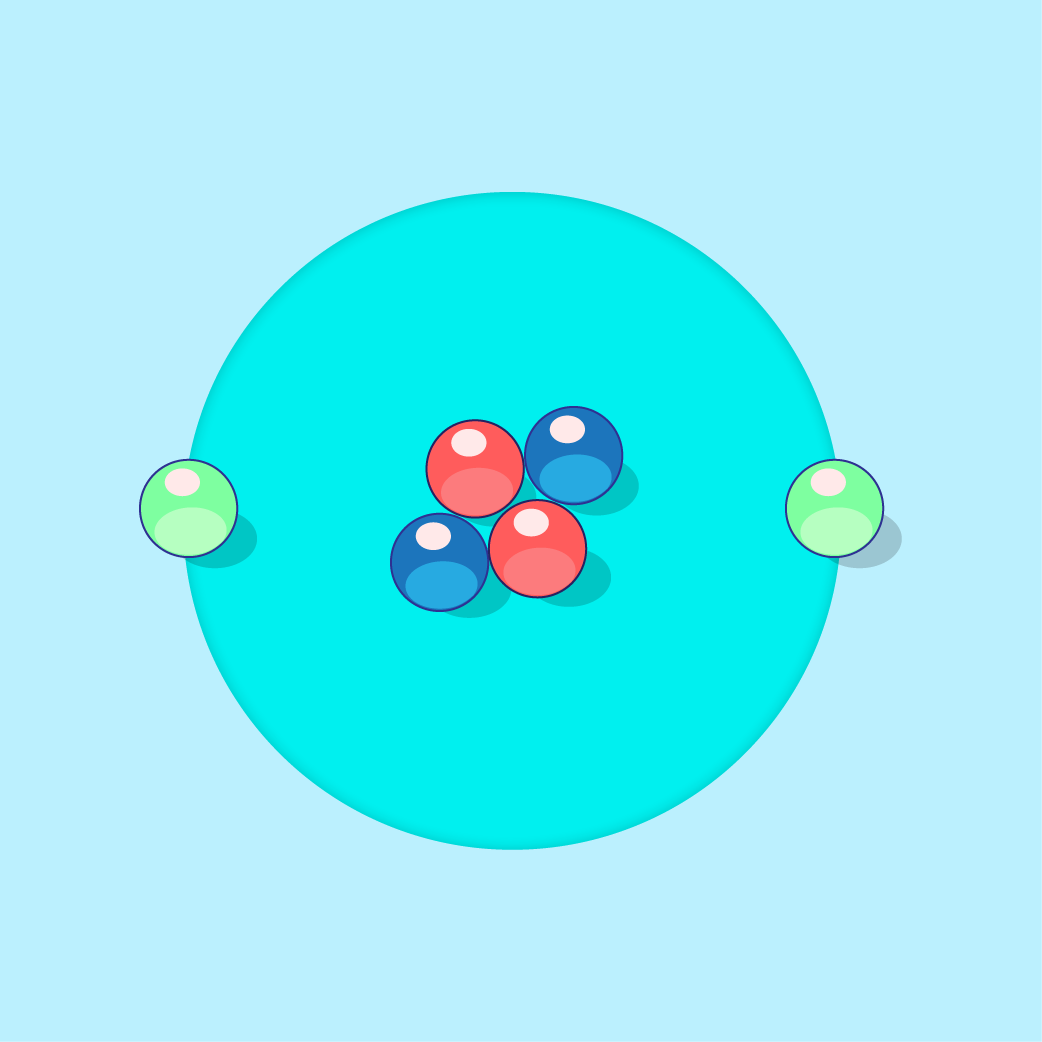
Nucleus contains protons and neutrons, surrounded by electron shells.
Brief Explanation
Subatomic particles and the scientists who shaped the atomic model.
| Subatomic particle | Symbol | Relative charge | Relative mass | Location |
|---|---|---|---|---|
| Proton | \(p\) | \(+1\) | \(1\) | Inside the nucleus |
| Neutron | \(n\) | \(0\) (Neutral) | \(1\) | Inside the nucleus |
| Electron | \(e\) | \(-1\) | \(\frac{1}{1840}\) | Outside the nucleus (moving in shells) |
1. John Dalton (1766 – 1844)
Matter is made up of particles called atoms. An atom is the smallest spherical body that cannot be created, destroyed, nor divided further. Atoms of the same element are identical.
2. J.J. Thomson (1856 – 1940)
Discovered negatively-charged particles called electrons. Proposed that an atom is a positively-charged sphere embedded with several electrons.
3. Ernest Rutherford (1871 – 1937)
Proposed that the nucleus is the centre of the atom. Discovered positively-charged particles called protons in the nucleus. Almost the whole mass of the atom is concentrated in the nucleus. Electrons move outside the nucleus.
4. Niels Bohr (1885 – 1962)
Proposed that electrons in an atom move in specific shells around the nucleus. The nucleus contains protons.
5. James Chadwick (1891 – 1974)
Discovered neutral particles called neutrons located in the nucleus. Proved that neutrons contribute almost half of the mass of an atom. Modern model features a nucleus containing protons and neutrons, surrounded by electrons orbiting in shells.
Check Understanding
Answer the questions, then check your answers.
What are the three subatomic particles in an atom, and which of them has a relative mass of \(\frac{1}{1840}\)?
Which scientist discovered the neutron, and what is its relative charge?
State the correct chronological order of the five scientists who developed the atomic structure model.
Common Mistakes
Avoid these errors when describing the atomic model.
Common Misconceptions
Compare each misconception with the correct fact.
An atom cannot be divided into smaller parts.
Dalton originally proposed that atoms cannot be divided, but subsequent experiments proved that atoms consist of smaller subatomic particles (protons, neutrons, and electrons).
The nucleus contains protons and electrons.
The nucleus contains protons and neutrons (except for ordinary hydrogen). Electrons move outside the nucleus in shells.
Summary
Key facts to remember.
- Protons (\(p\), \(+1\), mass \(1\)) and neutrons (\(n\), \(0\), mass \(1\)) reside in the nucleus.
- Electrons (\(e\), \(-1\), mass \(\frac{1}{1840}\)) orbit the nucleus in shells.
- Dalton → solid indivisible sphere.
- Thomson → discovered electrons; positive sphere with embedded electrons.
- Rutherford → discovered nucleus and protons; electrons move outside nucleus.
- Bohr → electrons orbit in shells.
- Chadwick → discovered neutrons in the nucleus.
Quick Activity
Complete all parts before checking your score.
A. Objective Quiz
Which scientist discovered the positively-charged nucleus containing protons?
What are the relative charge and relative mass of a neutron?
B. Fill in the Blanks
J.J. Thomson discovered negatively-charged subatomic particles called _____.
Niels Bohr proposed that electrons in an atom move in _____ around the nucleus.
C. Match the Scientist with the Contribution
Drag each scientist on desktop. On mobile, tap a scientist and then tap the matching box.
Answer Choices
John Dalton J.J. Thomson Niels Bohr James ChadwickContribution / Model Feature
Keywords
Tap or hover over a term to read its meaning.


