
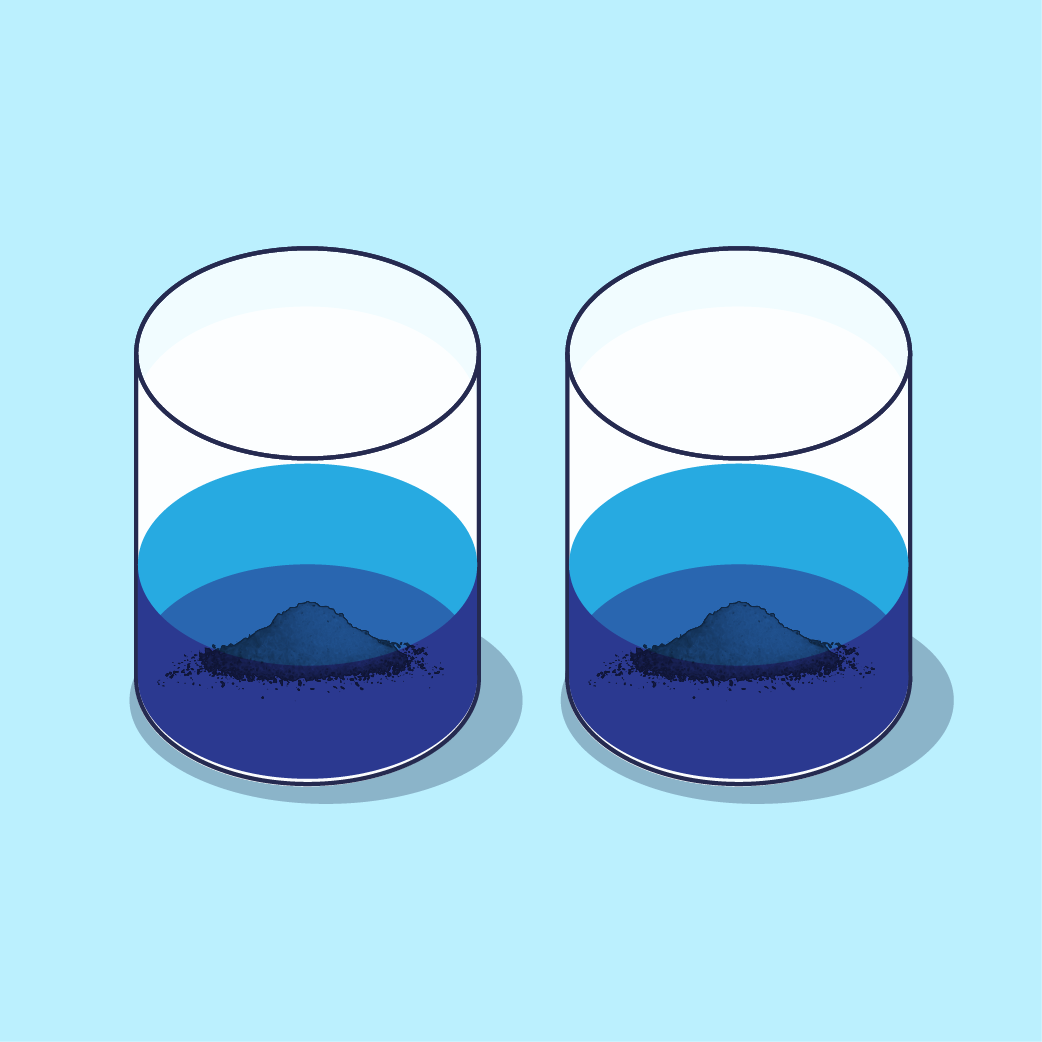
1.2Scientific Investigation in Chemistry
A scientific investigation is a systematic method used by scientists and researchers to solve problems related to science. In chemistry, investigations usually begin with the observation of a phenomenon or problem. Through structured steps—ranging from making observations and forming hypotheses to conducting controlled experiments, interpreting data, and drawing conclusions—scientific methods allow learners to find valid answers to chemical questions, such as how water temperature affects the solubility of salt.
Learning Objectives
- Design an experiment to test a hypothesis.
- Investigate through experiment the effect of temperature on the solubility of salt in water using a scientific method.
Steps in a Scientific Method & Experiment 1.1 Setup
Follow the 11-step scientific investigation flow and see how the solubility of salt is tested at different water temperatures.
11 Steps in the Scientific Method
- Making observations
- Making an inference
- Identifying the problem
- Making a hypothesis
- Identifying the variables
- Controlling the variables
- Planning an experiment
- Collecting data
- Interpreting data
- Making a conclusion
- Preparing a report
Experiment 1.1 Setup
Brief Explanation
Understand the scientific method and how it is applied in Experiment 1.1.
1. Making Observations
Using senses of sight, hearing, touch, taste, or smell to gather information about an object or a phenomenon taking place.
2. Making an Inference
Using data collection and past experience to make a conclusion and explanation about an event.
3. Identifying the Problem
Asking questions based on the inference made.
4. Making a Hypothesis
Making a general statement about the relationship between a manipulated variable and a responding variable to explain an event or observation. This statement can be tested to prove its validity.
5. Identifying the Variables
Identifying the manipulated variable, responding variable, and fixed variable(s) in an experiment to test the hypothesis that is formed.
6. Controlling the Variables
In an investigation, a variable is manipulated to observe its relationship with the responding variable. Simultaneously, other variables are fixed.
7. Planning an Experiment
Determining the materials and apparatus to be used, procedure of the experiment, method of collecting data, and the ways to analyse and interpret the data.
8. Collecting Data
Making observations or measurements and recording the data systematically.
9. Interpreting Data
Organising and interpreting the data collected. Data can be interpreted through calculations, graphs, or charts to find and determine the relationship between the variables.
10. Making a Conclusion
Making a statement on the results of the experiment on whether the hypothesis made is accepted or rejected.
11. Preparing a Report
Communicating in detail on all aspects of the experiment so that the outcome of the experiment can be shared for the development of chemistry knowledge.
| Experiment 1.1 | Details |
|---|---|
| Aim | To study the effect of temperature on the solubility of salt in water. |
| Problem statement | Does the temperature of water affect the solubility of salt in water? |
| Hypothesis | The increase in temperature of water will increase the solubility of salt in water. |
| Manipulated variable | Temperature of water |
| Responding variable | Solubility of salt in water |
| Fixed variables | Volume of water, mass of salt, time |
| Materials | Distilled water and salt. |
| Apparatus | \(150\text{ cm}^3\) beaker, \(100\text{ cm}^3\) measuring cylinder, thermometer, electronic scale, glass rod, Bunsen burner, stopwatch, wire gauze, and tripod stand. |
- Measure \(50\text{ cm}^3\) of distilled water at temperature \(10\text{ }^\circ\text{C}\) with a measuring cylinder and pour it into a beaker.
- Add \(40\text{ g}\) of salt into the beaker and stir the solution with a glass rod for 2 minutes.
- Observe the solubility of salt in the beaker.
- Repeat steps 1 to 3 with distilled water heated at \(30\text{ }^\circ\text{C}\) and \(80\text{ }^\circ\text{C}\).
- Record your observations in Table 1.1 (Temperatures: \(10\text{ }^\circ\text{C}\), \(30\text{ }^\circ\text{C}\), \(80\text{ }^\circ\text{C}\)).
| Temperature (\(^\circ\text{C}\)) | \(10\text{ }^\circ\text{C}\) | \(30\text{ }^\circ\text{C}\) | \(80\text{ }^\circ\text{C}\) |
|---|---|---|---|
| Observation | |
|
|
Check Understanding
Answer the questions, then check your answers.
What is the definition of a hypothesis in a scientific investigation?
In Experiment 1.1, what are the fixed variables kept constant throughout the investigation?
What is the main purpose of the "Making a conclusion" step in the scientific method?
Common Mistakes
Avoid these errors when planning and interpreting a scientific investigation.
Concept Misunderstandings
Compare each misconception with the correct fact.
An experiment is a failure if the results reject the hypothesis.
In the scientific method, the goal of an experiment is to test the validity of the hypothesis. Making a conclusion involves stating whether the hypothesis is accepted or rejected; rejecting a hypothesis provides valid scientific knowledge and leads to new inquiries.
"Controlling the variables" means changing all variables one after another in a single trial.
Controlling variables means only one variable is manipulated while all other identified variables are kept fixed (constant) simultaneously.
Summary
Key facts to remember.
- The scientific method is a systematic approach comprising 11 sequential steps: making observations, making an inference, identifying the problem, making a hypothesis, identifying variables, controlling variables, planning an experiment, collecting data, interpreting data, making a conclusion, and preparing a report.
- In Experiment 1.1, this method is applied to study how water temperature (manipulated variable) influences the solubility of salt (responding variable).
- The fixed variables are water volume, salt mass, and stirring time.
- A conclusion states whether the hypothesis is accepted or rejected.
Short Activity
Complete all parts before checking your score.
A. Objective Quiz
Which of the following is the manipulated variable in Experiment 1.1?
What step in the scientific method involves stating whether the hypothesis is accepted or rejected based on experimental results?
B. Fill in the Blanks
Making a ________ is formulating a general statement about the relationship between a manipulated variable and a responding variable that can be tested to prove its validity.
In Experiment 1.1, the mass of salt added into each beaker of distilled water is ________ g.
C. Match the Scientific Method Step with Its Description
Drag each step on desktop. On mobile, tap a step and then tap the matching box.
Step in Scientific Method
Making observations Making an inference Interpreting data Preparing a reportDescription
Keywords
Tap or hover over a term to read its meaning.


