
8.3 Microorganisms and Viruses
Microorganisms are microscopic organisms that cannot be seen by the naked eye and can only be observed under a microscope. Most microorganisms are unicellular. They are classified into bacteria, protozoa, algae, fungi, and viruses. These entities play essential ecological roles as producers, decomposers, and symbionts, drive vital biogeochemical cycles like the nitrogen cycle, but can also act as pathogens that cause diseases in humans and other living organisms.
Learning Objectives
- State the definition of microorganisms and identify the five main groups: bacteria, protozoa, algae, fungi, and viruses.
- Describe the main characteristics and structures of bacteria, protozoa, algae, fungi, and viruses.
- Explain the role of microorganisms in the nitrogen cycle, including nitrogen fixation, ammonification, nitrification, and denitrification.
- Describe the roles of microorganisms as producers, decomposers, parasites, and symbionts (ectosymbionts and endosymbionts).
- Define pathogens and vectors, identify common disease vectors, and explain the effects of pathogens on human health.
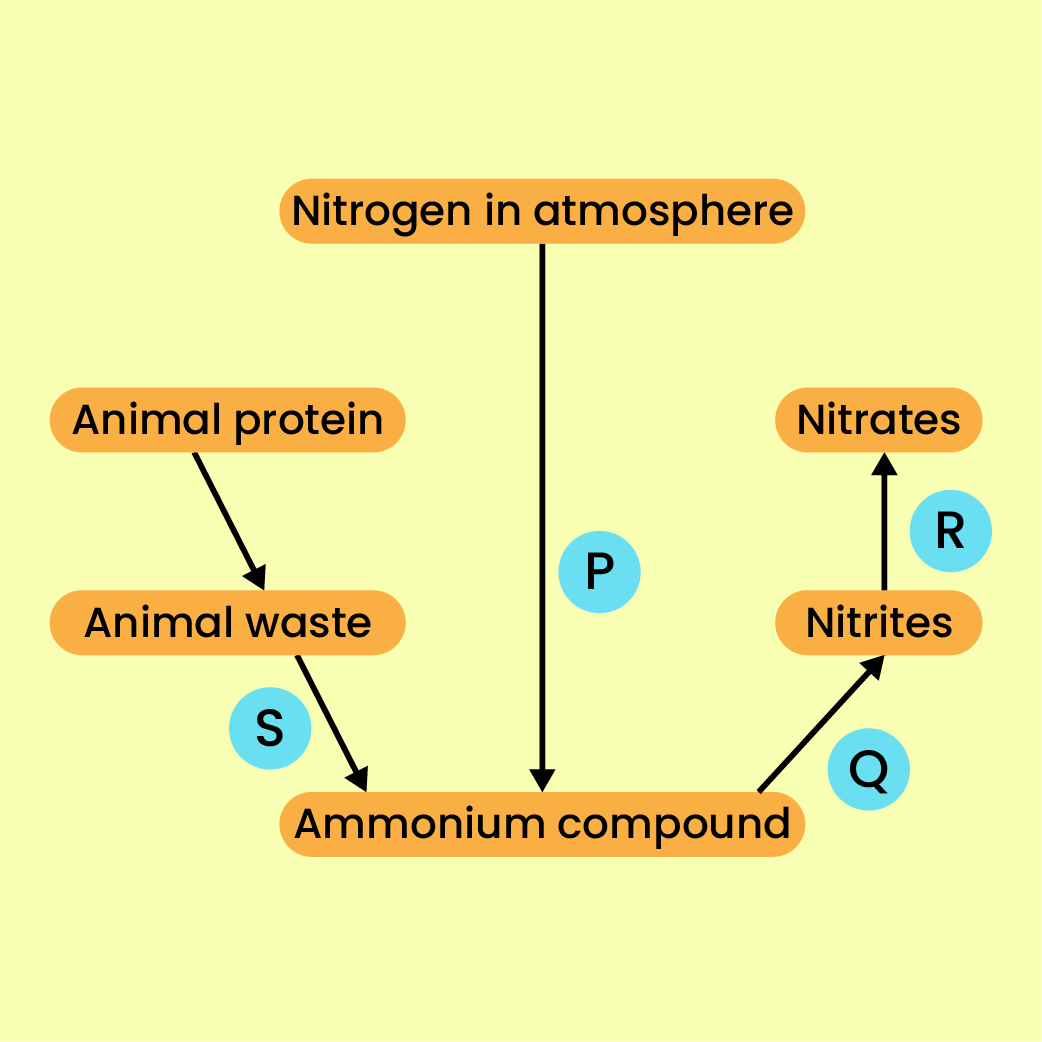
Flowchart of the Nitrogen Cycle & Microorganism Specialisation
Nitrogen gas is converted sequentially into ammonium, nitrites, and nitrates. Each chemical step is driven by a specific genus of bacteria.
Nitrogen fixation
Atmospheric N₂ is converted into NH₄⁺ by Rhizobium sp. and Azotobacter sp.
Ammonification
Decomposers break down dead organisms and animal waste into NH₄⁺.
Nitrification
Nitrosomonas sp. oxidises NH₄⁺ to NO₂⁻; Nitrobacter sp. oxidises NO₂⁻ to NO₃⁻.
Denitrification
Denitrifying bacteria convert soil NO₃⁻ back into atmospheric N₂.
Short Explanation
Definition
Microorganism — a microscopic organism that cannot be seen by the naked eye and can only be observed under a microscope. Most microorganisms are unicellular. They are classified into bacteria, protozoa, algae, fungi, and viruses.
Bacteria
Bacteria are prokaryotes. They lack a membrane-bound nucleus; their chromosomal DNA floats freely in the cytoplasm as a nucleoid. Some bacteria also contain small circular DNA molecules called plasmids. Basic shapes include coccus, vibrio, bacillus, and spirillum.
Protozoa
Protozoa are animal-like unicellular microorganisms, mostly found in aquatic habitats. They move using pseudopodia, cilia, or a flagellum. Amoeba sp. uses pseudopodia, Paramecium sp. uses cilia, and Euglena sp. uses a flagellum. Euglena sp. contains chloroplasts and can carry out photosynthesis.
Algae
Algae can be unicellular, such as Chlamydomonas sp., or multicellular, such as Fucus sp. They live in ponds, lakes, and oceans. Algae possess chloroplasts and are autotrophs, but they lack true leaves, stems, or roots.
Fungi
Fungi lack chlorophyll, making them heterotrophs. Their cell walls are made of chitin. They exist as a mycelium made of thread-like filaments called hyphae. Examples include unicellular yeast (Saccharomyces cerevisiae) and multicellular Mucor sp.
Viruses
Viruses are not included in any biological kingdom because they are non-cellular. They do not carry out life processes outside a host cell. A virus consists of nucleic acid (DNA or RNA) enclosed within a protein coat called a capsid. They are extremely small, visible only under an electron microscope.
Ecological roles
Microorganisms act as producers, decomposers, parasites, and symbionts. Phytoplankton are aquatic primary producers. Saprophytic fungi and bacteria decompose organic matter. Plasmodium sp. is a parasitic protozoan. Ectomycorrhiza is an ectosymbiont, while Trichonympha sp. is an endosymbiont in termites.
Try to Answer First
Answer in your mind, then press “Check Answer”.
Why are viruses not classified into any of the six biological kingdoms?
Name the two nitrifying bacteria involved in converting ammonium ions to nitrate ions and state their respective intermediate products.
Differentiate between an ectosymbiont and an endosymbiont, providing one example of each from the textbook.
Common Mistakes
- Confusing the sequential roles of Nitrosomonas sp. and Nitrobacter sp. Nitrosomonas produces nitrites NO₂⁻, while Nitrobacter produces nitrates NO₃⁻.
- Mistaking viruses for cellular prokaryotes or thinking they can be killed by antibiotics or observed using standard light microscopes.
- Calling all microorganisms parasites; many are photosynthetic autotrophs (phytoplankton) or essential decomposers.
- Confusing a pathogen (the disease-causing agent itself, e.g., Vibrio cholerae) with a vector (the carrier organism, e.g., Musca domestica).
Concept Misunderstandings
Protozoa are tiny plants because some, like Euglena sp., have chloroplasts and perform photosynthesis.
Protozoa are classified as animal-like unicellular microorganisms; Euglena sp. is an autotrophic exception possessing chloroplasts, but protozoa as a whole exhibit animal-like motility and cellular organisation.
Parasites aim to kill their hosts quickly to obtain food.
Parasites derive continuous benefits only as long as the host lives; therefore, most parasites adapt to avoid rapidly killing their hosts.
Summary
- Microorganisms comprise bacteria, protozoa, algae, fungi, and non-cellular viruses.
- Bacteria are prokaryotes with a nucleoid and circular plasmids; protozoa move using pseudopodia, cilia, or flagella; algae are autotrophic; fungi have chitinous walls; viruses consist of nucleic acid and a protein capsid.
- In the nitrogen cycle, Rhizobium sp. and Azotobacter sp. fix nitrogen; Nitrosomonas sp. and Nitrobacter sp. perform nitrification; decomposers carry out ammonification; denitrifying bacteria release nitrogen gas.
- Microorganisms act as aquatic primary producers, decomposers of organic material, symbiotic mutualists, or parasites.
- Pathogens cause cellular damage and release toxins, whereas vectors like mosquitoes, flies, and cockroaches transmit these pathogens to humans.
Short Activity
Objective: identify microorganisms, their roles in the nitrogen cycle, and their effects as pathogens and vectors.
A. Objective Quiz
Which bacterium is responsible for converting nitrite ions (NO₂⁻) into nitrate ions (NO₃⁻) during the nitrification process?
What structural feature is found in the cell wall of fungi?
B. Fill in the Blanks
The non-membrane-bound chromosomal DNA free-floating in the cytoplasm of a bacterium is known as the .
In the fight against dengue in Malaysia, scientists inject bacteria into mosquito eggs to suppress viral growth.
C. Matching / Drag and Drop
Match each disease to its corresponding pathogen type. On a phone, tap a choice first, then tap the matching box. Tap the Answer Choices area to return a selected item.
C. Match the Disease to Its Pathogen Type
Write the correct pathogen type next to each disease.
| Disease | Pathogen Type |
|---|---|
| 1. Hepatitis B | |
| 2. Tuberculosis | |
| 3. Dysentery | |
| 4. Tinea versicolour |
Answer choices: Virus • Bacteria • Protozoa • Fungi

