
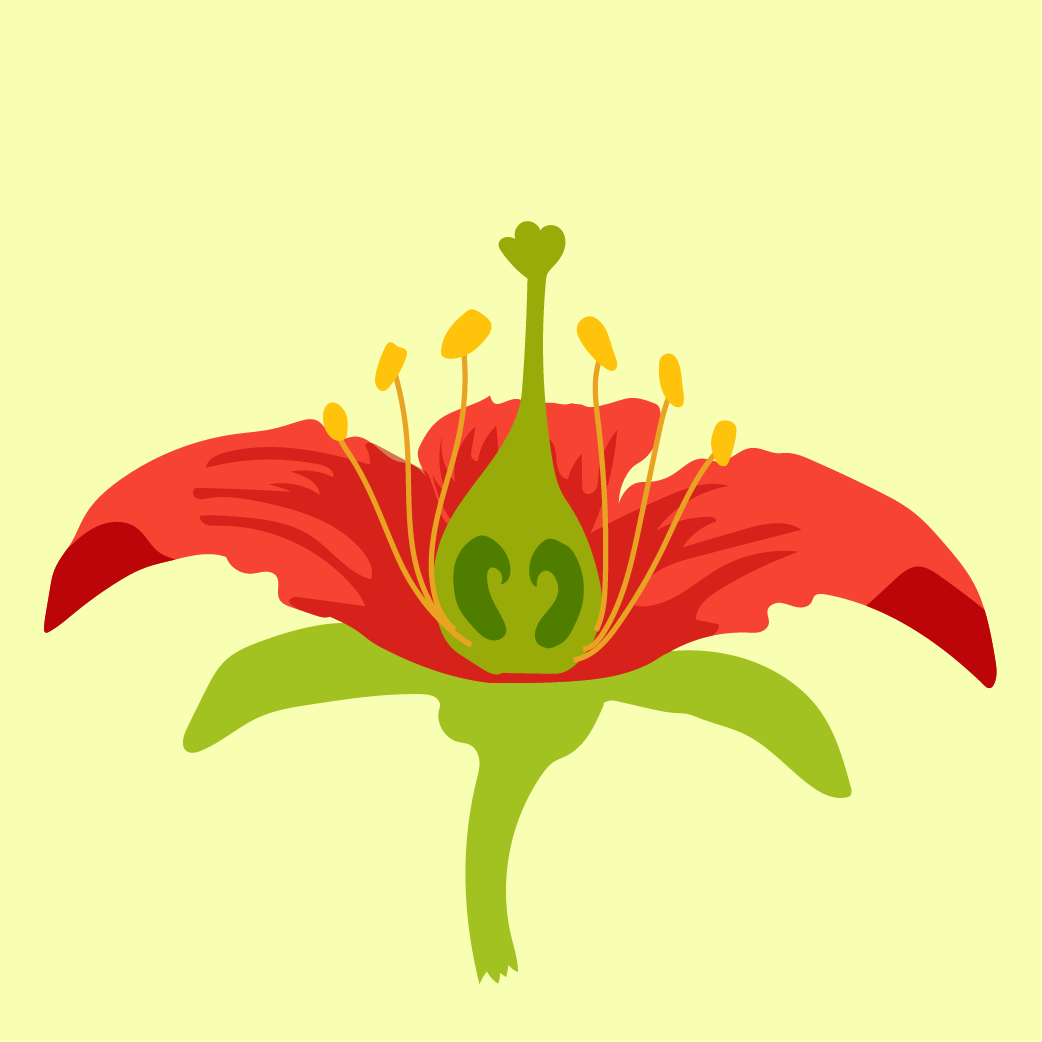
6.4 Development of Seeds and Fruits
Following the process of double fertilisation, significant changes take place in the flower. The triploid nucleus develops into nutritional endosperm tissue, while the diploid zygote undergoes division to form the plant embryo. Simultaneously, the ovule transforms into a protective seed, and the surrounding ovary matures into a fruit, with other floral structures either withering away or persisting in specific forms.
Learning Objectives
- Describe the division of the zygote and the development of the embryo and endosperm after double fertilisation.
- Relate the structures of a flower to the corresponding parts of the fruit and seed.
- Identify the structure of the pericarp and its three distinct layers.
- Classify fruits into simple, aggregate, multiple, and accessory fruits with textbook examples.
Transformation of Floral Parts into Fruit and Seed
A side-by-side comparison illustrating how each specific flower structure develops into a corresponding fruit or seed component.
Ovary → Fruit
The ovary develops into the fruit after fertilisation.
Ovary wall → Pericarp
The ovary wall thickens and swells to become the pericarp, made of exocarp, mesocarp and endocarp.
Ovule → Seed
The ovule develops into the seed inside the fruit.
Integument → Seed coat
The integument of the ovule develops into two layers of seed coat that protect the embryo.
Zygote → Embryo + Suspensor
The larger cell forms the suspensor; the smaller cell forms the embryo with plumule, radicle and cotyledon.
Triploid nucleus → Endosperm tissue
The triploid endosperm nucleus divides by mitosis to form food-storing endosperm tissue.
Short Explanation
Post-fertilisation changes
After fertilisation, the flower undergoes targeted structural changes. The triploid endosperm nucleus divides mitotically to produce nutrient-rich endosperm tissue. The zygote divides into a larger cell and a smaller cell.
Development of the zygote and embryo
The larger cell develops into a suspensor that anchors the embryo to the wall of the embryo sac. The smaller cell develops into an embryo consisting of three main parts: the plumule, the radicle, and the cotyledon.
Development of the seed and fruit
The ovule becomes the seed, shielded by a seed coat formed from the ovule's integuments. The ovary expands to form the fruit, and its wall becomes the pericarp.
Layers of the pericarp
The pericarp is made of three distinct layers: the outer exocarp, the middle mesocarp, and the inner endocarp.
Classification of fruits
Depending on carpel arrangement and floral origin, fruits are classified as simple, aggregate, multiple, or accessory.
Try to Answer First
Answer in your mind, then press “Check Answer”.
What does the larger cell formed by the initial mitotic division of the zygote develop into, and what is its function?
Which part of the flower develops into the pericarp of a fruit, and what are the three layers that make up the pericarp?
How does an aggregate fruit differ from a multiple fruit based on the number of flowers involved?
Common Mistakes
- Confusing the origin of the seed and the fruit: Students often write that the ovary becomes the seed and the ovule becomes the fruit, whereas the ovary becomes the fruit and the ovule becomes the seed.
- Mixing up the functions of the smaller and larger cells of the dividing zygote: The larger cell forms the suspensor, while the smaller cell forms the embryo.
- Confusing aggregate fruits (numerous carpels in one single flower) with multiple fruits (carpels from a cluster of flowers).
Concept Misunderstandings
The suspensor becomes part of the permanent adult plant structure.
The suspensor only serves an embryonic function by anchoring the embryo to the embryo sac wall to receive nutrients; it does not form the shoot or root of the mature plant.
All edible parts of all fruits always develop purely from the ovary wall.
Accessory fruits (such as apples) develop from tissues near the carpel that are not part of the ovary.
Summary
- Endosperm: Formed from the triploid endosperm nucleus by mitosis; stores food and nourishes the embryo.
- Zygote division: Larger cell → suspensor (anchors embryo); smaller cell → embryo (plumule, radicle, cotyledon).
- Ovule → Seed: Integuments become two layers of protective seed coat.
- Ovary → Fruit: Ovary wall becomes pericarp (exocarp, mesocarp, endocarp).
- Fruit Classification:
- Simple: Single carpel or fused carpels from one flower (e.g., peas).
- Aggregate: Numerous separate carpels from one flower (e.g., raspberry).
- Multiple: Carpels from a cluster of flowers (e.g., pineapple).
- Accessory: Develops from floral tissues near the carpel outside the ovary (e.g., apple).
Short Activity
Objective: identify the post-fertilisation changes and classify fruit types.
A. Objective Quiz
Which of the following floral structures develops into the seed coat after fertilisation?
A pineapple develops from the carpels of a cluster of flowers. Which type of fruit is a pineapple?
B. Fill in the Blanks
During embryo development, the larger cell produced by the zygote's mitotic division develops into a that anchors the embryo to the wall of the embryo sac.
The ovary wall develops into the of the fruit, which consists of the exocarp, mesocarp, and endocarp.
C. Matching / Drag and Drop
Match each fruit type to its correct textbook description. On a phone, tap a choice first, then tap the matching box. Tap the Answer Choices area to return a selected item.
C. Match the Fruit Type to Its Description
Write the correct fruit type next to each description.
| Description | Fruit Type |
|---|---|
| 1. Develops from a single carpel or several carpels fused together in a single flower. | |
| 2. Develops from numerous carpels in a single flower. | |
| 3. Develops from carpels of a cluster of flowers. | |
| 4. Develops from a tissue that is not in the ovary but from some tissues near the carpel. |
Answer choices: Simple fruit • Aggregate fruit • Multiple fruit • Accessories fruit

