
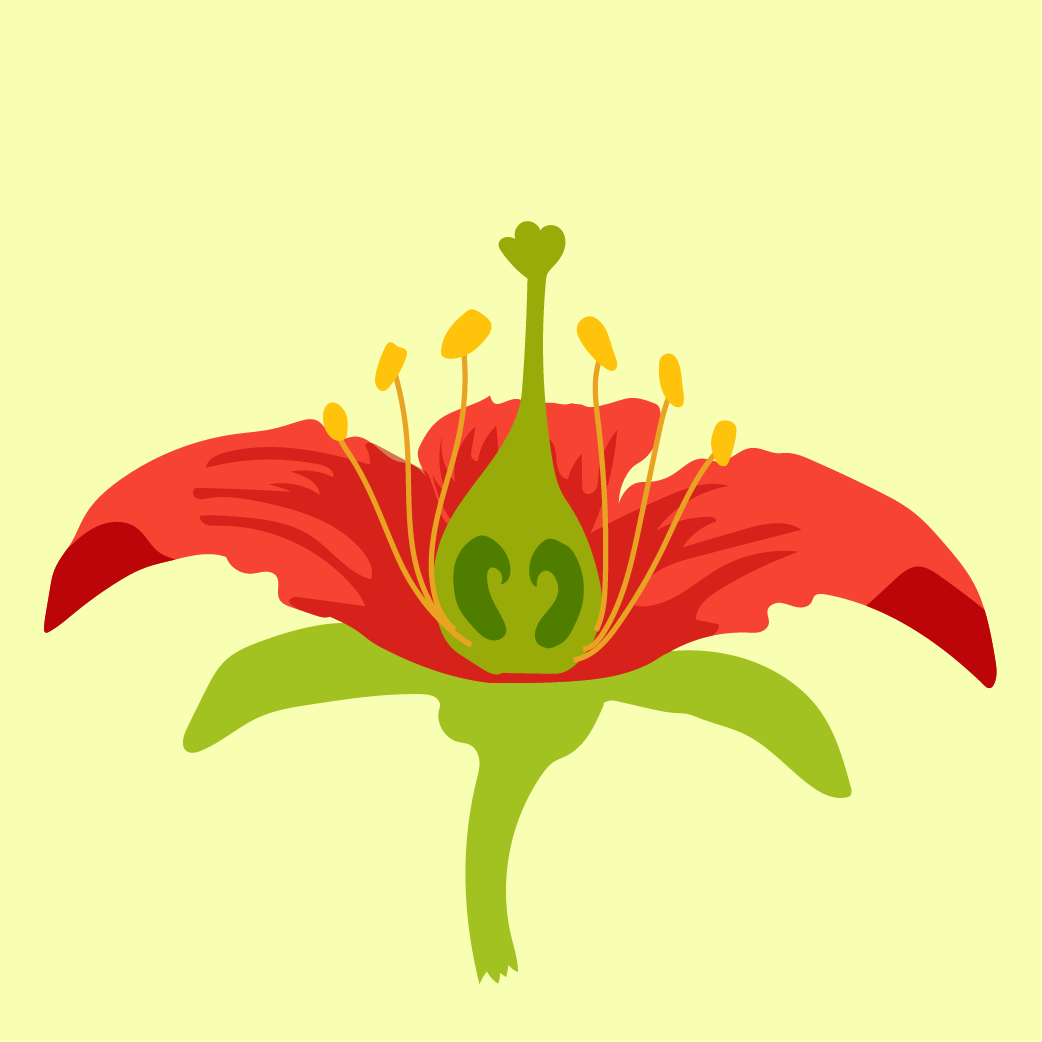
6.1 Structure of a Flower
Flowers are the most distinctive reproductive organs in angiosperms. Their beauty and scent attract animals and insects, helping to ensure the survival of the species. A complete flower typically contains both male and female reproductive organs, along with non-reproductive supporting structures such as peduncles, sepals, and petals.
Learning Objectives
- Identify and label the structures of a flower: petal, sepal, peduncle, stamen (anther and filament), and carpel (stigma, style, ovary, and ovule).
- State the functions of the male and female reproductive structures as well as other floral parts.
- Compare the similarities and differences between the male and female reproductive structures of a flower.
- Describe the nature of bisexual flowers (hermaphrodites) such as lilies and hibiscus.
Longitudinal Section and Parts of a Flower
A colour-coded cut-away diagram of a flower showing the male structures (stamen: anther and filament), female structures (carpel: stigma, style, ovary, ovule), and supporting organs (petal, sepal, peduncle).
Male — Stamen
Anther + Filament. Produces pollen grains.
Female — Carpel
Stigma + Style + Ovary + Ovule. Produces the embryo sac.
Supporting structures
Petal, sepal and peduncle. Non-reproductive.
Short Explanation
What is a flower?
Flowers are specialised reproductive shoots of angiosperms. The male reproductive part is the stamen, while the female reproductive part is the carpel, located in the centre of the flower. Flowers that bear both organs in one blossom are termed bisexual or hermaphroditic.
Male reproductive organ — Stamen
The anther contains pollen sacs where pollen grains (male gametophytes) are produced. The filament is a stalk that holds and projects the anther out from the base of the ovary.
Female reproductive organ — Carpel
The stigma is a sticky surface that receives pollen grains. The style joins the stigma to the ovary. The ovary contains one or more ovules, each containing an embryo sac.
Supporting structures
The peduncle is the flower stalk that supports the flower. The sepal protects the flower bud before it opens. The petal is distinctively coloured and scented to attract pollinators.
Bisexual flowers
Flowers that have both male and female reproductive organs within the same flower are known as bisexual flowers or hermaphrodites, for example lilies and Hibiscus sp.
| Characteristic | Male Flower Part (Stamen) | Female Flower Part (Carpel) |
|---|---|---|
| Constituent Organ | Consists of stamen | Consists of carpel |
| Composing Structures | Has filament and anther | Has stigma, style, and ovary |
| Product Formed | Produces pollen grains | Produces embryo sac |
| Position / Location | Projecting out from the base of the ovary | Located in the middle part of the flower |
Similarities between male and female structures
Both produce gametes, and both are located at the flower's organ.
Bio Exploration — Variation in flower parts
The number of stamens varies across species. The rosary pea has a single stamen, while the saguaro cactus (Sonoran Desert, Arizona) has the highest recorded number of stamens: 3,482 stamens in a single flower.
Try to Answer First
Answer in your mind, then press “Check Answer”.
What are the two structures that make up the stamen?
State the main difference between the location of the carpel and the stamen in a typical flower.
Why are plants like lilies referred to as hermaphrodites?
Common Mistakes
- Confusing the stamen with the carpel or mixing up their component parts, for example placing the stigma under the stamen instead of the carpel.
- Stating that petals are reproductive organs. Petals and sepals are sterile, non-reproductive supporting structures.
- Misidentifying the product of the carpel as only the ovule, rather than stating it produces the embryo sac.
Concept Misunderstandings
Flowers only contain either male or female organs.
Many flowering plants are bisexual (hermaphroditic), containing both stamens and carpels in the same flower.
The style produces ovules.
The style is simply a supporting neck connecting the stigma to the ovary; the ovules are produced inside the ovary.
Summary
- The stamen is the male organ (composed of anther and filament) and produces pollen grains.
- The carpel is the female organ (composed of stigma, style, and ovary containing ovules) and produces the embryo sac.
- Supporting structures include the peduncle (stalk), sepal (bud protection), and petal (attracts pollinators).
- Flowers having both stamens and carpels within the same flower are called bisexual flowers or hermaphrodites.
Short Activity
Objective: identify the structures of a flower and their functions.
A. Objective Quiz
Which of the following structures constitutes the male reproductive organ of a flower?
What is produced by the female reproductive organ of a flowering plant?
B. Fill in the Blanks
Organisms such as lilies that possess both male and female reproductive organs in the same flower are called .
In a flower, the stalk that supports the anther and projects it outward is called the .
C. Matching / Drag and Drop
Match each flower structure to its correct definition or description. On a phone, tap a choice first, then tap the matching box. Tap the Answer Choices area to return a selected item.
C. Match the Flower Structure to Its Description
Write the correct flower structure next to each description.
| Description / Function | Flower Structure |
|---|---|
| 1. Pollen sac-bearing structure that produces pollen grains | |
| 2. Receptive surface at the tip of the carpel that receives pollen grains | |
| 3. Brightly coloured and scented part evolved to attract pollinators | |
| 4. Stalk that supports the entire flower |
Answer choices: Anther • Stigma • Petal • Peduncle

