
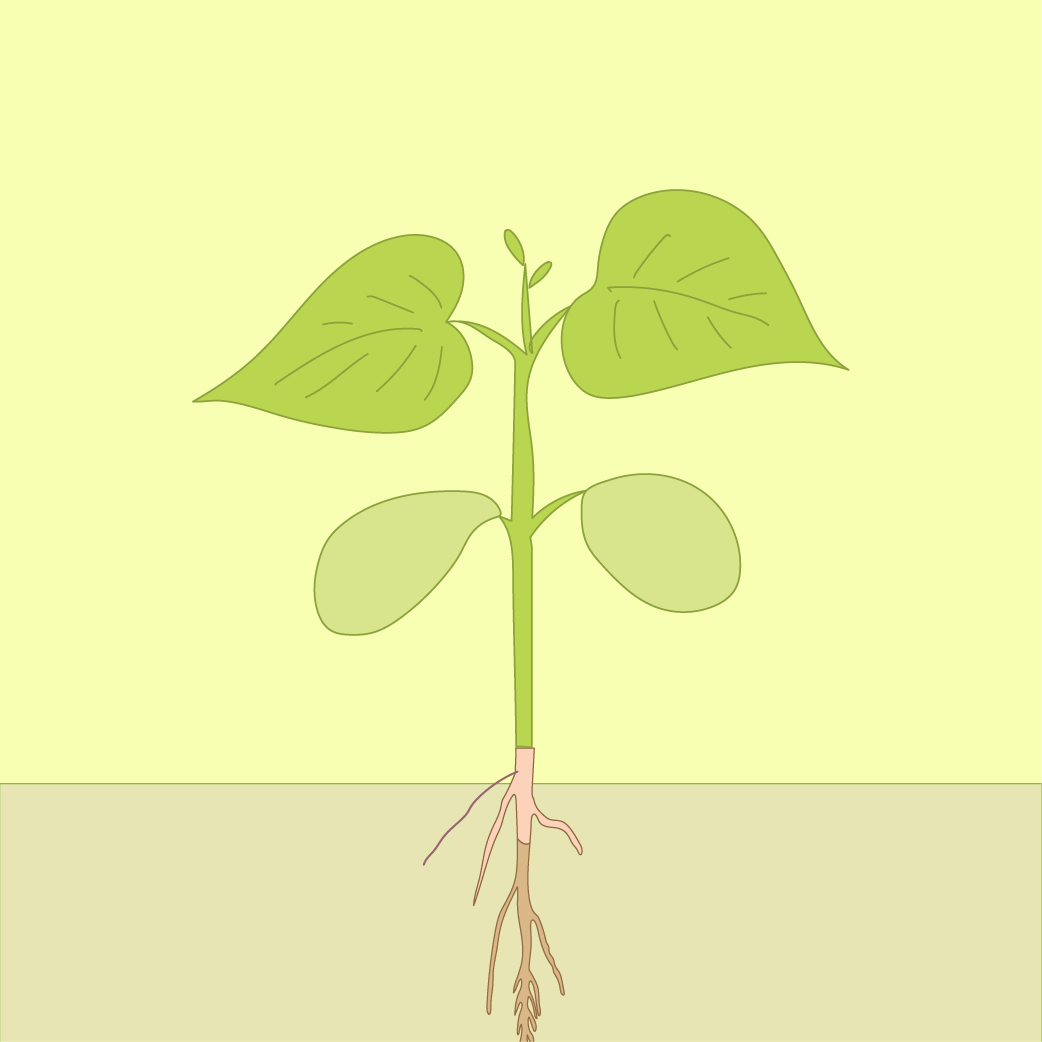
5.2 Phytohormone
Plants do not have a nervous or endocrine system. Their responses are coordinated by chemical messengers called phytohormones, which act at low concentrations and are transported through the phloem.
Learning Objectives
- Define phytohormones and identify their transport tissue in plants.
- State the main functions of five phytohormones: auxin, gibberellin, cytokinin, abscisic acid, and ethylene.
- Explain the effects of varying auxin concentrations on shoot and root cell elongation.
- Explain the role of auxin in phototropism and geotropism.
Auxin Distribution and Differential Growth in Geotropism
Gravity causes auxin to accumulate at the lower side of a horizontal seedling. The shoot bends upwards while the root bends downwards because shoot and root cells respond differently to the same auxin concentration.
Shoot response
High auxin at the lower side stimulates cell elongation. The lower side grows faster, so the shoot bends upwards.
Root response
High auxin at the lower side inhibits cell elongation. The upper side grows faster, so the root bends downwards.
Same signal, opposite result
Shoot and root cells have different sensitivities to auxin, producing opposite growth curvatures.
Short Explanation
Definition and transport
Phytohormones are chemical substances that stimulate and coordinate responses in plants at low concentrations. They are synthesised in specific plant organs and transported to target organs through the phloem.
Auxin
Functional in phototropism and geotropism. Stimulates apical dominance, cell elongation, adventitious roots, and cambium cell division. Inhibits abscission of fruits and young leaves, and inhibits lateral bud growth.
Gibberellin
Stimulates stem elongation, leaf, flower and fruit development, seed germination, and growth of flowers in dwarf plants. Inhibits root development.
Cytokinin
Stimulates cell division and elongation when auxin is present, seed germination, and lateral bud growth. Delays leaf senescence and inhibits apical dominance.
Abscisic acid and ethylene
Abscisic acid inhibits growth, induces seed dormancy and stomatal closing during drought. Ethylene stimulates fruit ripening, senescence, and abscission of leaves and fruits.
Effects of auxin concentration
Auxin is synthesised at coleoptile tips and stimulates cell elongation. Uniform distribution causes straight upward growth. Uneven distribution causes the side with more auxin to grow faster, curving the coleoptile towards the side with less auxin. Shoots respond best to high auxin concentrations, while roots require very low auxin concentrations; high auxin inhibits root cell elongation.
Try to Answer First
Answer in your mind, then press “Check Answer”.
Why does a shoot tip bend towards unidirectional light?
Why should a fruit seller separate overly ripe apples from other ripe apples?
How does auxin cause the root of a horizontal seedling to exhibit positive geotropism?
Common Mistakes
- Assuming that high auxin concentrations always stimulate growth in every part of a plant; in reality, high auxin concentrations inhibit cell elongation in roots.
- Thinking that auxin moves towards light; in phototropism, auxin actively moves away from the light source towards the shaded side.
- Confusing abscisic acid with gibberellin; gibberellin promotes seed germination, whereas abscisic acid maintains seed dormancy and inhibits germination.
Concept Misunderstandings
Plant responses occur instantaneously just like human nerve reflexes.
Plants lack nervous and endocrine systems; their responses depend on chemical phytohormones synthesised and transported through the phloem, meaning responses typically require hours or days to become visible.
The root bends downward because gravity pulls the cells down physically.
The bending is an active physiological growth response: auxin accumulation at the bottom inhibits cell elongation there, while the upper cells continue to elongate, turning the root downward.
Summary
- Phytohormones are chemical substances that stimulate and coordinate plant responses at low concentrations, transported mainly via the phloem.
- Auxin governs phototropism, geotropism, apical dominance, and cell elongation.
- Gibberellin promotes stem elongation, flowering, and seed germination.
- Cytokinin stimulates cell division and lateral bud growth, opposing apical dominance.
- Abscisic acid acts as a growth inhibitor, inducing seed dormancy and closing stomata during drought.
- Ethylene is a gaseous hormone stimulating fruit ripening, abscission, and senescence.
- Auxin causes differential cell elongation: high concentrations stimulate shoot elongation but inhibit root elongation.
Short Activity
Objective: check your understanding of phytohormone functions and auxin-regulated growth responses.
A. Objective Quiz
Which phytohormone induces stomatal closure during drought seasons to reduce water loss?
An experiment places an impermeable mica sheet horizontally across the shaded side of a shoot tip exposed to unidirectional light. Why does the shoot fail to bend towards the light?
B. Fill in the Blanks
Phytohormones are chemical substances synthesised in specific plant organs and transported to target organs through the .
In a horizontally placed seedling, high auxin concentration at the bottom side of the root tip cell elongation.
C. Matching / Drag and Drop
Drag each phytohormone to its primary function. On a phone, tap a choice first, then tap the matching box. Tap the Answer Choices area to return a selected item.
C. Match the Phytohormone to Its Function
Write the correct phytohormone next to each function.
| Function | Phytohormone |
|---|---|
| 1. Stimulates apical dominance and causes positive phototropism in shoots | |
| 2. Stimulates germination of seeds and causes growth of flowers in dwarf plants | |
| 3. Delays leaf senescence and stimulates the growth of lateral buds | |
| 4. Stimulates fruit ripening and abscission of leaves and fruits |
Answer choices: Auxin • Gibberellin • Cytokinin • Ethylene

