
4.1 Vascular Tissues
Learn about the necessity of transport in plants and the structural adaptations of xylem and phloem tissues.
Learning Objectives
- Explain the necessity of transport in plants.
- Identify the two main vascular tissues: xylem and phloem, along with their primary transport functions.
- Describe the structural adaptations of xylem vessels and tracheids to transport water and mineral salts, and provide mechanical support.
- Describe the structural adaptations of sieve tubes and companion cells to transport organic substances.
Comparison of Structural Adaptations in Xylem and Phloem
A side-by-side comparative summary of xylem vessels, tracheids, sieve tubes, and companion cells showing cell viability, wall thickening, and structural specialisations.
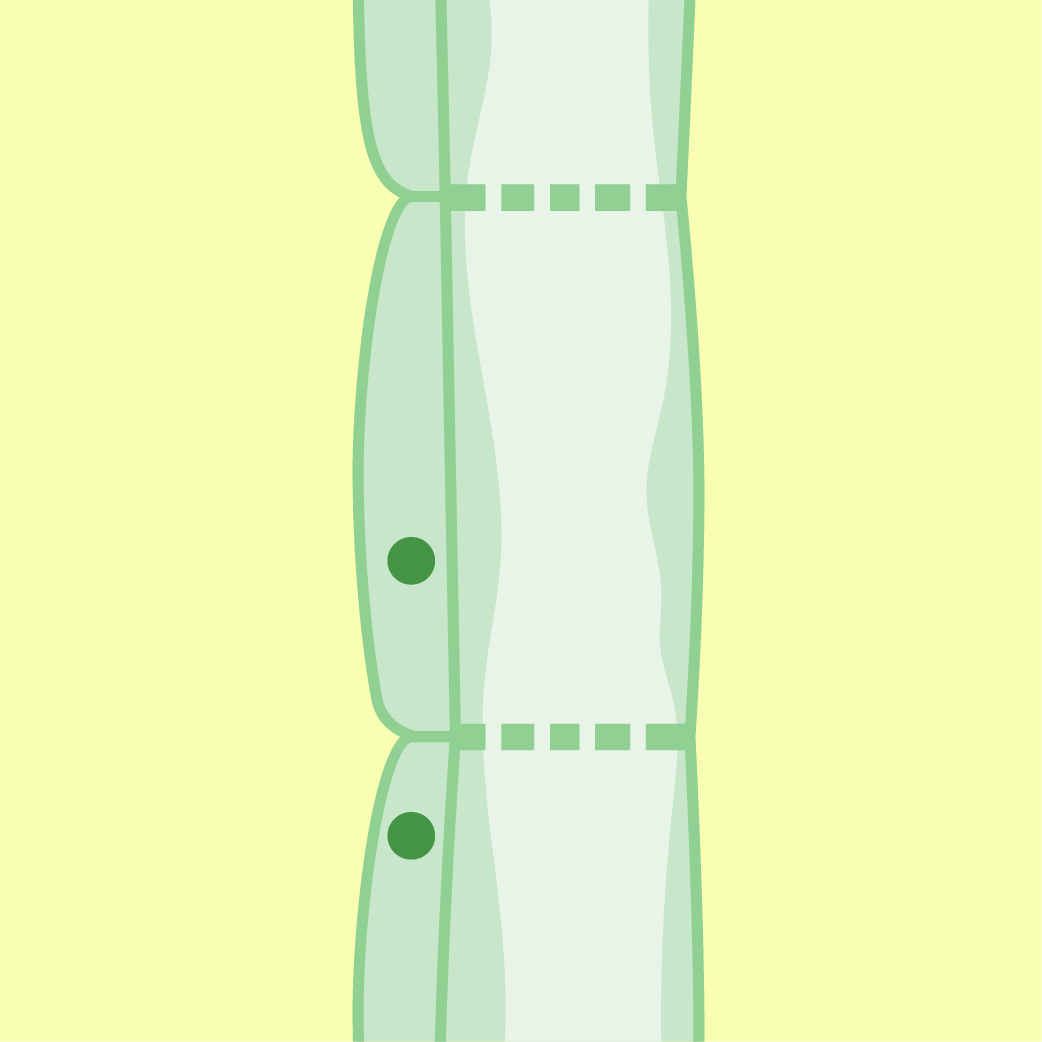
Xylem Vessel
Dead hollow tube arranged longitudinally end to end with uneven lignin thickening to transport water and give strength.
Tracheid
Elongated cell with lignified walls and pits to facilitate lateral water movement to adjacent cells.
Sieve Tube
Living conducting cell without a nucleus or vacuole, interconnected by perforated end plates.
Companion Cell
Living cell packed with mitochondria to generate ATP for active transport of sucrose.
Short Explanation
Why plants need transport systems
Plants are large and tall multicellular organisms made of cells requiring water and nutrients. Their total surface area is insufficient to absorb basic needs directly from the surroundings via diffusion alone. Vascular tissues allow the transport of water, mineral salts, and nutrients to all living cells.
Vascular plants
Plants that possess a transport system. Examples include trees and flowering plants in tropical rainforests.
Non-vascular plants
Plants that do not have a transport system. Examples include algae such as the giant brown macro alga Macrocystis pyrifera, which can grow up to 60 m high without a transport system, and moss.
Xylem
Transports water and mineral salts absorbed by roots upwards to stems and leaves. It also provides mechanical support to the plant.
Phloem
Transports organic compounds such as sucrose, amino acids, and plant hormones synthesised by leaves through photosynthesis to stems and roots.
Historical context
In 1858, botanist Carl Nägeli introduced the names xylem and phloem for these plant transport tissues.
Xylem vessels
Consist of dead cells at maturity that lack cytoplasm, forming hollow conduits. Cells are joined and arranged longitudinally end to end to form a continuous hollow tube, allowing unobstructed flow of water from roots to leaves. Vessel cell walls have uneven lignin thickening, which gives mechanical strength to prevent vessels from collapsing under tension forces and negative pressure changes during water movement, and prevents the plant from bending or breaking.
Tracheids
Elongated cells with tapering ends. Cell walls are thickened with lignin for mechanical strength. They contain pits on the walls to allow water and mineral salts to pass laterally to adjacent cells.
Sieve tubes
Mature sieve tube cells lack nuclei, ribosomes, and vacuoles. This hollow cytoplasm reduces resistance and allows sucrose molecules and other solutes to pass through easily. At both ends of each sieve tube cell, there is a perforated cross-wall called a sieve plate with pores, allowing the continuous flow of organic solutes from one sieve tube element to the next.
Companion cells
Closely associated with sieve tube cells. They contain dense cytoplasm and abundant mitochondria. Mitochondria produce energy in the form of ATP through cellular respiration. This ATP powers the active transport of sucrose from photosynthetic mesophyll cells in leaves into sieve tubes.
Activity 4.1: Observing Xylem in Celery Stalk
Aim: To observe the structure of xylem in a longitudinal cross-section of a celery stalk.
Procedure:
- Add 5 drops of red dye to 150 ml of distilled water in a 250 ml beaker and mix thoroughly.
- Immerse a celery stalk in the red dye solution for one hour.
- Rinse the stalk with distilled water, cut a thin cross-section horizontally with a sharp knife, mount it on a slide with a drop of water, cover with a cover slip, and examine under low-power and high-power microscope objectives.
Observation & Discussion: The red dye is transported only in the xylem tissues, staining them red. In herbaceous plants lacking woody tissues, turgor pressure of cells and the lignified walls of xylem vessels provide essential mechanical support.
Try to Answer First
Answer in your mind, then press “Check Answer”.
Do all plants require a vascular transport system? Explain your answer with an example.
A tree trunk is infected by a bacterial pathogen that damages its xylem vessels. Predict two consequences to the tree.
Sieve tube elements lack nuclei and have very few mitochondria. How do they obtain the energy required for the active transport of sucrose?
Common Mistakes
- Confusing the living status of xylem and phloem: assuming both are dead tissues. Xylem vessels and tracheids are dead at maturity, whereas phloem (sieve tubes and companion cells) is a living tissue.
- Thinking sieve tubes are completely dead because they lack nuclei and vacuoles; sieve tubes retain living cytoplasm and plasma membranes.
- Stating that companion cells transport water; companion cells only assist sieve tubes in loading and unloading organic solutes such as sucrose using ATP.
- Assuming lignin is present in phloem cell walls; lignin thickening is a key characteristic of xylem vessels and tracheids, not sieve tubes.
Concept Misunderstandings
Algae are large, so giant kelp like Macrocystis pyrifera must possess vascular tissues like terrestrial trees.
Macrocystis pyrifera is a non-vascular brown macro alga that can grow up to 60 m long in the ocean without any vascular transport system.
Lignin in xylem vessels is strictly to keep water inside the tube.
Lignin is deposited unevenly primarily to provide mechanical strength, preventing the vessel from collapsing under the negative pressure/tension generated when water is pulled upwards, and preventing the stem from bending.
Xylem and phloem both transport substances in both directions.
Xylem transports water and minerals unidirectionally upwards from roots to stems and leaves, whereas phloem transports organic nutrients from leaves to both growing stems and storage roots.
Summary
- Need for Transport: Large size and small surface area to volume ratio prevent sufficient absorption via simple diffusion.
- Vascular vs Non-vascular: Vascular plants have xylem and phloem; non-vascular plants (e.g., moss, Macrocystis pyrifera) lack vascular tissues.
- Xylem: Composed of xylem vessels and tracheids. Dead at maturity, without cytoplasm. Lignin thickening provides mechanical strength and prevents collapse. Pits in tracheids allow lateral water movement. Transports water and mineral salts from roots to leaves.
- Phloem: Composed of sieve tubes and companion cells. Living cells with cytoplasm. Sieve tubes lack nuclei, vacuoles, and ribosomes to facilitate easy flow of sucrose. Sieve plates with pores connect adjacent sieve tube elements. Companion cells contain numerous mitochondria to generate ATP for active transport of sucrose.
Short Activity
Objective: identify structural adaptations of xylem and phloem tissues.
A. Objective Quiz
Which of the following is a structural feature of xylem vessels that prevents them from collapsing under tension forces?
Why do mature sieve tube elements lack nuclei, ribosomes, and vacuoles?
B. Fill in the Blanks
Companion cells contain numerous to provide energy in the form of ATP for active transport.
The cell wall of a tracheid contains lignin thickening and that allow water movement to adjacent cells.
C. Matching / Drag and Drop
Match each vascular cell type or structure to its correct structural adaptation or function. On a phone, tap a choice first, then tap the matching box. Tap the Answer Choices area to return a selected item.
C. Match the Cell / Structure to Its Adaptation and Function
Write the correct cell or structure next to each adaptation and function.
| Adaptation and Function | Cell / Structure |
|---|---|
| 1. Dead hollow tube arranged longitudinally end to end with uneven lignin thickening to transport water and give strength | |
| 2. Elongated cell with lignified walls and pits to facilitate lateral water movement to adjacent cells | |
| 3. Living conducting cell without a nucleus or vacuole, interconnected by perforated end plates | |
| 4. Living cell packed with mitochondria to generate ATP for active transport of sucrose |
Answer choices: Xylem vessel • Tracheid • Sieve tube • Companion cell

