
2.4 Main Organ for Photosynthesis
Photosynthesis is the fundamental biological process through which autotrophic plants synthesize their own food using light energy, carbon dioxide, and water. While green stems and other green parts can carry out photosynthesis, the leaf is the principal photosynthetic organ. Within the leaf, specialized tissues and the internal architecture of chloroplasts are adapted to capture light energy and convert it into chemical energy in the form of glucose. Understanding the two interconnected stages—light-dependent and light-independent reactions—and the environmental factors that govern their rates provides vital insight into plant growth, crop productivity, and atmospheric gas balance.
Learning Objectives
- State the necessity of photosynthesis in autotrophic plants.
- Relate the history of the discovery of photosynthesis through the experiments of Jan-Baptista van Helmont and Joseph Priestley.
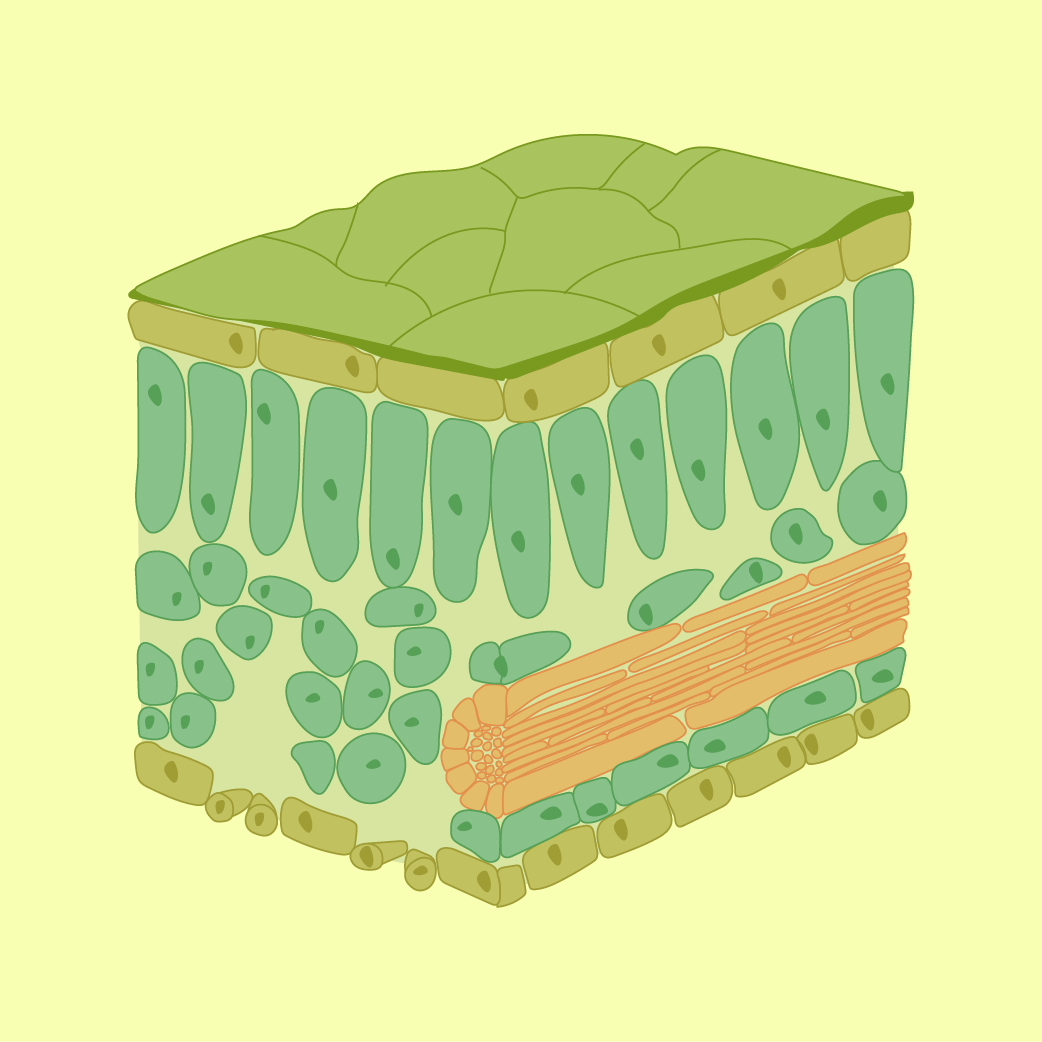
- Relate the adaptation of the internal structure of a leaf to the process of photosynthesis.
- Identify the structure of a chloroplast (outer membrane, inner membrane, thylakoid, granum, stroma, and lamellae) and its adaptations.
- Explain the separation of photosynthetic pigments using paper chromatography and the calculation of \(R_f\) values.
- Describe the mechanisms of the light-dependent reaction and light-independent reaction in photosynthesis.
- Compare and contrast the light-dependent and light-independent reactions.
- Explain the environmental factors affecting the rate of photosynthesis: light intensity, light colour, carbon dioxide concentration, and temperature.
Summary of Photosynthesis: Dual Stages, Chloroplast Compartments, and Limiting Factors
A comprehensive overview showing where light-dependent and light-independent reactions take place inside the chloroplast, how they connect via ATP/NADPH, and how external factors govern the rate.
Light-Dependent Reaction
Occurs in the thylakoid membranes. Light energy excites electrons, photolyses water, and produces ATP, NADPH and oxygen.
Light-Independent Reaction
Occurs in the stroma. ATP and NADPH drive the reduction of carbon dioxide to synthesize glucose.
Limiting Factors
Light intensity, light colour, carbon dioxide concentration and temperature govern the rate of photosynthesis.
Short Explanation
Definition
Photosynthesis converts solar energy into chemical energy stored in glucose. Inside the leaf, the upper transparent cuticle lets light reach the palisade cells, which are densely packed with chloroplasts. Each chloroplast contains thylakoid membranes arranged into stacks called grana, bathed in a fluid called stroma. In the thylakoids, light energy excites electrons from chlorophyll, photolyses water to release oxygen, and produces ATP and NADPH. In the stroma, ATP and NADPH drive the reduction of carbon dioxide to synthesize glucose (light-independent reaction). The speed of photosynthesis depends on light intensity, light colour (highest in red and blue), carbon dioxide concentration, and an optimum temperature range (\(25^\circ\text{C}\)–\(30^\circ\text{C}\)) governed by enzyme activity.
The Necessity of Photosynthesis
Plants are autotrophic organisms that produce glucose through photosynthesis. Glucose is oxidized by living organisms to release energy needed for growth, reproduction, and living processes.
History of Discovery
Jan-Baptista van Helmont (1640s) planted a \(2.3\text{ kg}\) seedling in \(90\text{ kg}\) of dried soil and watered it for 5 years. The plant grew to \(77\text{ kg}\) while the soil remained \(90\text{ kg}\). He concluded that the plant grew by only being watered and not from the soil. Joseph Priestley (1772) showed that a rat placed in an inverted glass jar died, but when a plant was placed inside the jar with a rat, the rat lived. He concluded that plants release oxygen into the atmosphere.
Internal Leaf Adaptations
The upper and lower epidermis have a transparent waxy cuticle that allows sunlight to penetrate into the palisade mesophyll. Stomata, mostly on the lower epidermis, open in the presence of light to allow gaseous exchange. The palisade mesophyll is closely packed with chloroplasts to absorb sunlight at a maximum rate. The spongy mesophyll contains fewer chloroplasts and has large air spaces for efficient gas exchange. Vascular bundles contain xylem, which transports water and mineral salts from the roots, and phloem, which transports sucrose from the leaf to all parts of the plant.
Chloroplast Structure
The chloroplast is enclosed by an outer membrane and an inner membrane. Thylakoids are disc-shaped sacs containing chlorophyll; their membranes house photosynthetic pigments that trap sunlight. A granum is a stack of thylakoids that increases surface area for optimal photosynthesis. The stroma is the colourless fluid surrounding grana and is the site of the light-independent reaction. Lamellae are connecting membranes between grana.
Paper Chromatography
Chromatography separates components based on their differences in solubility in specific solvents. Pigment extraction uses \(80\%\) acetone and fine sand. The developing solvent consists of 1 part acetone and 9 parts petroleum ether. The retention factor is \(R_f = \dfrac{\text{Distance travelled by pigment}}{\text{Distance travelled by solvent}}\). Pigment colours and \(R_f\) values: carotenoid (orange, \(R_f = 0.95\)), pheophytin (grey, \(R_f = 0.70\)), chlorophyll a (blue/greenish, \(R_f = 0.60\)), chlorophyll b (green, \(R_f = 0.50\)), xanthophyll (yellow, \(R_f = 0.35\)).
Light-Dependent Reaction
Occurs in the thylakoids. Photosynthetic pigments absorb light energy, exciting electrons in chlorophyll to a higher energy level. Excited electrons pass through a series of electron carriers, generating ATP. Electrons are accepted by the terminal electron acceptor, \(\text{NADP}^+\), which combines with \(\text{H}^+\) from photolysis to form \(\text{NADPH}\). Chlorophyll regains electrons via the photolysis of water. Photolysis breaks down water molecules into hydrogen ions (\(\text{H}^+\)) and hydroxide ions (\(\text{OH}^-\)) using light energy and chlorophyll. Hydroxide ions lose electrons to form oxygen (\(\text{O}_2\)) and water (\(\text{H}_2\text{O}\)).
Light-Independent Reaction / Calvin Cycle
Occurs in the stroma. 5-carbon organic compounds fix carbon dioxide (\(\text{CO}_2\)) gas to form 6-carbon organic compounds. \(\text{NADPH}\) and \(\text{ATP}\) from the light-dependent reaction reduce these organic compounds into glucose monomers. Glucose monomers condense into starch molecules, stored as starch granules in the stroma. The overall chemical equation is:
\[12\text{H}_2\text{O} + 6\text{CO}_2 \xrightarrow[\text{Chlorophyll}]{\text{Light energy}} \text{C}_6\text{H}_{12}\text{O}_6 + 6\text{O}_2 + 6\text{H}_2\text{O}\]
Comparison of the Two Reactions
Similarities: Both take place inside the chloroplast and are catalysed by enzymes.
Differences: The light-dependent reaction occurs in the thylakoids, consumes water, produces oxygen and water molecules, produces ATP, and involves photolysis of water. The light-independent reaction occurs in the stroma, consumes carbon dioxide, produces glucose, uses ATP, and involves reduction of carbon dioxide.
Environmental Factors
Carbon dioxide concentration: Increasing \(\text{CO}_2\) concentration increases the photosynthetic rate until a saturation point (\(P\)), where another factor becomes limiting.
Light intensity: Photosynthetic rate increases with light intensity up to light saturation point \(P\). Beyond \(P\), rate plateaus because it is limited by temperature or \(\text{CO}_2\) concentration. Increasing environmental \(\text{CO}_2\) (e.g., from \(0.03\%\) to \(0.13\%\)) raises the plateau.
Temperature: Reactions are catalysed by enzymes. The rate rises with temperature until reaching optimum temperature (\(25^\circ\text{C}\) to \(30^\circ\text{C}\)). High temperatures denature enzymes, stopping photosynthesis.
Light colour / spectrum: Chlorophyll mainly absorbs red and blue light and reflects green light (making leaves appear green). Blue light is absorbed by carotenoids and transferred to chlorophyll. The rate of photosynthesis is highest in red and blue light.
Experimental method (using Hydrilla sp.): Rate is measured by the number of air bubbles (\(\text{O}_2\)) released in 5 minutes. Sodium hydrogen carbonate solution (\(\text{NaHCO}_3\)) is used to provide dissolved carbon dioxide.
Try to Answer First
Answer in your mind, then press “Check Answer”.
What is the primary function of the photolysis of water during the light-dependent reaction?
Why does the rate of photosynthesis plateau when light intensity is increased beyond point \(P\) under normal atmospheric conditions?
Why do leaves appear green under white sunlight?
Common Mistakes
- Confusing the sites of the two reactions: thinking the light-independent reaction takes place in the thylakoid or cytoplasm, rather than correctly identifying the stroma of the chloroplast.
- Thinking oxygen is produced from carbon dioxide: oxygen released during photosynthesis comes entirely from the photolysis of water (\(\text{H}_2\text{O}\)), not from \(\text{CO}_2\).
- Forgetting why sodium hydrogen carbonate is used in aquatic plant experiments: assuming it is a buffer or nutrient rather than understanding that it supplies dissolved carbon dioxide for photosynthesis.
- Assuming the light-independent reaction only happens in complete darkness: it does not require direct photon absorption, but it depends on ATP and NADPH generated by the light-dependent reaction, so it takes place concurrently in the presence of light.
Concept Misunderstandings
Van Helmont showed that plants grow by taking carbon dioxide from the air.
Van Helmont only concluded that the plant grew from the water supplied, because the soil mass barely changed; he did not yet know about the role of carbon dioxide in the air.
Photosynthesis increases infinitely as temperature rises.
Photosynthesis is an enzyme-catalysed biochemical process. Above the optimum temperature (\(25^\circ\text{C}\) to \(30^\circ\text{C}\)), the enzymes denature, causing the rate of photosynthesis to plummet to zero.
Chlorophyll absorbs all wavelengths of white light equally.
Chlorophyll specifically absorbs blue and red wavelengths; green light is largely reflected rather than absorbed.
Summary
- Photosynthesis is an autotrophic process taking place mainly in leaves, which possess specialized palisade mesophyll packed with chloroplasts.
- Within chloroplasts, two distinct stages occur: the light-dependent reaction on thylakoid membranes (generating ATP, NADPH, and \(\text{O}_2\) via photolysis of water) and the light-independent reaction in the stroma (fixing \(\text{CO}_2\) using ATP and NADPH to yield glucose).
- The overall rate is governed by limiting factors including light intensity, carbon dioxide concentration, temperature, and light wavelength (optimally red and blue light).
Short Activity
Objective: identify the stages of photosynthesis, their sites, and the adaptations of leaf and chloroplast structures.
A. Objective Quiz
Which of the following correctly pairs the stage of photosynthesis with its exact reaction site and main substance consumed?
What happens to the rate of photosynthesis when the temperature exceeds \(40^\circ\text{C}\)?
B. Fill in the Blanks
In the light-dependent reaction, the terminal electron acceptor that combines with hydrogen ions to form NADPH is .
In paper chromatography, a pigment travels 4.5 cm while the solvent front travels 5.0 cm, giving an Rf value of .
C. Matching / Drag and Drop
Drag each leaf or chloroplast structure to its correct adaptation or function in photosynthesis. On a phone, tap a choice first, then tap the matching box. Tap the Answer Choices area to return a selected item.
C. Match the Plant Structure to Its Role / Adaptation
Write the correct plant structure next to each role or adaptation.
| Role / Adaptation | Plant Structure |
|---|---|
| 1. Closely packed with chloroplasts to absorb sunlight at a maximum rate | |
| 2. Colourless fluid that acts as the site for the light-independent reaction | |
| 3. Contains large air spaces allowing efficient gaseous exchange | |
| 4. Disc-shaped sac containing chlorophyll where photolysis of water occurs |
Answer choices: Palisade mesophyll • Stroma • Spongy mesophyll • Thylakoid

