
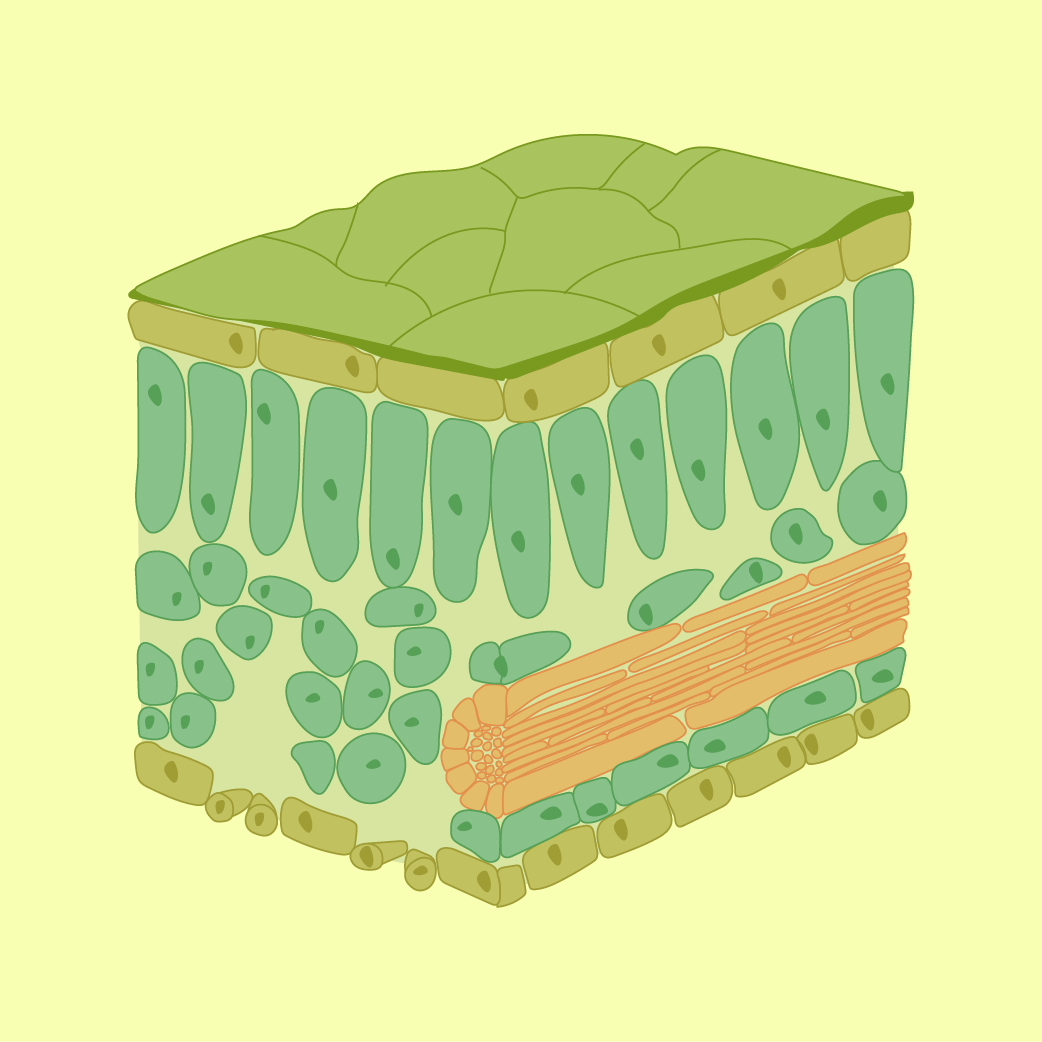
2.3 Main Organ for Transpiration
Learn how water vapour escapes from plants through the stomata, why transpiration is necessary, the environmental factors that change its rate, and how a potometer is used to measure it.
Learning Objectives
- Define transpiration and identify the leaf stomata as the main site of transpiration.
- Explain the necessity of transpiration in plants.
- Describe the path of water movement through a plant from the soil to the atmosphere.
- Explain the effects of environmental factors on the rate of transpiration.
- Understand the setup, operational definition, and calculations involved in measuring the rate of transpiration using a potometer.
Path of Water Movement and Factors Influencing Transpiration
Trace the pathway of water from soil to stomata and understand how external environmental factors alter the rate of water loss.
1. Roots
Roots absorb water from the soil continuously by osmosis.
2. Stem
The xylem transports water upwards in the plant stem.
3. Leaves
Leaf veins transport water to the leaves.
4. Stomata
Water evaporates to the atmosphere through the stomata.
Light intensity
The higher the light intensity, the higher the rate of transpiration. The rate becomes constant when other factors become limiting factors.
Relative air humidity
The lower the relative air humidity, the faster water vapour escapes from the stomata, so the rate of transpiration becomes higher.
Temperature
An increase in temperature increases the kinetic energy of water molecules, increasing the rate of evaporation and diffusion.
Air movement
The movement of air carries away water molecules that have diffused out from the leaves, so faster air movement increases the rate of transpiration.
Short Explanation
Definition
Transpiration is a process of water loss in the form of water vapour through evaporation from plants to the atmosphere. Leaves are the main organ of transpiration; 90% of water diffuses out through stomata pores in the leaves. A small amount of transpiration also takes place through stems and flowers.
Why is transpiration necessary?
Transpiration enables plant roots to absorb water and mineral salts from the soil. Water absorbs heat energy from leaves and evaporates as water vapour to provide a cooling effect. It also produces a pulling force that moves water and mineral salts continuously in the xylem vessels from the roots to all plant cells.
Measuring transpiration
A potometer is a device used to measure water intake by a leafy twig, which reflects the rate of transpiration. The rate is calculated as \(\text{Rate of transpiration} = \dfrac{\text{Distance travelled by air bubble (cm)}}{\text{Time (min)}}\).
Try to Answer First
Answer in your mind, then press “Check Answer”.
Why must a leafy twig be cut under water when preparing a potometer?
How does high relative air humidity affect the rate of transpiration?
State two reasons why transpiration is necessary for plants.
Common Mistakes
- Assuming that a potometer directly measures the exact amount of water evaporated from leaves; it actually measures water intake by the leafy twig, which is a close proxy for transpiration.
- Confusing the graph of relative air humidity with the other factors; unlike temperature, light, and wind speed, relative air humidity has an inverse relationship with the rate of transpiration.
- Forgetting that the curve for light intensity levels off because other environmental conditions such as temperature, humidity, or air movement become limiting factors.
Concept Misunderstandings
Transpiration is purely harmful because the plant loses valuable water.
While excessive water loss can cause wilting, transpiration is vital because it creates the transpiration pull required to transport water and essential mineral salts, as well as providing thermal cooling.
Transpiration occurs equally across all plant surfaces.
Approximately 90% of transpiration occurs exclusively through the stomata pores in the leaves, while only minimal loss occurs via stems and flowers.
Summary
- Definition: Transpiration is the loss of water vapour through evaporation from plants into the atmosphere.
- Main organ: Leaves (90% via stomata pores).
- Necessities: root absorption of water and mineral salts, cooling effect via latent heat of vaporisation, and pulling force in xylem vessels.
- Pathway: Soil \(\rightarrow\) Roots (by osmosis) \(\rightarrow\) Stem xylem \(\rightarrow\) Leaf veins \(\rightarrow\) Stomata \(\rightarrow\) Atmosphere.
- Environmental factors: light intensity, temperature, air movement and relative humidity.
- Measurement: Potometer measures water intake via distance travelled by an air bubble over time, \(\text{Rate} = \dfrac{\text{Distance}}{\text{Time}}\).
Short Activity
Objective: check your understanding of transpiration, its site, factors and measurement.
A. Objective Quiz
Which of the following correctly describes the main site of transpiration in plants?
Why does the rate of transpiration become constant at very high light intensities?
B. Fill in the Blanks
Water diffuses into the root system from the soil continuously by the process of .
The rate of transpiration using a potometer is calculated by dividing the distance travelled by the air bubble (cm) by the (min).
C. Matching / Drag and Drop
Match each environmental factor with its direct effect or mechanism on the rate of transpiration. On a phone, tap a choice first, then tap the matching box. Tap the Answer Choices area to return a selected item.
C. Match the Environmental Factor to Its Effect
Write the correct environmental factor next to each effect.
| Effect / Mechanism | Environmental Factor |
|---|---|
| 1. Increases the kinetic energy of water molecules, increasing the transpiration rate | |
| 2. Lower values allow water vapour to escape faster from stomata, increasing the transpiration rate | |
| 3. Carries away water molecules that have diffused out from the leaves | |
| 4. Transpiration increases as this factor increases until other factors become limiting |
Answer choices: Temperature • Relative air humidity • Air movement • Light intensity

