
2.2 Main Organ for Gaseous Exchange
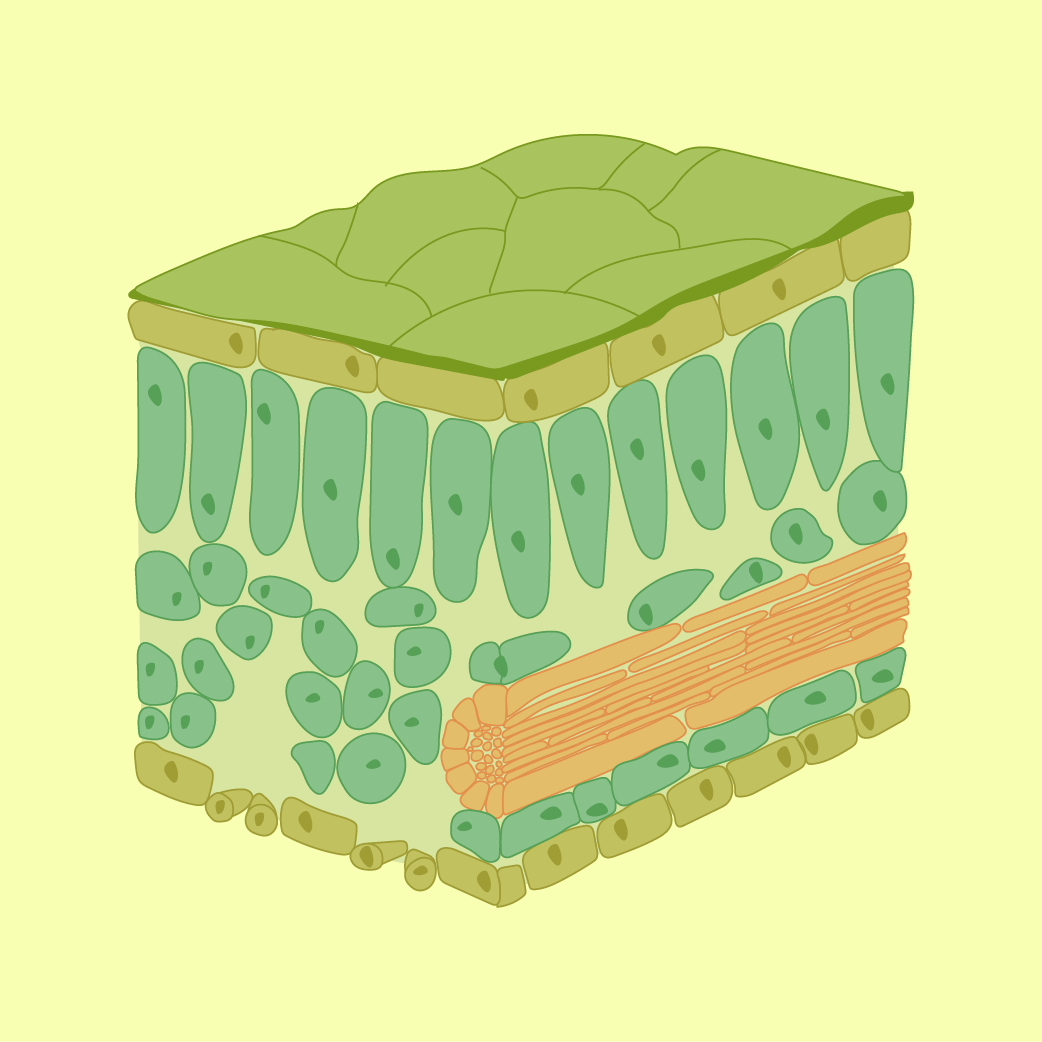
Plants synthesise their own food through photosynthesis and require an efficient exchange of gases and absorption of light. The exchange of oxygen and carbon dioxide between plants and their surroundings takes place primarily through minute pores called stomata, which are predominantly located on the lower epidermis of leaves. Each stoma is regulated by specialized guard cells that alter their shape to open or close the pore.
Learning Objectives
- State the necessity of gaseous exchange in plants.
- Explain the mechanism of stomatal opening and closing based on the uptake of potassium ions (\(K^+\)) and changes in sucrose concentration.
- Compare the distribution of stomata on the upper and lower epidermis of monocot and eudicot leaves.
- Explain the effect of water deficiency in plants on stomatal opening and closing.
Structural Changes of Guard Cells During Stomatal Opening and Closing
Differential wall thickness causes guard cells to curve outwards when turgid and straighten when flaccid.
Short Explanation
The Necessity of Gaseous Exchange in Plants
Plants require carbon dioxide for photosynthesis and oxygen for cellular respiration. The exchange of oxygen and carbon dioxide between plants and the surroundings occurs through stomata. Each stoma is guarded by a pair of guard cells that control the opening and closing of the pore by changing their shape. Guard cells contain chloroplasts to carry out photosynthesis.
Bio Exploration: Cacti in the desert open their stomata only at night to take in carbon dioxide. Colder temperatures at night reduce the loss of water.
Uptake of Potassium Ions (\(K^+\))
Opening: Potassium ions (\(K^+\)) enter the guard cells. The solute potential in the guard cells increases, so the water potential decreases. Water molecules from neighbouring epidermal cells diffuse into the guard cells by osmosis. The guard cells become turgid and curve outwards, opening the stoma.
Closing: Potassium ions (\(K^+\)) move out from the guard cells. The solute potential decreases, so the water potential increases. Water molecules diffuse out from the guard cells into the epidermal cells by osmosis. The guard cells become flaccid and the stoma closes.
Sucrose Concentration in Guard Cell Sap
Opening: In the presence of light during daytime, photosynthesis occurs in the guard cells. Dissolved sugar (sucrose) is produced, leading to a high concentration of sucrose in the guard cells. The water potential decreases, water enters by osmosis, the guard cells become turgid and curve outwards, opening the stoma.
Closing: In the absence of light at night, photosynthesis does not occur. Sucrose in the guard cells is converted into insoluble starch, causing the sucrose concentration to become low. The water potential increases, water leaves by osmosis, the guard cells become flaccid and the stoma closes.
Structural Adaptations of Guard Cells
The inner cell wall of the guard cell facing the stoma pore is thick and less elastic. The outer cell wall of the guard cell is thin and more elastic. When water diffuses into the guard cell, the thin, more elastic outer wall stretches and bulges outward more than the thick inner wall, causing the guard cell to curve outwards and open the pore.
Distribution of Stomata on Leaves
Balsam leaf represents a eudicot leaf, while a lily leaf represents a monocot leaf. The distribution of stomata on the lower epidermis is more packed (higher density) compared to the upper epidermis. Having fewer stomata on the upper epidermis prevents excessive water loss due to direct exposure to sunlight.
The Effect of Water Deficiency on Stomatal Opening and Closing
Water is lost from plants in the form of water vapour to the surroundings through stomata. When the stoma opens widely, the rate of water loss is high. Stomatal opening and closing depend on the turgor pressure of the guard cells:
Fresh plants (Adequate water): Guard cells become turgid; the thin and elastic outer cell wall expands outwards, causing the guard cells to curve outwards and the stoma to open.
Wilted plants (Water deficiency): When the plant lacks water, guard cells lose turgidity and become flaccid; the stoma closes to prevent excessive water loss.
Try to Answer First
Answer in your mind, then press “Check Answer”.
Why do cacti in the desert open their stomata only during the night?
Explain why the stoma curves outwards when the guard cells become turgid.
What happens to the sucrose in guard cells during the night or in the absence of light?
Common Mistakes
- Confusing the properties of the guard cell walls: Students often mistakenly think the inner wall is thin and elastic and the outer wall is thick, when in fact the inner wall is thick and less elastic, while the outer wall is thin and more elastic.
- Reversing the movement of potassium ions: Forgetting that \(K^+\) ions move into guard cells during stomatal opening, not out of them.
- Misunderstanding water potential changes: Thinking that higher solute concentration increases water potential, whereas an increase in solutes (potassium ions or sucrose) decreases water potential.
Concept Misunderstandings
Stomata open by being pulled apart by neighbouring epidermal cells.
Opening is an autonomous response driven by internal turgor pressure changes within the guard cells themselves.
Stomata remain open all the time in the daytime regardless of water availability.
Under severe water deficit, guard cells lose water and become flaccid, closing the stoma even in daylight to prevent wilting.
Stomata are evenly distributed on both sides of a leaf.
In terrestrial plants, stomata are far more densely packed on the lower epidermis to reduce excessive transpiration.
Summary
- Stomata are pores on the leaf epidermis (mostly lower epidermis) responsible for gaseous exchange and transpiration.
- Each stoma is enclosed by a pair of guard cells containing chloroplasts.
- Stomatal opening occurs when guard cells become turgid as water enters by osmosis, driven by \(K^+\) ion intake and high sucrose concentration from photosynthesis.
- Stomatal closing occurs when guard cells become flaccid as water leaves by osmosis, driven by \(K^+\) ion exit and conversion of sucrose to starch.
- The uneven elasticity of guard cell walls (thick inner wall, thin outer wall) creates the curvature required to open the stoma.
- Under water deficiency, guard cells lose turgidity, closing the stoma to conserve plant moisture.
Short Activity
Objective: test your understanding of stomatal opening, closing and guard cell behaviour.
A. Objective Quiz
Which of the following events leads to the opening of a stoma?
What structural characteristic causes guard cells to curve outwards when turgid?
B. Fill in the Blanks
During the night or in the absence of light, dissolved sucrose in the guard cells is converted into .
When a plant experiences water deficiency, its guard cells lose turgor pressure and become .
C. Matching / Drag and Drop
Match each physiological condition of guard cells to its correct stomatal outcome or description. On a phone, tap a choice first, then tap the matching box. Tap the Answer Choices area to return a selected item.
C. Match the Physiological Condition to Its Outcome
Write the correct physiological condition next to each outcome.
| Stomatal Outcome / Description | Physiological Condition |
|---|---|
| 1. Decreases water potential, causing water to enter and open the stoma. | |
| 2. Increases water potential, causing water to leave and close the stoma. | |
| 3. Results from daytime photosynthesis, making guard cells turgid. | |
| 4. Causes the pore to close during wilting or water deficiency. |
Answer choices: Uptake of \(K^+\) ions • Elimination of \(K^+\) ions • High sucrose concentration • Flaccid guard cells

