
2.1 Leaf Structure
A leaf is the primary organ in a plant dedicated to carrying out photosynthesis. Its overall shape and internal anatomical organisation are specially adapted to harvest the maximum amount of sunlight and allow efficient gaseous exchange and fluid transport.
Learning Objectives
- Identify and describe the external structures of a green leaf: lamina and petiole.
- Explain the meaning and importance of leaf mosaic arrangement.
- Identify the internal structures of a leaf lamina from a cross-section: cuticle, upper epidermis, palisade mesophyll, spongy mesophyll, vascular bundles (xylem and phloem), and lower epidermis with guard cells and stomata.
- Explain the specific structural adaptations and functions of each internal layer of the leaf lamina.
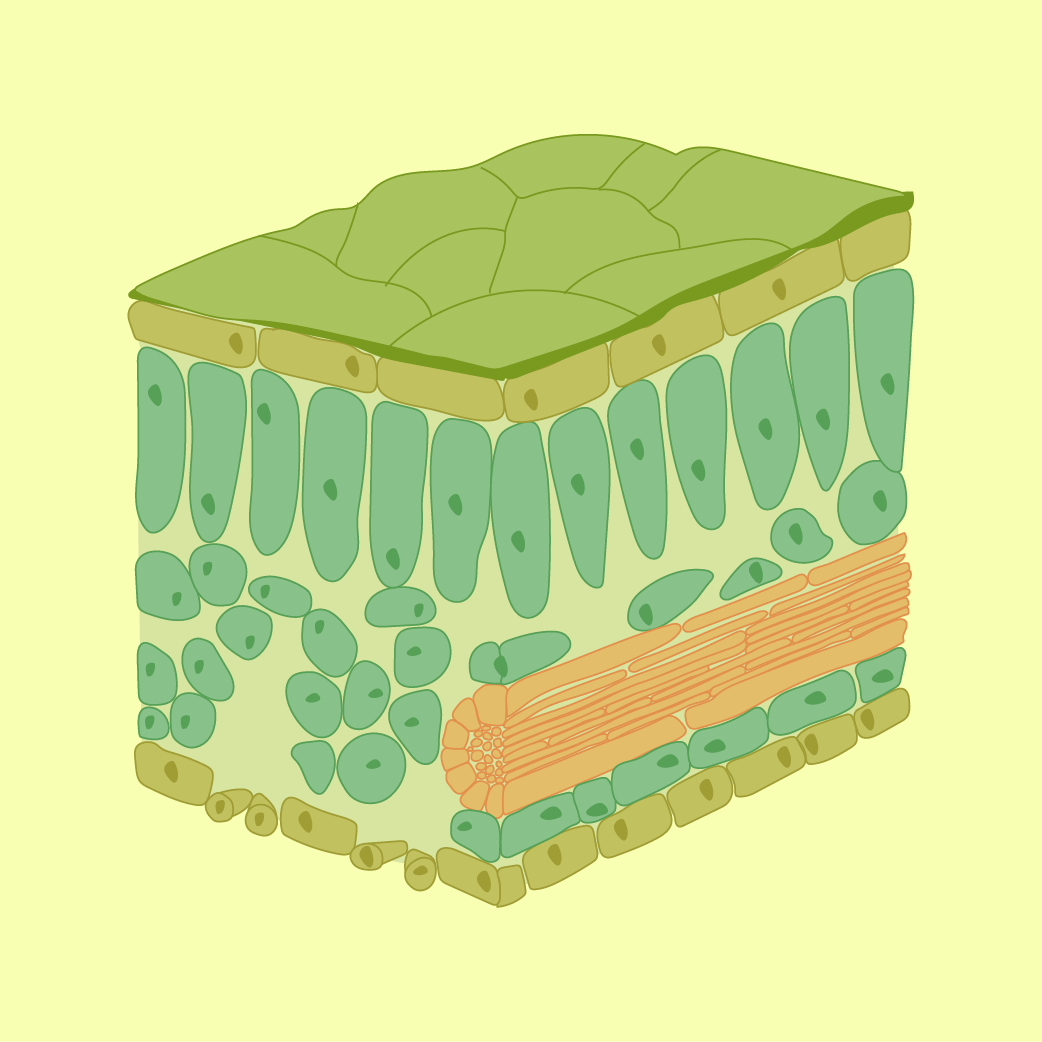
Cross-Section and Layers of a Leaf Lamina
The spatial organisation of the tissue layers from upper cuticle to lower epidermis, showing the distribution of chloroplasts and vascular bundles.
Lamina
Flat, thin, smooth and green part of the leaf for maximum sunlight capture and efficient gas diffusion.
Petiole
The leaf stalk that attaches the lamina to the plant stem and supports the lamina.
Leaf mosaic
Non-overlapping arrangement of leaves that allows each leaf to receive optimum light.
Short Explanation
External structure of a leaf
The lamina is the flat, thin, smooth and green part of the leaf. Its flat shape provides a wide surface area to expose cells containing chloroplasts to the maximum amount of sunlight. Its thin structure allows gases involved in photosynthesis to diffuse rapidly and efficiently within the leaf. The petiole is the leaf stalk that attaches the lamina to the plant stem. It extends into the lamina to form a network of middle veins that structurally support the lamina.
Leaf mosaic
Leaf mosaic is an arrangement in most plants where leaves grow without overlapping. This enables each leaf to receive optimum light to carry out photosynthesis.
Cuticle and upper epidermis
The cuticle is a waxy, waterproof and transparent outer layer covering both the upper and lower epidermis. It reduces excessive water loss through evaporation, while its transparency allows sunlight to penetrate easily. The upper epidermis is located immediately below the upper cuticle layer. Its cells do not contain chloroplasts and are transparent, allowing light to pass through.
Palisade and spongy mesophyll
The palisade mesophyll cells are arranged vertically and closely packed together to absorb maximum light. It acts as the primary site of photosynthesis and contains a large number of chloroplasts. The spongy mesophyll cells are irregular in shape to increase the internal surface area for gaseous exchange. They are loosely arranged with abundant intercellular air spaces, facilitating the diffusion of carbon dioxide and water through the leaf to the palisade mesophyll cells. It contains fewer chloroplasts compared to the palisade mesophyll.
Vascular bundle and lower epidermis
The xylem transports water and mineral salts absorbed from the roots up to the leaf. Its walls are lignified and thickened to provide mechanical support and strength. The phloem transports organic substances produced during photosynthesis from the leaves to other parts of the plant. The lower epidermis is the outermost cellular layer on the lower surface of the leaf. It contains stomata, where each stoma is regulated and guarded by a pair of specialized guard cells.
Try to Answer First
Answer in your mind, then press “Check Answer”.
Why is the leaf lamina typically flat and thin?
Why are the cells of the upper epidermis devoid of chloroplasts and transparent?
What are the respective roles of xylem and phloem inside the vascular bundle of a leaf?
Common Mistakes
- Confusing the palisade mesophyll with the spongy mesophyll in terms of chloroplast abundance; palisade mesophyll contains significantly more chloroplasts because it receives direct sunlight.
- Assuming that epidermal cells have chloroplasts; normal upper and lower epidermal cells lack chloroplasts. Chloroplasts in the epidermis are found within guard cells.
- Reversing the transport roles of xylem (water and minerals) and phloem (organic substances).
Concept Misunderstandings
The waxy cuticle completely blocks all solar radiation from entering the leaf.
The cuticle is waterproof to prevent excessive water loss by transpiration, but it is completely transparent, allowing sunlight to penetrate directly into the photosynthetic tissues.
Summary
- The external structure of a leaf comprises the broad, thin lamina (for maximum sunlight capture and efficient gas diffusion) and the supportive petiole.
- Leaves are commonly arranged in a leaf mosaic pattern to prevent overlapping and optimize sunlight absorption.
- The internal structure features a protective, transparent cuticle and upper epidermis.
- Photosynthesis mainly occurs in the vertically arranged, tightly packed palisade mesophyll.
- The spongy mesophyll contains fewer chloroplasts and extensive intercellular air spaces for gas exchange.
- Vascular bundles consist of xylem (water/mineral transport and support) and phloem (transport of synthesized organic substances).
- The lower epidermis contains stomata guarded by guard cells to regulate gas exchange.
Short Activity
Objective: identify the internal leaf tissues and their functions.
A. Objective Quiz
Which internal leaf tissue consists of vertically oriented, closely packed cells containing the highest density of chloroplasts?
What is the main purpose of the waxy cuticle covering the leaf epidermis?
B. Fill in the Blanks
The arrangement of leaves growing without overlapping to receive optimum light is called leaf .
In the leaf vascular bundle, transports organic substances produced during photosynthesis to other plant parts.
C. Matching / Drag and Drop
Drag each leaf structure to its correct description or function. On a phone, tap a choice first, then tap the matching box. Tap the Answer Choices area to return a selected item.
C. Match the Leaf Structure to Its Description or Function
Write the correct leaf structure next to each description.
| Description / Function | Leaf Structure |
|---|---|
| 1. Transparent and waxy waterproof layer reducing transpiration | |
| 2. Closely packed vertical cells that are primary sites of photosynthesis | |
| 3. Irregularly shaped cells with large intercellular air spaces | |
| 4. Lignified vessels transporting water and mineral salts to the leaf |
Answer choices: Cuticle • Palisade mesophyll • Spongy mesophyll • Xylem

