
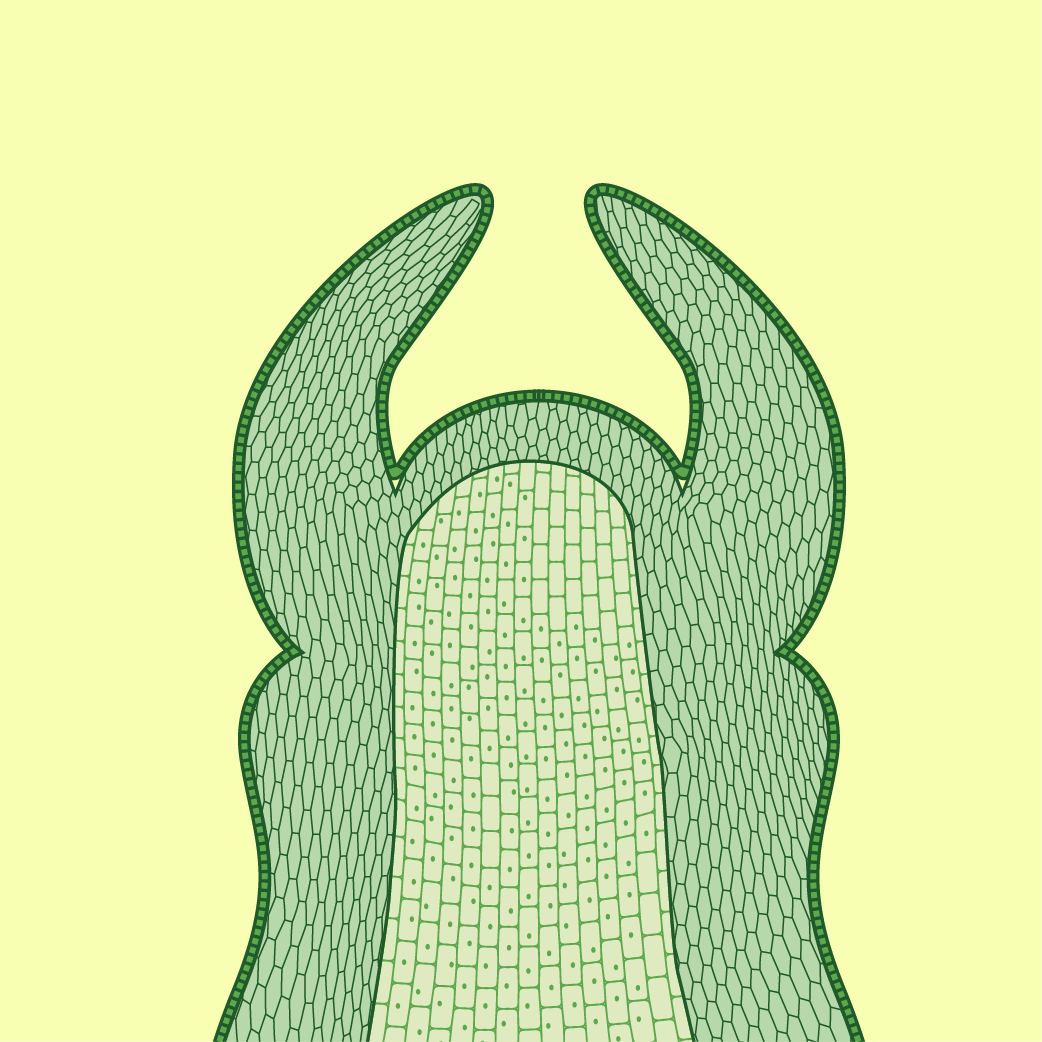
1.2 Meristematic Tissues and Growth
Meristematic tissues are undifferentiated living plant tissues that divide actively to drive growth and development throughout a plant's life. Unlike animals, which grow across their entire body, plant growth is restricted to specific regions containing meristematic tissues. Plants exhibit two major types of growth: primary growth, which elongates stems and roots from apical meristems, and secondary growth, which increases the girth or circumference of stems and roots from lateral meristems.
Learning Objectives
- Identify the two main types of meristematic tissues: apical meristems and lateral meristems.
- Explain the three zones of cell growth at the shoot and root tips: zone of cell division, zone of cell elongation, and zone of cell differentiation.
- Describe the mechanism and necessity of primary growth in plants.
- Explain the mechanism and necessity of secondary growth in eudicot stems and roots.
- Identify examples of monocots that undergo secondary growth.
- Compare primary growth and secondary growth in eudicots in terms of similarities and differences.
- Discuss the economic importance of plants that undergo secondary growth.
Zones of Cell Growth and Secondary Growth in a Eudicot Stem
Illustrate the sequential organisation of the three growth zones at root/shoot tips and depict the cross-sectional arrangement of primary vs. secondary vascular tissues during secondary growth.
Apical Meristems
Located at shoot and root tips; drive primary longitudinal growth.
Lateral Meristems
Vascular cambium and cork cambium along stems and roots; drive secondary radial growth.
Growth Zones
Division, elongation and differentiation occur sequentially at shoot and root tips.
Short Explanation
Definition
Meristematic tissue — undifferentiated living plant tissues that divide actively through mitosis to drive growth and development throughout a plant's life. Plant growth is localised and restricted to regions containing meristematic tissues.
Types of Meristematic Tissues
Apical meristems are located at the tips of plant shoots and roots. Lateral meristems are located along the sides of stems and roots and consist of vascular cambium and cork cambium.
Zones of Cell Growth
Both shoot tips and root tips are divided into three distinct zones of primary growth: zone of cell division, zone of cell elongation, and zone of cell differentiation.
Primary Growth
Growth that occurs after germination in all plants to elongate stems and roots. It occurs at apical meristems. At shoot tips, leaf primordia and shoot/bud primordia develop into new leaves and shoots, increasing height. At root tips, the root cap protects the root tip.
Secondary Growth
Occurs mainly in eudicots and a small number of monocots (e.g., Dracaena sp., Aloe sp., Agave sp.) to increase stem and root circumference. It does not occur in non-woody herbaceous plants. It involves lateral meristems: vascular cambium and cork cambium.
Mechanism of Secondary Growth at the Eudicot Stem
Secondary growth begins when vascular cambium cells divide actively through mitosis. Cells in the cambium ring divide inwards to form secondary xylem and outwards to form secondary phloem. Primary xylem is pushed towards the central pith; primary phloem is pushed outwards towards the epidermis. Primary xylem tissues become compressed to form a strong wood layer. As secondary xylem expands, the outer epidermis stretches and cracks. Cork cambium divides actively to produce cork cells on the outer side and cortex on the inner side. The cork layer protects the stem against insects, pathogen attack, and excessive water loss.
Annual Growth Rings
Formed in woody plants living in temperate climates due to seasonal growth rates. In spring, abundant water supply and sunlight lead to rapid growth; secondary xylem vessels are larger with thinner walls, forming a brightly coloured ring. In summer, unfavourable conditions lead to slower growth; secondary xylem vessels are smaller with thicker walls, forming a dark coloured ring. One pair of bright and dark rings represents one year of secondary growth, enabling age determination.
Necessity of Growth
Primary growth: maximises stem elongation so leaves can absorb sunlight for photosynthesis; primary phloem transports organic nutrients; primary xylem transports water and mineral salts; primary xylem provides support to herbaceous or young plants.
Secondary growth: provides stability by expanding stem and root girth to support increasing plant height; provides mechanical support via thickened lignified secondary xylem; produces continuous xylem and phloem tissues to replace old, damaged, or non-functional vascular tissues; produces thick, protective bark; extends plant lifespan, increasing chances of seed production and reproduction.
Economic Importance of Secondary Growth
Timber production: strong, hard wood from species such as Shorea sp. (meranti) and Balanocarpus sp. (cengal) used for construction, houseboats, furniture, fences, and doors. Aesthetics: attractive patterns of annual growth rings used in high-value decorative furniture and carvings. Resin and oils: wood and bark of species like Hopea sp. (merawan) and meranti yield resins and oils used for varnishes, adhesives, perfumes, and pharmaceuticals. Decorative plants: flowering woody plants used in ornamental landscaping. Commercial fruit crops: woody fruit-bearing trees (e.g., mango, mangosteen) generate income and support agriculture.
Try to Answer First
Answer in your mind, then press "Check Answer".
Name the three zones of cell growth found at the root and shoot tips of plants in order from the apical tip inwards.
Explain how vacuolation causes cell enlargement in the zone of cell elongation.
Which lateral meristem forms secondary xylem and secondary phloem, and in which direction is each tissue produced?
Common Mistakes
- Confusing the locations and products of the two lateral meristems (e.g., incorrectly stating that cork cambium produces secondary xylem or that vascular cambium produces cork).
- Reversing the direction of tissue formation: secondary xylem forms inwards (towards the pith), whereas secondary phloem forms outwards (towards the cortex/epidermis).
- Assuming all monocots completely lack secondary growth, overlooking anomalous secondary growth in species such as Aloe sp., Dracaena sp., and Agave sp.
- Misidentifying the structural changes during vacuolation (thinking cell division occurs during cell elongation, rather than water uptake and vacuole fusion).
Concept Misunderstandings
Plants grow throughout their entire bodies just like animals.
Animal growth occurs throughout the organism's body, but plant growth is localised and restricted to regions with meristematic tissues (apical and lateral meristems).
Herbaceous eudicots undergo secondary growth because they are eudicots.
Secondary growth occurs primarily in woody eudicots; non-woody herbaceous plants undergo primary growth only.
Annual growth rings are found equally in tropical and temperate plants.
Annual rings are distinctly formed in temperate woody plants due to clear seasonal shifts in temperature and water supply between spring and summer, whereas tropical plants experience less pronounced seasonal fluctuations.
Summary
- Meristematic Tissues: Undifferentiated tissues capable of mitotic division, categorised into apical meristems (shoot/root tips) and lateral meristems (vascular and cork cambium).
- Growth Zones: Primary growth progresses through three zones: division (mitosis), elongation (water intake and vacuolation), and differentiation (development of specialised tissues such as guard cells and root hairs).
- Primary vs. Secondary Growth: Primary growth increases stem and root length (longitudinal); secondary growth increases girth and thickness (radial).
- Mechanism of Secondary Growth: Vascular cambium divides to yield secondary xylem inwards and secondary phloem outwards; cork cambium divides to yield cork cells outwards and cortex inwards.
- Necessity & Economic Value: Growth provides mechanical support, vascular replenishment, and environmental protection. Secondary growth yields timber (Shorea sp., Balanocarpus sp.), resins, oils (Hopea sp.), and fruits.
Short Activity
Objective: test your understanding of meristematic tissues, growth zones and secondary growth.
A. Objective Quiz
Which of the following tissues is correctly matched to its origin during secondary growth in a eudicot stem?
Why do secondary xylem vessels formed during spring appear brighter in colour compared to those formed during summer in temperate trees?
B. Fill in the Blanks
The process during cell elongation where small vacuoles absorb water and fuse together to form a single large vacuole is called .
In a woody eudicot undergoing secondary growth, primary xylem is pushed towards the as new secondary xylem layers form.
C. Matching / Drag and Drop
Match each plant tissue or cell type to its correct developmental description or function. On a phone, tap a choice first, then tap the matching box. Tap the Answer Choices area to return a selected item.
C. Match the Plant Structure / Tissue to Its Function / Description
Write the correct plant structure or tissue next to each description.
| Function / Description | Plant Structure / Tissue |
|---|---|
| 1. Formed by epidermal cell differentiation at root tips to increase surface area for absorption. | |
| 2. Lateral meristem located between xylem and phloem that produces secondary vascular tissues. | |
| 3. Lateral meristem beneath the epidermis that produces protective cork cells to the outside. | |
| 4. Undifferentiated tissue at shoot and root tips responsible for primary longitudinal growth. |
Answer choices: Root hair cell • Vascular cambium • Cork cambium • Apical meristem

