
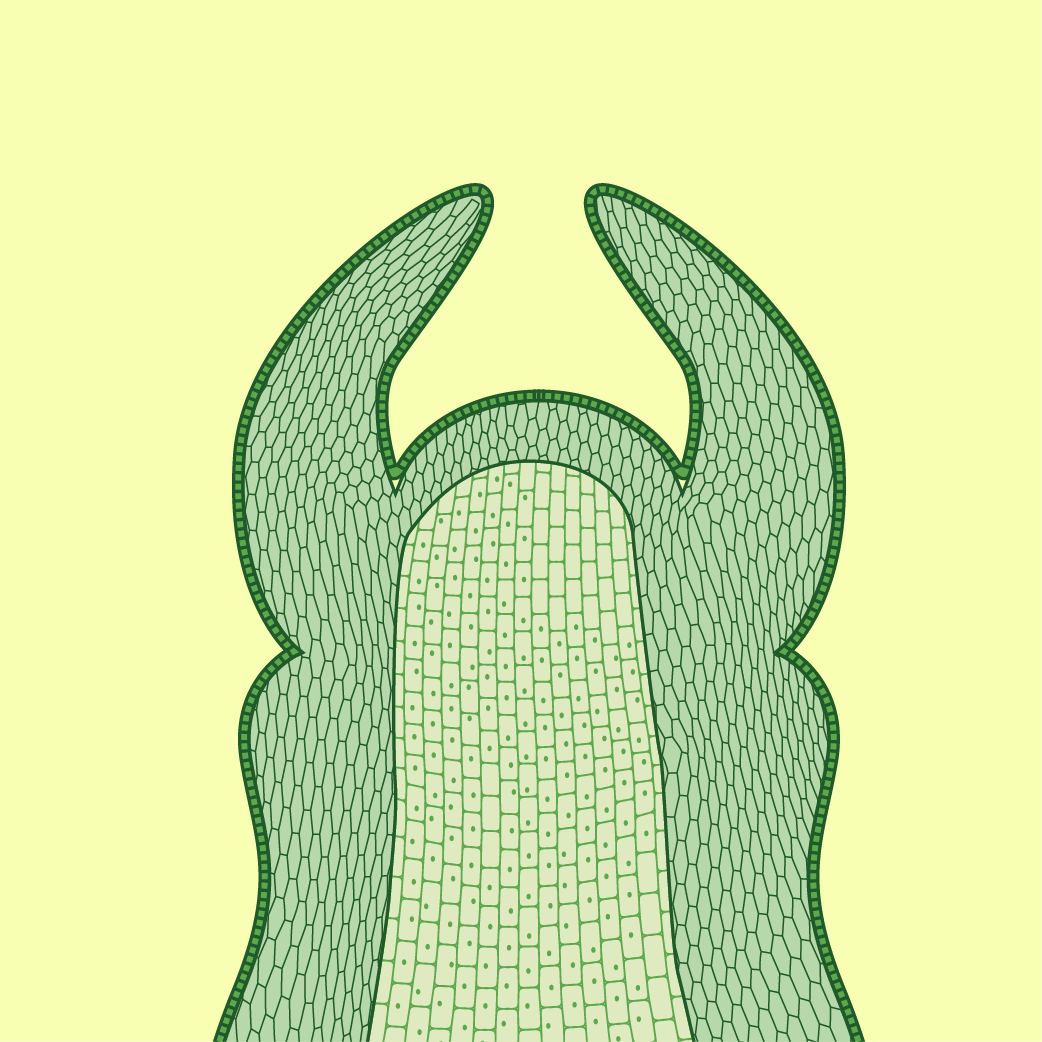
1.1 Organisation of Plant Tissues
Plants are multicellular organisms composed of specialised cells organised into specific tissues. Plant tissues are broadly classified into meristematic tissues and permanent tissues. Meristematic tissues consist of actively dividing cells, whereas permanent tissues are mature tissues that have differentiated to carry out specific structural, protective, and transport functions throughout the plant.
Learning Objectives
- State the classification of plant tissues into meristematic tissues and permanent tissues.
- Identify the three types of permanent tissues: epidermal tissues, ground tissues, and vascular tissues.
- Describe the structural adaptations and functions of epidermal tissues and their modified cells (guard cells and root hair cells).
- Compare the structures and functions of the three ground tissues: parenchyma, collenchyma, and sclerenchyma.
- Describe the structures and transport roles of vascular tissues: xylem and phloem.
Hierarchical Classification and Structural Overview of Permanent Plant Tissues
Plant tissues are divided into meristematic and permanent tissues. Permanent tissues are further classified into epidermal, ground and vascular tissues.
Epidermal Tissues
Outermost layer covering stems, leaves and roots of young plants. Bears a waxy cuticle and modified cells such as guard cells and root hair cells.
Ground Tissues
Form the main bulk of the plant body. Include parenchyma, collenchyma and sclerenchyma tissues.
Vascular Tissues
Transport tissues made of xylem and phloem. Xylem moves water and minerals; phloem translocates photosynthetic sugars.
Short Explanation
Permanent Tissues
Permanent tissues are differentiated plant tissues performing specialised functions. They are classified into epidermal tissues, ground tissues and vascular tissues.
Epidermal Tissues
Epidermal tissue forms the outer protective coat of young plant organs. Its exposed cell walls bear a waxy, waterproof cuticle. Modified epidermal cells include guard cells and root hair cells.
Ground Tissues
Ground tissues form the main bulk of the plant body. Thin-walled living parenchyma performs metabolic and storage roles. Living collenchyma with pectin and hemicellulose walls grants flexibility and elasticity. Thick-walled, dead sclerenchyma delivers rigid mechanical strength.
Xylem
Xylem vessels are hollow, dead, lignified tubes moving water and minerals upward from roots to all parts of the plant. They also provide mechanical support.
Phloem
Phloem consists of companion cells and sieve tubes. Living phloem sieve tubes transport photosynthesised sugars to growth and storage organs.
Try to Answer First
Answer in your mind, then press “Check Answer”.
State two examples of specialised cells modified from epidermal cells and state their functions.
Compare parenchyma, collenchyma, and sclerenchyma in terms of cell viability at maturity and cell wall thickness.
How is the structure of xylem vessels adapted to their function in transporting water and mineral salts?
Common Mistakes
- Stating that all ground tissues are dead: only sclerenchyma cells are dead at maturity, while parenchyma and collenchyma remain living cells.
- Confusing the cell wall composition of collenchyma and sclerenchyma: collenchyma cell walls are thickened with pectin and hemicellulose, whereas sclerenchyma cell walls contain lignin.
- Assuming phloem sieve tubes are dead because they lack a nucleus: sieve tubes are living cells containing cytoplasm, even though their nuclei and ribosomes disintegrate at maturity.
- Swapping the substances transported by xylem and phloem: xylem transports water and dissolved mineral salts, whereas phloem transports organic nutrients (sugars from photosynthesis).
Concept Misunderstandings
Parenchyma tissues are inert filler tissues with no active physiological roles.
Parenchyma cells are active, living cells involved in vital metabolic processes such as photosynthesis, carbohydrate and starch storage, gaseous exchange, and tissue repair and regeneration.
The waxy cuticle completely replaces the epidermis.
The cuticle is an external non-cellular waxy layer secreted onto the exposed outer cell walls of epidermal cells, not a replacement of the epidermal layer itself.
Summary
- Plant tissues comprise meristematic tissues (actively dividing) and permanent tissues (differentiated).
- Permanent tissues include epidermal tissues (outer barrier with waxy cuticle, guard cells, and root hair cells).
- Ground tissues include parenchyma for metabolism/storage, collenchyma for flexible support, and sclerenchyma for rigid strength.
- Vascular tissues include xylem for water/mineral transport and support, and phloem for translocating photosynthetic sugars.
Short Activity
Objective: identify the characteristics and functions of permanent plant tissues.
A. Objective Quiz
Which of the following ground tissues consists of dead cells at maturity and possesses the thickest cell walls?
What is the structural feature of mature sieve tubes in phloem tissue?
B. Fill in the Blanks
Epidermal cell walls exposed to the air are covered by a waxy and waterproof layer called the which reduces water loss through transpiration.
The cell walls of collenchyma tissues are unevenly thickened with and hemicellulose.
C. Matching / Drag and Drop
Drag each plant tissue to its correct structural characteristic or primary function. On a phone, tap a choice first, then tap the matching box. Tap the Answer Choices area to return a selected item.
C. Match the Plant Tissue to Its Characteristic / Function
Write the correct plant tissue next to each characteristic or function.
| Characteristic / Function | Plant Tissue |
|---|---|
| 1. Modified epidermal cell that increases root surface area for water and mineral absorption | |
| 2. Living tissue with the thinnest walls that remains turgid to support herbaceous plants | |
| 3. Elongated, hollow dead tube with lignified walls that transports water and mineral salts | |
| 4. Vascular tissue made of sieve tubes and companion cells that transports photosynthetic sugars |
Answer choices: Root hair cell • Parenchyma tissue • Xylem vessel • Phloem

