
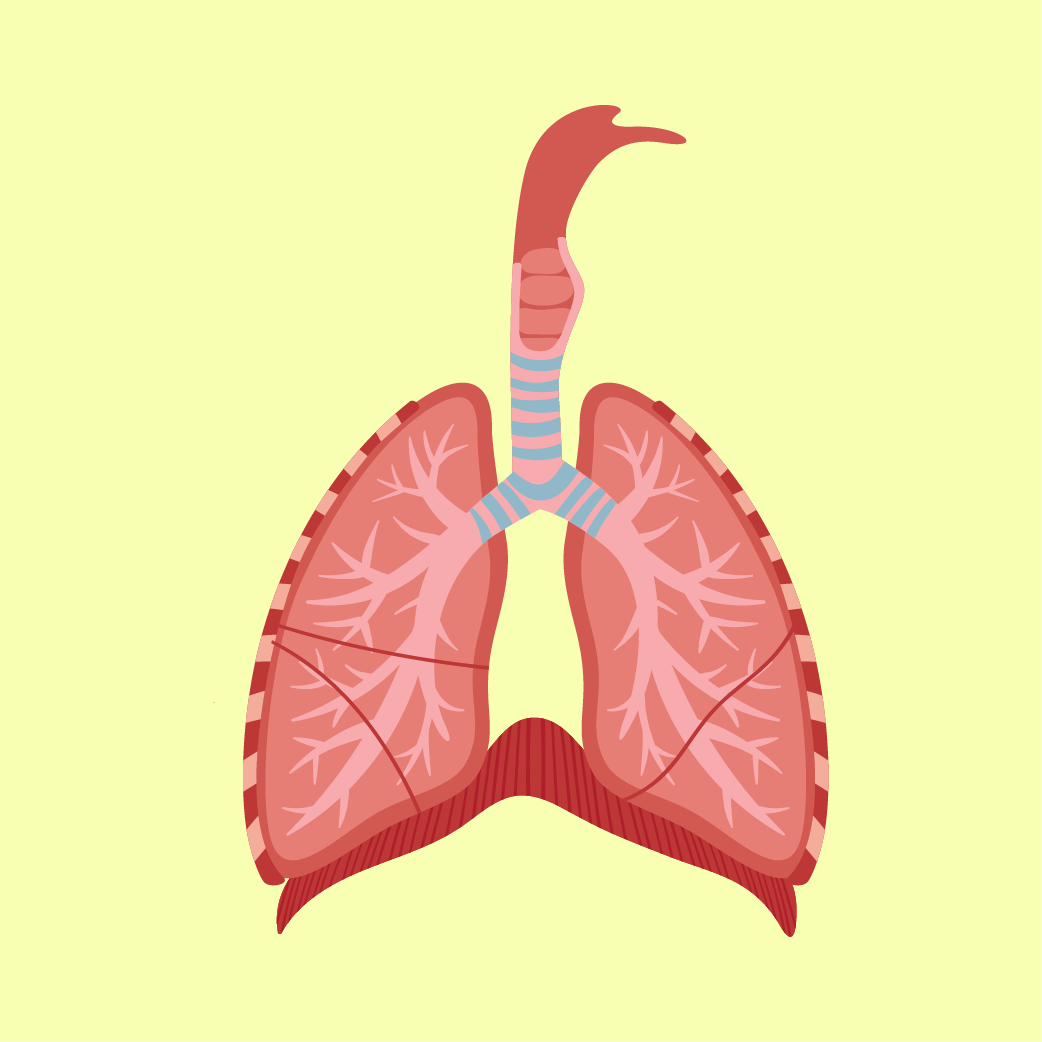
8.1 Types of Respiratory System
Learn the adaptations of respiratory structures in insects, fish, frogs, and humans for efficient gaseous exchange.
Learning Objectives
- State the relationship between organism size and the total surface area to volume (TSA/V) ratio.
- Identify the specialised respiratory structures in insects, fish, frogs, and humans.
- Describe the structural adaptations of respiratory surfaces that facilitate efficient gaseous exchange.
- Compare and contrast the respiratory systems of insects, fish, frogs, and humans.
Comparative Adaptations of Respiratory Structures in Animals and Humans
How insects, fish, frogs, and humans achieve the four essential respiratory requirements: large surface area, thin wall, moisture, and capillary supply.
Insect
Tracheoles branch directly to body cells; no blood capillaries are needed.
Fish
Gill filaments and lamellae provide a large surface area with rich capillaries.
Frog
Moist vascular skin for inactive states and folded lungs for active states.
Human
Millions of one-cell-thick alveoli wrapped in dense capillary networks.
Short Explanation
Size and TSA/V Ratio
Unicellular organisms such as Amoeba sp. have a large TSA/V ratio, allowing efficient gaseous exchange through simple diffusion across the body surface. As multicellular organisms grow larger, their TSA/V ratio decreases because body volume increases faster than surface area. Large organisms therefore require specialised respiratory structures.
Four key adaptations
All respiratory surfaces share four adaptations: large TSA/V ratio, thin respiratory structure, moist surface, and dense network of blood capillaries (except in insects).
Insect tracheal system
Air enters through spiracles, travels through tracheae, and reaches fine tracheoles that touch body cells directly. No blood capillaries are used.
Fish gills
Each gill has two rows of gill filaments. Each filament contains thin, flat folds called lamellae, which are richly supplied with blood capillaries.
Frog skin and lungs
Frogs use cutaneous respiration through moist skin when inactive, and pulmonary respiration through folded lungs when active.
Human alveoli
Millions of alveoli provide an enormous surface area. Each alveolar wall is only one cell thick and is wrapped in a dense capillary network.
Comparison
Insects, fish, frogs, and humans all achieve a large TSA/V ratio, thin moist membranes, and efficient gas transport. Insects differ by lacking blood capillaries; gases diffuse directly between tracheoles and body cells.
Try to Answer First
Answer in your mind, then press “Check Answer”.
State two adaptations of the human alveolus that facilitate rapid gaseous exchange.
Why do insects not require a circulatory system with blood capillaries to transport oxygen?
Predict what will happen to a fish if its gill filaments are torn and damaged after being caught in a net.
Common Mistakes
- Assuming insects transport oxygen through their blood. Insects have an open circulatory system that does not transport respiratory gases; gas delivery is handled entirely by tracheoles.
- Confusing the structural levels of fish gills: mistaking the gill arch for the respiratory surface, rather than identifying the lamellae on the filaments as the functional gas exchange surfaces.
- Believing larger animals have a larger surface area to volume ratio. In reality, larger organisms have a smaller TSA/V ratio compared to smaller organisms.
- Overlooking the frog's dual respiratory structures: stating that frogs only breathe through their skin or only through lungs, rather than recognising that cutaneous respiration operates during inactive states and pulmonary respiration occurs during activity.
Concept Misunderstandings
Fish gills can work in air because air contains more oxygen than water.
Out of water, gill filaments and lamellae stick together and collapse due to surface tension and lack of buoyancy. This drastically reduces the total surface area and causes the gills to dry out, leading to suffocation.
Frog lungs are as complex and efficient as human lungs.
Frog lungs are simple sac-like organs with folded inner walls, which provide much less surface area than the millions of alveoli in mammalian lungs; hence, frogs must rely heavily on their moist skin to supplement gaseous exchange.
Summary
- The TSA/V ratio decreases as organism size increases, requiring large organisms to have specialised respiratory structures.
- All respiratory surfaces share adaptations: large TSA/V ratio, thin walls, moist surfaces, and vascularisation (except in insects).
- Insects: Tracheal system (spiracles \(\rightarrow\) tracheae \(\rightarrow\) tracheoles); tracheoles touch body cells directly.
- Fish: Gills consisting of filaments lined with lamellae, rich in capillaries.
- Frogs: Moist, vascular skin (inactive state) and folded lungs (active state).
- Humans: Highly vascularised, moist, one-cell-thick alveoli providing an enormous surface area.
Short Activity
Objective: identify respiratory structures and their adaptations.
A. Objective Quiz
Which of the following respiratory structures performs gaseous exchange without the assistance of a blood capillary network?
What is the main reason large and complex organisms require specialised respiratory structures?
B. Fill in the Blanks
In fish gills, each filament contains numerous thin, flat projections called that provide a large surface area and contain blood capillaries for gaseous exchange.
The respiratory wall of a human alveolus is as thick as cell, which allows gases to diffuse rapidly.
C. Matching / Drag and Drop
Match each organism to the structure that provides its large total surface area to volume ratio for gaseous exchange. On a phone, tap a choice first, then tap the matching box. Tap the Answer Choices area to return a selected item.
C. Match the Organism to Its Structural Feature
Write the correct organism next to each structural feature.
| Structural Feature | Organism |
|---|---|
| 1. Large number of microscopic tracheoles branching directly to cells | |
| 2. Large number of filaments and lamellae supported by gill arches | |
| 3. Folded inner lung surface combined with an extensive moist skin surface | |
| 4. Millions of spherical alveoli surrounded by capillary beds |
Answer choices: Insect • Fish • Frog • Human

