
3.4 Movement of Substances across a Plasma Membrane and its Application in Daily Life
The principles of movement of substances across a plasma membrane—specifically osmosis and diffusion—are not just theoretical concepts in cellular biology. They are widely applied in everyday life, agricultural practices, food preservation, modern medical treatments, and environmental engineering. Understanding how water and solutes move across selectively permeable membranes allows us to prevent plant wilting, preserve food, rehydrate the human body, deliver targeted medications safely, and desalinate seawater into fresh drinking water.
Learning Objectives
- Explain the phenomenon of plant wilting caused by excessive fertiliser use.
- Describe daily life applications of osmosis and diffusion in food preservation.
- Explain the use and significance of rehydration drinks, isotonic sports drinks, and saline solutions in medical and daily contexts.
- Describe the structure of a liposome and its role in protecting and delivering drugs to target cells.
- Explain the concept and application of reverse osmosis technology in seawater desalination.
Daily Life and Biomedical Applications of Membrane Transport
Membrane transport mechanisms operate in plant cells, liposome drug delivery, and reverse osmosis water purification.
Plant Wilting
Excessive fertiliser makes soil hypertonic, causing water to leave root cells by osmosis.
Liposome
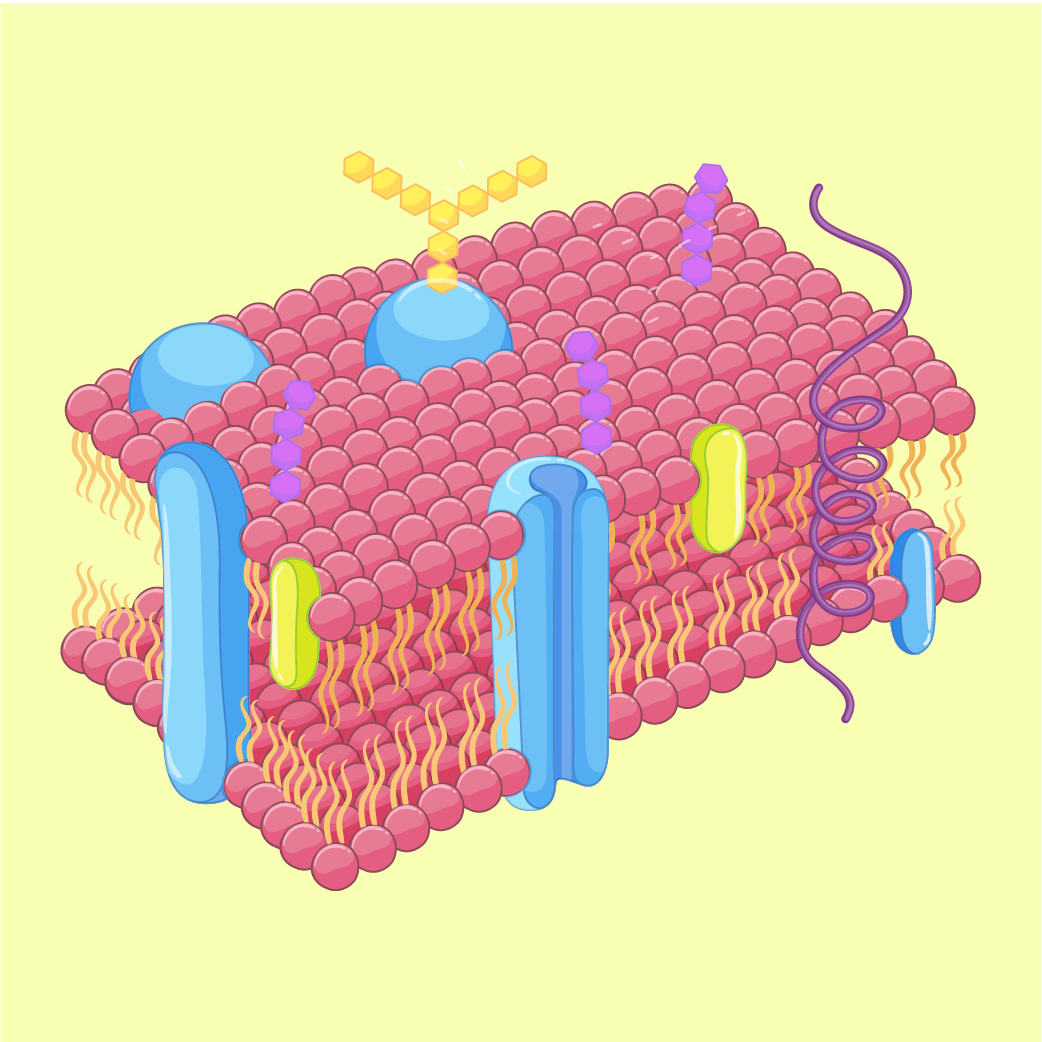
Phospholipid bilayer vesicle that shields drugs from gastric juices.
Reverse Osmosis
Applied pressure forces water through a semi-permeable membrane, blocking salts and microbes.
Short Explanation
Key Principle
Solute concentration outside cells directly determines the movement of water across membranes. When soil water becomes hypertonic due to excessive fertiliser, root cells lose water via osmosis, leading to plasmolysis and wilting.
Medical Fluid Balance
Saline drips are isotonic (0.85–0.90 g NaCl/100 ml) to blood plasma to prevent cell lysis or shrinking. Oral rehydration salts and isotonic drinks replenish water and vital electrolytes like sodium and potassium.
Advanced Membrane Technologies
Liposomes use a phospholipid bilayer to shield oral drugs from gastric juices. Reverse osmosis applies mechanical pressure across semi-permeable membranes to filter out salts and microbes from seawater to produce fresh water.
Food Preservation
High concentrations of salt, sugar, or vinegar create a hypertonic environment, causing water to diffuse out of microbial and food cells, preventing microbial spoilage.
Malaysian Innovation
Malaysian researchers successfully developed Sil-RH Membrane Distillation, made from paddy chaff, for desalination processes.
Try to Answer First
Answer in your mind, then press “Check Answer”.
Why does adding too much fertiliser cause crops or potted plants to wilt?
How do liposomes protect orally ingested medicines from being degraded in the digestive system?
In reverse osmosis, what is the role of applied pressure?
Common Mistakes
- Assuming excessive fertilisers always boost plant growth. More fertiliser provides more nutrients immediately, but high solute concentration in the soil induces osmotic water loss and fatal plasmolysis.
- Confusing reverse osmosis with standard osmosis. In standard osmosis, water moves spontaneously down its water potential gradient without external mechanical pressure. In reverse osmosis, high external pressure must be applied to force water against its natural direction through a selectively permeable membrane.
- Assuming saline solution is pure sterile water. Saline solution is not distilled water; it contains 0.85–0.90 g of sodium chloride per 100 ml to ensure it is isotonic to blood plasma.
Concept Misunderstandings
A wilted plant due to fertiliser application is permanently dead immediately.
If watered promptly, the soil becomes hypotonic to the root cells, water re-enters via osmosis, and cells deplasmolyse to recover turgidity. Only prolonged plasmolysis leads to permanent cell death.
Liposomes can only transport lipid-soluble drugs because they are made of phospholipids.
Liposomes can transport both water-soluble drugs (in the internal aqueous hydrophilic core) and water-insoluble drugs (within the hydrophobic region of the phospholipid bilayer).
Summary
- Plant Wilting: Excessive fertiliser creates a hypertonic soil solution → water leaves root cell sap by osmosis → cells become plasmolysed → wilting occurs (reversible by watering, fatal if prolonged).
- Medical Fluid Balance: Oral Rehydration Salts (ORS) restores water and electrolytes lost during diarrhoea. Isotonic sports drinks replace water, sodium, and potassium lost via perspiration. Saline solution is isotonic to blood plasma (0.85–0.90 g NaCl per 100 ml).
- Liposomes: Vesicles with a phospholipid bilayer that safeguard drugs against gastric juices to deliver water-soluble (in hydrophilic core) and water-insoluble (in hydrophobic bilayer) substances to target cells.
- Reverse Osmosis: Desalination method applying pressure to force seawater through a semi-permeable membrane, blocking salts, microbes, and debris while yielding pure fresh water.
- Malaysian Innovation: Sil-RH Membrane Distillation developed from paddy chaff for water desalination.
Short Activity
Objective: test your understanding of membrane transport applications.
A. Objective Quiz
What happens to a plant's root cells when excessive chemical fertilisers are added to the soil?
Which part of a liposome vesicle carries water-soluble drugs?
B. Fill in the Blanks
Normal saline solution used in medical intravenous drips is isotonic to human blood plasma and contains g of sodium chloride per 100 ml.
In the desalination of seawater using reverse osmosis, external is applied to push water molecules through a semi-permeable membrane.
C. Matching / Drag and Drop
Match each daily life or medical application to its correct description based on membrane transport principles. On a phone, tap a choice first, then tap the matching box. Tap the Answer Choices area to return a selected item.
C. Match the Application to Its Description
Write the correct application next to each description.
| Description | Application |
|---|---|
| 1. Solution isotonic to blood plasma containing 0.85–0.90 g sodium chloride per 100 ml | |
| 2. Phospholipid bilayer vesicle used to shield drugs from gastric juices | |
| 3. Restores water and electrolyte loss in individuals suffering from diarrhoea | |
| 4. Membrane technology that uses applied pressure to extract fresh water from seawater |
Answer choices: Saline solution • Liposome • Oral rehydration salts • Reverse osmosis

