
3.2 Concept of Movement of Substances across a Plasma Membrane
Substances continuously move across the plasma membrane to maintain cellular functions and survival. This movement depends heavily on the physical and chemical properties of the molecules, including their size, polarity, and ionic charge.
Learning Objectives
- State the three common factors that determine whether a molecule can pass through a plasma membrane.
- Differentiate between substances that can pass directly through the phospholipid bilayer and those requiring transport proteins.
- Explain the concepts and mechanisms of passive transport: simple diffusion, osmosis, and facilitated diffusion.
- Explain the concept and mechanism of active transport using the sodium-potassium pump and proton pump as examples.
- Compare and contrast passive transport and active transport.
Summary of Passive and Active Transport Across the Plasma Membrane
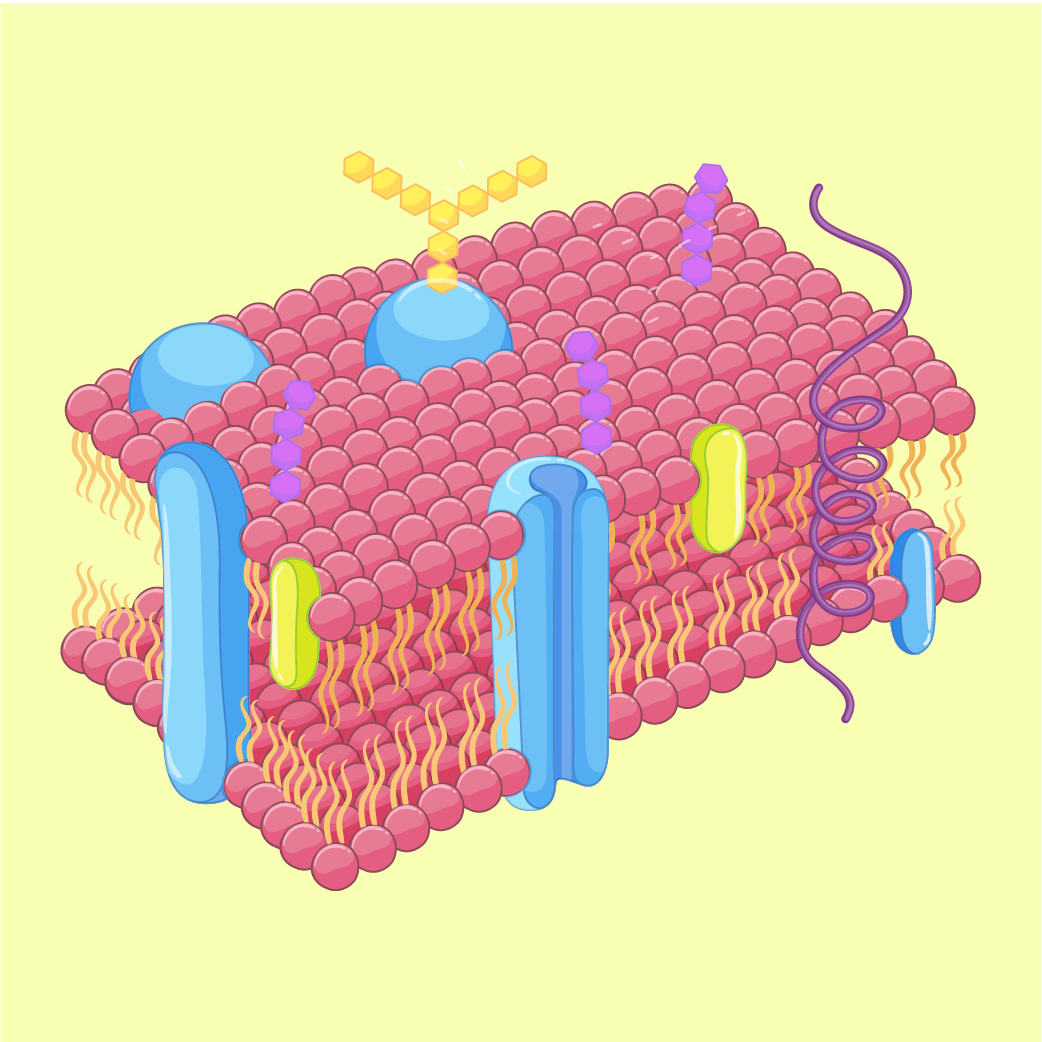
A single clear schematic showing how nonpolar molecules, ions, large molecules, and water cross the plasma membrane via simple diffusion, osmosis, facilitated diffusion, and active transport.
Simple diffusion
Nonpolar lipid-soluble substances and small gases pass directly through the phospholipid bilayer down a concentration gradient.
Osmosis
Water moves from high water potential to low water potential across a selectively permeable membrane.
Facilitated diffusion
Ions and large polar molecules move down a gradient through channel or carrier proteins without ATP.
Active transport
Substances move against a concentration gradient using ATP energy and specific carrier proteins called pumps.
Short Explanation
What determines whether a molecule can cross the membrane?
Three common factors determine whether a molecule can pass through a plasma membrane: molecule size, whether the molecule is a polar molecule, and its ionic charge.
Lipid-soluble substances
Nonpolar molecules such as fatty acids, glycerol, fat-soluble vitamins (A, D, E, K) and steroid compounds move directly across the phospholipid bilayer.
Lipid-insoluble substances
Small polar molecules like water, nonpolar gases like oxygen and carbon dioxide, and ions such as \(\text{K}^+\), \(\text{Na}^+\), \(\text{Ca}^{2+}\) and \(\text{Mg}^{2+}\) require transport proteins or pass directly through the bilayer depending on their properties.
Passive transport
Passive transport is like riding a bicycle downhill: it does not require energy. Molecules move down a concentration gradient until dynamic equilibrium is achieved. It includes simple diffusion, osmosis and facilitated diffusion.
Active transport
Active transport moves molecules or ions against a concentration gradient. It requires energy from ATP generated during cellular respiration and specific carrier proteins called pumps.
Facilitated diffusion mechanism
For glucose transport: extracellular glucose concentration is higher than in the cytoplasm. Glucose binds to the specific active site of the carrier protein. The carrier protein changes shape to allow glucose to pass through into the cell, then returns to its original shape.
Sodium-potassium pump
Three \(\text{Na}^+\) ions bind to specific sites on the carrier protein from the cytoplasm. ATP decomposes into ADP and P; the phosphate group binds to the carrier protein. The phosphate bond provides energy and alters the shape of the carrier protein, releasing three \(\text{Na}^+\) ions outside the cell. Two \(\text{K}^+\) ions from outside the cell bind to the carrier protein; the phosphate group is released. Loss of phosphate restores the original shape of the carrier protein, and two \(\text{K}^+\) ions are transported into the cytoplasm.
Proton pump
Found on epithelial cells lining the stomach cavity, the proton pump transports hydrogen ions (\(\text{H}^+\)) using ATP energy into the extracellular fluid against the gradient. This causes accumulation of \(\text{H}^+\) and acid production in the stomach cavity.
Try to Answer First
Answer in your mind, then press “Check Answer”.
Which substance moves across the plasma membrane via simple diffusion through the phospholipid bilayer?
What provides the energy for the conformational shape change of carrier proteins during active transport?
Explain why the concentration of mineral salts in plant roots increases when the oxygen concentration in the surrounding solution is increased.
Common Mistakes
- Confusing channel proteins with carrier proteins: channel proteins form fixed pore-like canals for ions and small solutes, whereas carrier proteins possess specific binding sites and undergo alternating conformational shape changes to move substances like glucose.
- Thinking that facilitated diffusion requires energy because it uses carrier proteins: facilitated diffusion moves substances down a concentration gradient, so it does not require ATP.
- Assuming active transport moves substances down a gradient: active transport strictly moves substances against a concentration gradient, from low to high concentration.
Concept Misunderstandings
Water enters the cell by active transport because it needs to overcome membrane resistance.
Water enters and leaves cells passively by osmosis, moving from an area of higher water potential to an area of lower water potential across the selectively permeable membrane.
Visking tubing behaves identically to living cell membranes in active transport.
Visking tubing is an artificial selectively permeable membrane that only separates particles by pore size through passive physical filtration; it lacks carrier proteins and cellular respiration, so it cannot perform active transport.
Summary
- Substances cross the plasma membrane either passively or actively.
- Passive transport — simple diffusion, osmosis and facilitated diffusion — occurs down a concentration gradient without ATP until dynamic equilibrium is reached.
- Active transport requires ATP energy and carrier proteins called pumps to move substances against a concentration gradient.
- Active transport leads to the accumulation or excretion of substances such as \(\text{Na}^+\), \(\text{K}^+\) and \(\text{H}^+\).
Short Activity
Objective: check your understanding of passive and active transport mechanisms.
A. Objective Quiz
Which of the following substances crosses the plasma membrane via facilitated diffusion using a carrier protein?
What occurs when ATP decomposes into ADP and phosphate during the operation of the sodium-potassium pump?
B. Fill in the Blanks
Osmosis refers to the net movement of water molecules from an area of high potential to an area of low solute potential randomly across a selectively permeable membrane.
The carrier proteins that transport hydrogen ions into the extracellular fluid to maintain stomach acidity are known as pumps.
C. Matching / Drag and Drop
Drag each transport process to its correct description. On a phone, tap a choice first, then tap the matching box. Tap the Answer Choices area to return a selected item.
C. Match the Transport Process to Its Description
Write the correct transport process next to each description.
| Description | Transport Process |
|---|---|
| 1. Movement of lipid-soluble molecules or small gases directly across the phospholipid bilayer down a concentration gradient. | |
| 2. Passive net movement of water molecules across a selectively permeable membrane down a water potential gradient. | |
| 3. Movement of lipid-insoluble substances down a concentration gradient with the aid of channel or carrier proteins without using ATP. | |
| 4. Movement of substances against a concentration gradient requiring ATP energy and specific carrier proteins. |
Answer choices: Simple diffusion • Osmosis • Facilitated diffusion • Active transport

