
3.1 Structure of Plasma Membrane
Every living cell is enclosed by a thin plasma membrane that separates its internal living contents from the external environment. Cells continuously require nutrients from outside to sustain cellular activities and must simultaneously dispose of harmful metabolic waste products. The plasma membrane acts as a selective barrier that regulates the movement of these substances into and out of the cell. Its architecture is explained by the fluid mosaic model.
Learning Objectives
- State the necessity of the movement of substances across the plasma membrane.
- Describe the components and arrangement of the plasma membrane based on the fluid mosaic model.
- Explain the characteristics and functions of phospholipids, membrane proteins, cholesterol, glycoproteins, and glycolipids.
- Define permeability and explain the selectively permeable property of the plasma membrane.
The Fluid Mosaic Model of the Plasma Membrane
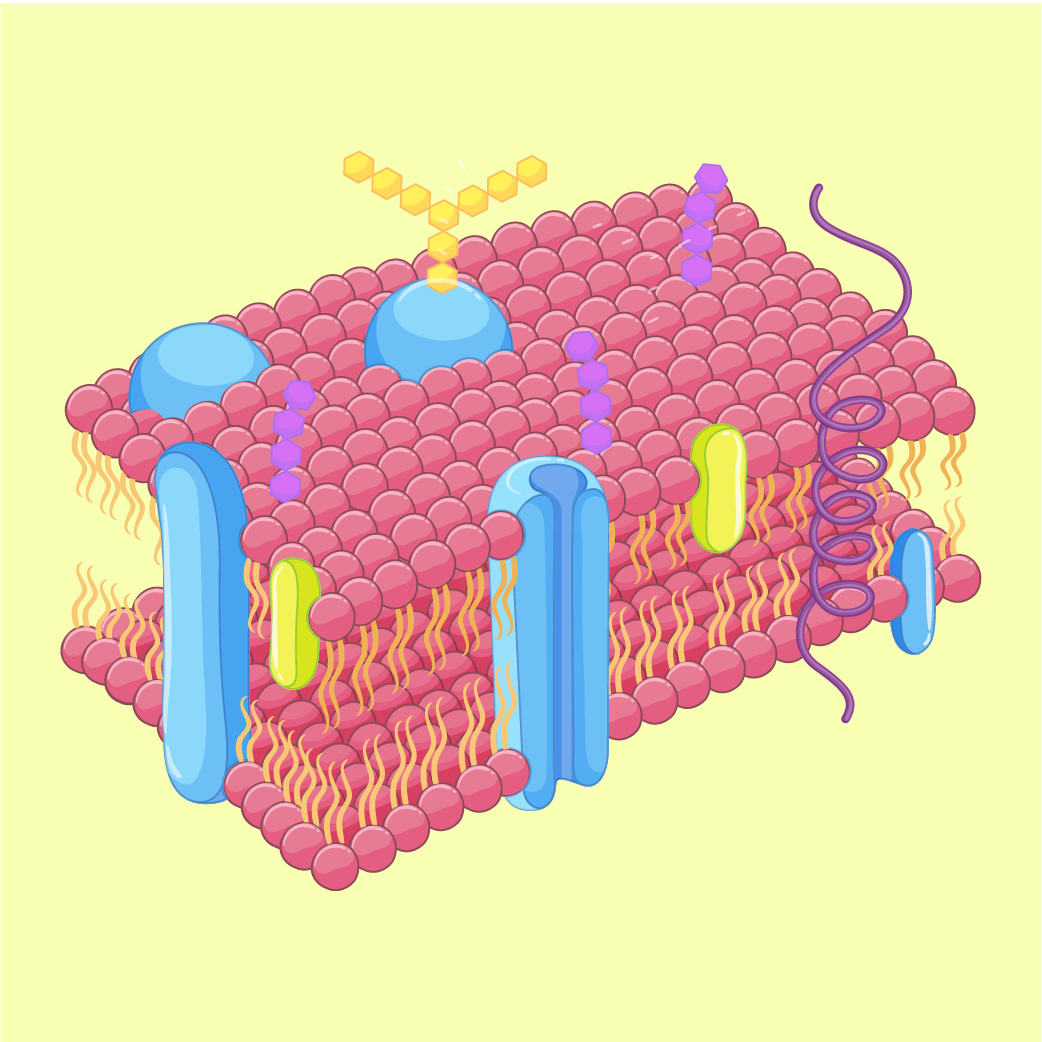
A three-dimensional cross-section showing the phospholipid bilayer, embedded proteins, cholesterol and carbohydrate chains.
Phospholipid bilayer
Hydrophilic heads face water; hydrophobic tails hide inside.
Channel protein
Contains a pore that allows specific molecules or ions to pass through.
Carrier protein
Has binding sites and transports specific molecules across the membrane.
Cholesterol
Makes the bilayer stronger, more flexible and less permeable to ions.
Glycoprotein
Carbohydrate chain attached to a protein; acts as receptor and antigen.
Glycolipid
Carbohydrate chain attached to a lipid; stabilises the membrane.
Short Explanation
What is the plasma membrane?
The plasma membrane is not a rigid boundary; it behaves like a dynamic two-dimensional fluid. Because cellular environments are aqueous on both sides — extracellular fluid outside and cytoplasm inside — phospholipid molecules naturally assemble into a bilayer: water-loving hydrophilic polar heads orient towards the fluids, while water-fearing hydrophobic nonpolar tails hide inside the core.
Fluid mosaic model
Proposed by S. J. Singer and G. L. Nicholson in 1972. Protein molecules float within a double layer of phospholipids, creating a mosaic-like pattern that changes frequently.
Membrane proteins
Channel proteins form open pores, while carrier proteins actively move specific substances. Both are embedded partially or fully within the phospholipid bilayer.
Cholesterol
Cholesterol molecules tucked between phospholipids fine-tune the membrane's stability, flexibility, and permeability to water-soluble ions.
Carbohydrate chains
Surface sugar chains — glycoproteins and glycolipids — act as cellular identification tags and docking stations for chemical messengers.
Try to Answer First
Answer in your mind, then press “Check Answer”.
What are the two main chemical components of the plasma membrane?
Explain what is meant by the “fluid mosaic model”.
Predict what will happen to the plasma membrane if cholesterol molecules are absent.
Common Mistakes
- Misidentifying the orientation of the phospholipid layers by stating that hydrophobic tails face the extracellular fluid or cytoplasm.
- Confusing channel proteins with carrier proteins, assuming both have open central pores.
- Defining a selectively permeable membrane as completely impermeable or completely permeable, rather than recognising that it discriminates between substances.
- Assuming cholesterol only makes the membrane hard and rigid, overlooking its role in maintaining flexibility and controlling ion permeability.
Concept Misunderstandings
The plasma membrane is a static, rigid wall like a plant cell wall.
The membrane is flexible and dynamic; phospholipids and proteins move and shift within the plane of the membrane.
Carbohydrate chains (glycoproteins and glycolipids) are found equally on both the inside and outside of the membrane.
Carbohydrate chains project exclusively towards the extracellular surface to interact with external hormones and neighbouring cells.
All substances pass through the plasma membrane in the same manner.
The membrane's structural components — bilayer core versus specific transport proteins — dictate which molecules pass freely and which require special channels or carriers.
Summary
- The plasma membrane regulates the exchange of nutrients and metabolic wastes between the cell and its environment.
- According to the fluid mosaic model (Singer and Nicholson, 1972), proteins float within a dynamic phospholipid bilayer.
- Phospholipids have hydrophilic polar heads (facing water) and hydrophobic nonpolar tails (facing inward).
- Channel proteins provide pores for substance movement, while carrier proteins bind and transport specific molecules.
- Glycoproteins and glycolipids stabilise the membrane via hydrogen bonding, act as hormone receptors (e.g., insulin), and serve as identification antigens.
- Cholesterol provides strength, flexibility, and lowers permeability to water-soluble substances like ions.
- The plasma membrane is selectively permeable, allowing only certain substances to pass through freely.
Short Activity
Objective: identify the components and functions of the plasma membrane.
A. Objective Quiz
Which component of the plasma membrane acts as a receptor for hormones such as insulin and serves as an antigen for cell identification?
What is the function of cholesterol molecules within the phospholipid bilayer?
B. Fill in the Blanks
The polar head of a phospholipid molecule is described as because it is attracted to water.
A membrane that allows the free passage of only certain molecules while restricting others is known as a permeable membrane.
C. Matching / Drag and Drop
Drag each membrane component to its correct structural feature or biological function. On a phone, tap a choice first, then tap the matching box. Tap the Answer Choices area to return a selected item.
C. Match the Membrane Component to Its Function / Feature
Write the correct membrane component next to each function or feature.
| Function / Feature | Membrane Component |
|---|---|
| 1. Protein with a channel or pore that allows specific substances to move across | |
| 2. Protein that functions specifically as a carrier to transport molecules | |
| 3. Hydrophobic part of a phospholipid that repels water and points toward the membrane interior | |
| 4. Lipid that makes the bilayer more flexible, stronger, and less permeable to ions |
Answer choices: Channel protein • Carrier protein • Nonpolar tail • Cholesterol

