
2.2 Living Processes in Unicellular Organisms
Learn how unicellular organisms like Amoeba sp. and Paramecium sp. carry out essential living processes within a single cell.
Learning Objectives
- Identify and describe the seven life processes carried out by unicellular organisms (Amoeba sp. and Paramecium sp.): movement, responding to stimuli, respiration, nutrition, growth, excretion, and reproduction.
- Describe how Amoeba sp. and Paramecium sp. move and respond to external stimuli.
- Explain the steps of nutrition in Amoeba sp. via phagocytosis and how Paramecium sp. obtains food.
- Explain gas exchange and osmoregulation in freshwater protozoans.
- Differentiate the reproductive methods of Amoeba sp. and Paramecium sp. under favourable and unfavourable environmental conditions.
Nutrition and Phagocytosis in Amoeba sp.
Follow the four steps of how Amoeba sp. engulfs food particles, digests them with lysosomes, absorbs nutrients, and eliminates undigested waste.
Extension of pseudopodium
Amoeba sp. moves towards food by extending its pseudopodia to trap food particles by phagocytosis.
Food vacuole and lysosome
The trapped food particle forms a food vacuole, which fuses with a lysosome. Food particles are hydrolysed by the enzyme lysozyme.
Nutrient absorption
The digested nutrients are absorbed into the cytoplasm.
Waste discharge
Undigested food is discharged when Amoeba sp. moves away.
Short Explanation
Unicellular Organisms
Unicellular organisms are living entities made up of only a single cell. Even though they consist of just one cell, that single cell is a complete and functional unit of life, capable of carrying out all necessary living processes just like complex multicellular organisms. These fundamental life processes include movement, responding to stimuli, respiration, nutrition, growth, excretion, and reproduction. Protozoans such as Amoeba sp. and Paramecium sp. serve as prime examples of the simplest free-living unicellular organisms.
Movement
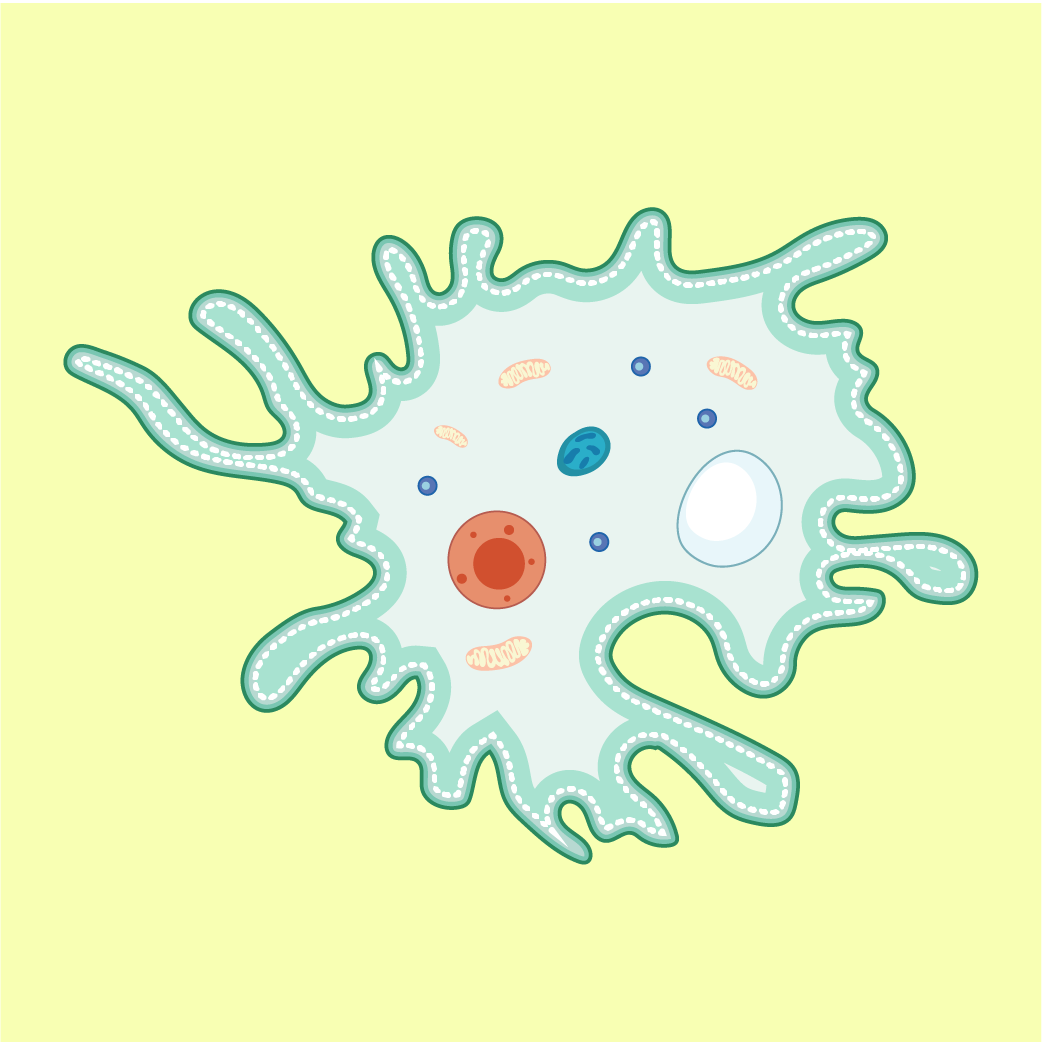
Amoeba sp. constantly changes its shape when encountering obstacles. It moves by extending its pseudopodium (false feet), followed by the flow of cytoplasm into the extended pseudopodium. Paramecium sp. moves using rhythmic cilia beats.
Responding to Stimuli
Both Amoeba sp. and Paramecium sp. respond to external stimuli such as chemicals, touch, or bright light by moving away from the stimuli.
Respiration
Exchange of oxygen and carbon dioxide gases occurs directly across the plasma membrane by simple diffusion over the cell surface.
Growth
Both Amoeba sp. and Paramecium sp. grow by synthesising new cytoplasm.
Excretion and Osmoregulation
Metabolic wastes such as carbon dioxide and ammonia are removed by simple diffusion across the plasma membrane. Because Amoeba sp. and Paramecium sp. live in freshwater environments (hypotonic to cell contents), water continuously diffuses into the cell by osmosis and fills the contractile vacuole. When the contractile vacuole expands to its maximum size, it contracts to excrete excess water from time to time. This regulatory process is known as osmoregulation.
Reproduction
Under favourable conditions (plenty of food and suitable environment), both Amoeba sp. and Paramecium sp. reproduce via asexual reproduction, specifically binary fission through mitosis. Under unfavourable conditions (dry conditions, low temperature, food shortage), Amoeba sp. forms spores that germinate only when environmental conditions improve, while Paramecium sp. carries out sexual reproduction via conjugation.
Try to Answer First
Answer in your mind, then press “Check Answer”.
How does Amoeba sp. move?
What is the function of the contractile vacuole in freshwater unicellular organisms like Paramecium sp.?
How do Amoeba sp. and Paramecium sp. reproduce when environmental conditions are unfavourable?
Common Mistakes
- Confusing the hydrolytic enzyme in the lysosome: thinking it is general digestive acid rather than the enzyme lysozyme.
- Confusing the organelle used for egestion in Paramecium sp.: forgetting that Paramecium sp. discharges undigested food through an anus, whereas Amoeba sp. discharges waste anywhere from the cell surface when it moves.
- Misunderstanding the role of the contractile vacuole: thinking it removes metabolic wastes like urea, when in fact metabolic waste like ammonia and carbon dioxide is removed by diffusion, while the contractile vacuole is primarily for osmoregulation (expelling excess water).
Concept Misunderstandings
Unicellular organisms are too simple to carry out sexual reproduction.
When environmental conditions become unfavourable, Paramecium sp. undergoes sexual reproduction via conjugation.
Amoeba sp. stays inside a shell and does not change shape.
Amoeba sp. constantly changes its shape, especially when encountering obstacles and when extending pseudopodia during movement and feeding.
Summary
- Unicellular organisms (Amoeba sp. and Paramecium sp.) carry out all seven living processes within a single cell.
- Movement relies on pseudopodia in Amoeba sp. and rhythmic cilia beats in Paramecium sp.
- Both organisms exhibit negative responses to adverse stimuli (chemicals, touch, bright light) by moving away.
- Respiration and excretion of ammonia/carbon dioxide occur across the plasma membrane by simple diffusion.
- Phagocytosis in Amoeba sp. involves pseudopodia engulfing food, lysosome fusing with the food vacuole, digestion by lysozyme, and nutrient absorption.
- Osmoregulation by contractile vacuoles maintains internal water balance in freshwater environments.
- Under favourable conditions, reproduction occurs by binary fission; under unfavourable conditions, Amoeba sp. forms spores and Paramecium sp. undergoes conjugation.
Short Activity
Objective: check your understanding of living processes in unicellular organisms.
A. Objective Quiz
Which enzyme inside lysosomes is responsible for hydrolysing food particles trapped in the food vacuole of Amoeba sp.?
What happens to the contractile vacuole of Amoeba sp. living in a freshwater environment?
B. Fill in the Blanks
Under unfavourable environmental conditions such as drought or food shortage, Paramecium sp. undergoes sexual reproduction called .
The process of regulating water balance in freshwater unicellular organisms using the contractile vacuole is known as .
C. Matching / Drag and Drop
Drag each structure or process to its correct description. On a phone, tap a choice first, then tap the matching box. Tap the Answer Choices area to return a selected item.
C. Match the Structure or Process to Its Description
Write the correct structure or process next to each description.
| Description | Structure / Process |
|---|---|
| 1. Extension of cytoplasm used by Amoeba sp. for movement and trapping food | |
| 2. Hair-like structures that beat rhythmically to move Paramecium sp. and sweep food into the oral groove | |
| 3. Asexual reproduction through mitosis occurring when conditions are favourable with plenty of food | |
| 4. Method used by Amoeba sp. to survive unfavourable conditions until the environment improves |
Answer choices: Pseudopodium • Cilia • Binary fission • Spore formation

