
1.3 Communicating in Biology
Learn how biologists present and share research findings systematically through tables, graphs, biological drawings, body planes, sections, and anatomical directions.
Learning Objectives
- Record and present experimental data correctly using tables with appropriate headings and units.
- Construct line graphs, bar charts, and histograms following standard graphing conventions.
- Produce biological drawings (plan drawings and detailed drawings) according to standard criteria and determine their magnification factors.
- Identify and describe the body planes (sagittal, frontal, and horizontal), sections (cross section and longitudinal section), and anatomical directions in organisms.
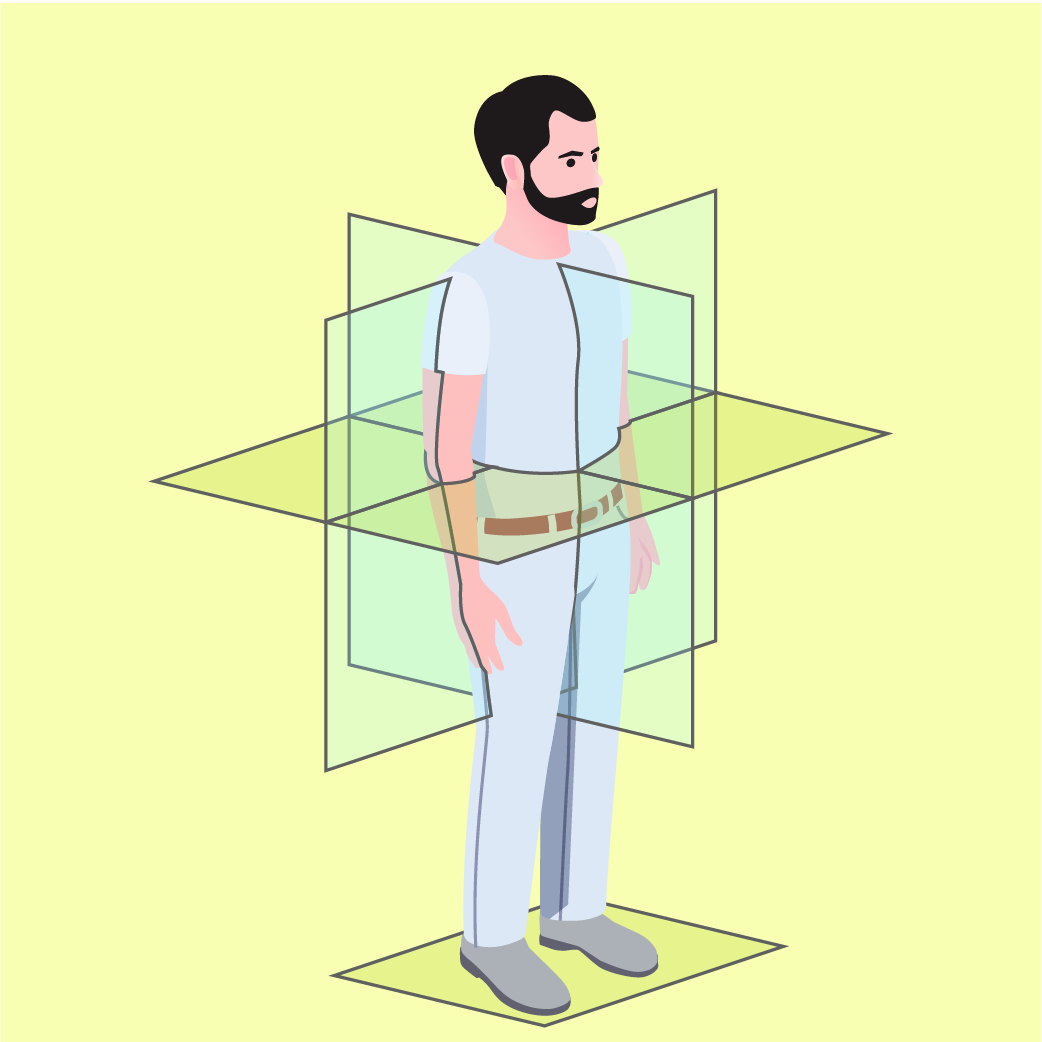
Anatomical Planes, Sections, and Directions in Biology
Compare the three body planes, distinguish cross sections from longitudinal sections, and explore anatomical directional terms on a human and a fish model.
Sagittal Plane
Divides the body vertically into right and left parts.
Frontal Plane
Divides the body vertically into frontal and rear parts.
Horizontal Plane
Divides the body into upper and lower parts.
Short Explanation
What is communication in biology?
Communication in biology is essential for biologists to present and share their research findings systematically. It includes constructing organized data tables, plotting appropriate graphs, producing precise biological drawings with magnification calculations, and describing anatomical orientations using specific planes, sections, and directional terms.
Tables
Tables record and present experimental data systematically for easy comparison. The manipulated variable is placed in the left-hand column, while the responding variable is placed in the right-hand column. Both headings must include the variable name and its unit.
Graphs
Graphs illustrate the relationship between the manipulated variable and the responding variable. The responding variable is on the vertical \(y\)-axis, and the manipulated variable is on the horizontal \(x\)-axis. Axis scaling must be uniform, and data points are marked with an appropriate symbol such as 'x'.
Biological drawings
Biological drawings must provide an exact, accurate representation of an observed specimen. They are drawn with a sharp pencil, have clear continuous lines, no artistic shading, and no ruler-drawn specimen outlines. Label lines must be straight, without arrowheads, and must not cross.
Planes, sections, and directions
Three reference planes — sagittal, frontal, and horizontal — cut through organisms. Two sectioning methods — cross section and longitudinal section — expose internal structures. Directional terms such as superior, inferior, anterior, posterior, dorsal, ventral, and lateral ensure precise descriptions of structure locations.
Try to Answer First
Answer in your mind, then press “Check Answer”.
In a data table, where should the manipulated variable and responding variable be placed?
What is the main structural difference in the bars of a bar chart compared to those of a histogram?
If the length of a drawing is \(2.4\text{ cm}\) and the actual length of the specimen is \(1.2\text{ cm}\), what is the magnification factor?
Common Mistakes
- Putting arrowheads on biological drawing label lines; label lines must be straight lines without arrowheads.
- Crossing label lines when labelling different structures.
- Shading structures artistically to show depth; biological drawings must not be shaded artistically.
- Using a ruler to trace the outline of biological specimens.
- Leaving gaps between bars when drawing a histogram, or touching bars together when drawing a bar chart.
- Reversing graph axes by putting the manipulated variable on the \(y\)-axis instead of the \(x\)-axis.
Concept Misunderstandings
A plan drawing includes individual cell walls and organelles.
A plan drawing only shows the outlines and boundaries of tissue layers, without individual cells.
Anterior/posterior and superior/inferior mean the same thing in all organisms.
In fish, the dorsal side is upper and the ventral side is lower, while anterior is towards the front (head) and posterior is towards the back (tail).
Magnification factor has units such as cm.
Magnification is a dimensionless ratio expressed with an 'x', for example \(2\text{x}\).
Summary
- Tables: Manipulated variable on the left, responding variable on the right, each with correct units.
- Graphs: Title is “\(y\)-axis versus \(x\)-axis”. \(x\)-axis is manipulated variable, \(y\)-axis is responding variable. Bar charts have spaces between bars; histograms have touching bars.
- Biological drawings: Drawn with a sharp pencil, clear continuous lines, no artistic shading, no ruler-drawn specimen outlines, straight label lines without arrowheads, accompanied by a title and magnification factor \(\left(\text{Length of drawing} \div \text{Length of specimen}\right)\).
- Planes: Sagittal (left/right), frontal (front/rear), horizontal (upper/lower).
- Sections: Cross section (horizontal division into upper/lower), longitudinal section (division into left/right).
- Directions: Superior (headwards), inferior (feetwards), lateral (towards the side/away from midline), anterior (front), posterior (back), dorsal (upper part in animals), ventral (lower part in animals).
Short Activity
Objective: test your understanding of planes, biological drawing rules, magnification, and anatomical directions.
A. Objective Quiz
Which plane divides the body into frontal and rear parts?
Which rule must be adhered to when producing a scientific biological drawing?
B. Fill in the Blanks
The magnification factor of a drawing is calculated by dividing the length of the drawing by the length of the in cm.
A section divides an anatomical structure horizontally into upper and lower portions.
C. Matching / Drag and Drop
Match each anatomical directional term with its correct textbook definition. On a phone, tap a choice first, then tap the matching box. Tap the Answer Choices area to return a selected item.
C. Match the Directional Term to Its Definition
Write the correct directional term next to each definition.
| Definition | Directional Term |
|---|---|
| 1. The part that is above all other parts or towards the head | |
| 2. Situated below other parts or towards the feet | |
| 3. Far from the midline or at the side of the body | |
| 4. Towards the back part of the body |
Answer choices: Superior • Inferior • Lateral • Posterior

