
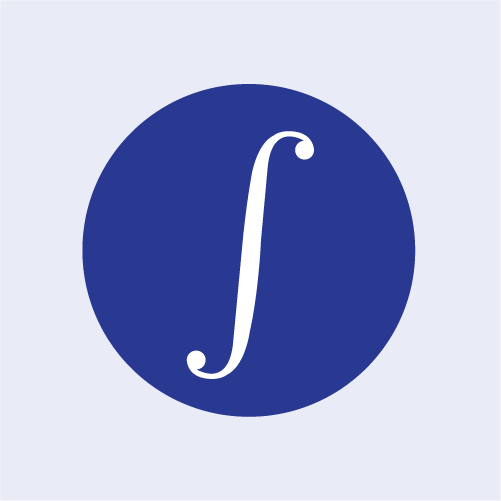
3.1 Integration as the Inverse of Differentiation
In previous lessons, we learned that differentiation is the process of finding the rate of change or derivative of a function \(y = f(x)\), written as \(\dfrac{dy}{dx}\) or \(f'(x)\). Integration is the reverse or inverse process of differentiation. When we integrate the derivative of a function with respect to \(x\), we obtain the original function, known as the antiderivative. The integral symbol \(\int\) is used to denote this operation.
Learning Objectives
- Explain the relationship between differentiation and integration as inverse processes.
- Determine the integral of a derivative function using the rule: if \(\dfrac{d}{dx}[f(x)] = f'(x)\), then \(\int f'(x) \, dx = f(x)\).
- Apply the concept of integration as the reverse of differentiation to solve algebraic and contextual problems.
The Reversible Cycle of Calculus: Differentiation vs Integration
Differentiation maps \(f(x)\) to \(f'(x)\). Integration returns \(f'(x)\) back to \(f(x)\) as an inverse operation.
\(\dfrac{d}{dx}\)
\(\int \dots dx\)
Short Explanation
Differentiation and integration are inverse operations.
Recall of Differentiation Rules
If \(y = ax^n\), then \(\dfrac{dy}{dx} = anx^{n-1}\).
If \(y = a\) (a constant), then \(\dfrac{dy}{dx} = 0\).
If \(y = ax\), then \(\dfrac{dy}{dx} = a\).
The Relationship Between Differentiation and Integration
Differentiation takes an original function \(f(x)\) and produces its derivative \(f'(x)\): \(\dfrac{d}{dx}[f(x)] = f'(x)\). Integration reverses this operation to retrieve the original function \(f(x)\) from its derivative \(f'(x)\): \(\int f'(x) \, dx = f(x)\). The original function \(f(x)\) is called the antiderivative of the integrated function.
Fundamental General Statement
\(\int f'(x) \, dx = f(x)\)If \(\dfrac{d}{dx}[f(x)] = f'(x)\), then the integral of \(f'(x)\) with respect to \(x\) is \(f(x)\).
| Given derivative | Original function | Integral result |
|---|---|---|
| \(\dfrac{d}{dx}(4x^2) = 8x\) | \(4x^2\) | \(\int 8x \, dx = 4x^2\) |
| \(\dfrac{d}{dx}(5x^3 + 4x) = 15x^2 + 4\) | \(5x^3 + 4x\) | \(\int (15x^2 + 4) \, dx = 5x^3 + 4x\) |
| \(\dfrac{d}{dx}(8x^3) = 24x^2\) | \(8x^3\) | \(\int 24x^2 \, dx = 8x^3\) |
| \(\dfrac{dy}{dx} = 18(2x + 2)^2\) | \(y = 3(2x + 2)^3\) | \(\int [18(2x + 2)^2] \, dx = 3(2x + 2)^3\) |
Worked Example: Coal Production
Mass of coal produced: \(K = 48\,000t - 100t^3\).
Rate of coal production: \(\dfrac{dK}{dt} = 48\,000 - 300t^2\).
If a new rate is given as \(\dfrac{dK}{dt} = 96\,000 - 600t^2 = 2(48\,000 - 300t^2)\), then by reversing differentiation:
\(\int 2(48\,000 - 300t^2) \, dt = 2(48\,000t - 100t^3) = 96\,000t - 200t^3\).
For \(t = 4\) years, mass produced \(= 96\,000(4) - 200(4)^3 = 384\,000 - 12\,800 = 371\,200\text{ tonnes}\).
Historical Note
Gottfried Wilhelm Leibniz, a German mathematician, introduced the integral symbol \(\int\) in 1675. The symbol was adapted from the letter "long s" (\(\int\)) standing for summa.
Try to Answer First
Answer in your mind, then press "Check Answer".
Given that \(\dfrac{d}{dx}(5x^3 + 4x) = 15x^2 + 4\), determine the value of \(\int (15x^2 + 4) \, dx\).
Given that \(\dfrac{d}{dx}(8x^3) = 24x^2\), find \(\int 24x^2 \, dx\).
If \(y = 3(2x + 2)^3\) and \(\dfrac{dy}{dx} = 18(2x + 2)^2\), find \(\int [18(2x + 2)^2] \, dx\).
Common Mistakes
- Differentiating again when the problem asks for the integral of a derivative.
- Forgetting that multiplying the integrand by a scalar constant multiplies the antiderivative by the same scalar constant, for instance missing the factor of 2 in \(\int 2(48\,000 - 300t^2) \, dt\).
- Omitting the differential operator symbol \(dx\) or \(dt\) inside the integration expression.
- Confusing the derivative \(f'(x)\) with the original function \(f(x)\) when writing the final answer.
Concept Misunderstandings
Integration is completely unrelated to differentiation.
Integration is strictly the inverse (reverse) process of differentiation.
The symbol \(\int\) is a variable or a letter to be solved.
The symbol \(\int\) is an operator introduced by Leibniz (from the long "s") to denote the operation of integration.
Integrating \(f'(x)\) produces a completely new, unpredictable formula.
Integrating \(f'(x)\) yields the antiderivative, which matches the original function \(f(x)\) whose derivative was taken.
Summary
- Differentiation transforms \(f(x)\) into \(f'(x)\): \(\dfrac{d}{dx}[f(x)] = f'(x)\).
- Integration is the inverse process of differentiation: \(\int f'(x) \, dx = f(x)\).
- The function \(f(x)\) obtained through integration is called the antiderivative.
- The integral sign \(\int\) was introduced in 1675 by Gottfried Wilhelm Leibniz.
- When given a derivative and its original function, the integral of the derivative can be stated directly as the original function without using complex integration rules.
Short Activity
Objective: Check your understanding of integration as the inverse of differentiation.
A. Objective Quiz
1 If \(\dfrac{d}{dx}(4x^2) = 8x\), what is the result of \(\int 8x \, dx\)?
2 Which mathematician introduced the integral symbol \(\int\) in 1675 from the long letter s?
B. Fill in the Blanks
3 Integration is the reverse process of ________.
4 If \(\dfrac{d}{dx}[f(x)] = f'(x)\), then \(\int f'(x) \, dx =\) ________.
C. Matching / Drag and Drop
Drag each integral expression to its correct antiderivative or result. On a phone, tap a card first, then tap the matching box.

