
2.4 Application of Differentiation
Differentiation helps us determine gradients of tangents, equations of tangents and normals, stationary points, maximum or minimum values, rates of change, and small changes in quantities.
Learning Objectives
- Determine gradients of tangents and the equations of tangents and normals.
- Identify maximum points, minimum points and points of inflection.
- Use the second order derivative to determine the nature of turning points.
- Solve problems involving maximum values, minimum values and rates of change.
- Use differentiation to determine small changes, approximate values and percentage changes.
Application of Differentiation at a Glance
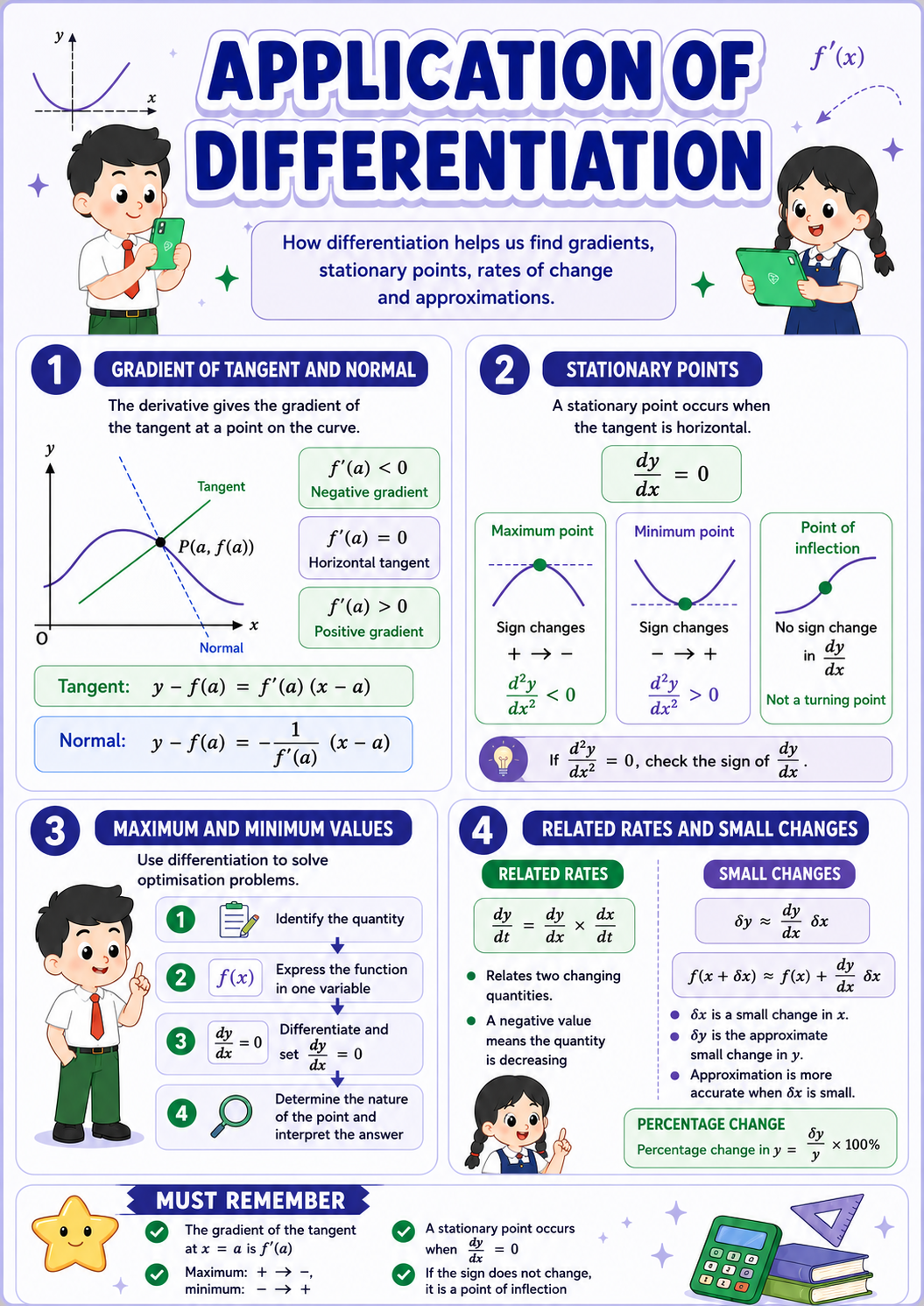
Review gradients, tangent and normal, stationary points, optimisation, related rates and small changes in one visual.
Gradient of Tangent to a Curve
Move the value of \(x=a\) to see how the gradient of the tangent to \(f(x)=x^2\) changes at different points.
Graph of \(f(x)=x^2\) and Its Tangent
Explore the value of \(x=a\)
The values match those in the textbook example: −2, −1, 0, 1 and 2.
The tangent line is horizontal.
Negative gradient — the tangent line falls from left to right.
Zero gradient — the tangent line is horizontal.
Positive gradient — the tangent line rises from left to right.
Chain Rule — Rates of Change of Connected Quantities
Connecting three rates of change: \(\dfrac{dy}{dx}\), \(\dfrac{dx}{dt}\) and \(\dfrac{dy}{dt}\).
\(\dfrac{dy}{dt} > 0\)
The value of \(y\) is increasing with respect to time.
\(\dfrac{dy}{dt} < 0\)
The value of \(y\) is decreasing with respect to time.
Short Explanation
Use the first and second order derivatives according to the type of problem.
1. Gradient of Tangent
For \(y=f(x)\), the gradient of the tangent at point \(P(a,f(a))\) is \(f'(a)\).
2. Equations of Tangent and Normal
Tangent: \(y-f(a)=f'(a)(x-a)\). If \(f'(a)\neq0\), the normal is: \(y-f(a)=-\dfrac{1}{f'(a)}(x-a)\).
3. Stationary Points
A stationary point occurs when \(\dfrac{dy}{dx}=0\). The tangent to the graph at that point is horizontal.
4. Nature of Stationary Points
A sign change of \(+\to-\) indicates a maximum point; \(-\to+\) indicates a minimum point; no sign change indicates a point of inflection.
5. Second Order Derivative Test
When \(\dfrac{dy}{dx}=0\): if \(\dfrac{d^2y}{dx^2}<0\), the turning point is a maximum; if \(\dfrac{d^2y}{dx^2}>0\), it is a minimum.
6. Maximum and Minimum Values
Express the function in one variable, find the first derivative, set it equal to zero, and determine the nature of the stationary point obtained.
7. Related Rates (Chain Rule)
Use: \(\dfrac{dy}{dt}=\dfrac{dy}{dx}\times\dfrac{dx}{dt}\). A negative value shows that the quantity is decreasing.
8. Small Changes and Approximations
If \(\delta x\) is small: \(\delta y\approx\dfrac{dy}{dx}\delta x\) and \(f(x+\delta x)\approx f(x)+\dfrac{dy}{dx}\delta x\).
| Condition | Sign / Test | Interpretation |
|---|---|---|
| Maximum point | \(+\to-\) or \(\dfrac{d^2y}{dx^2}<0\) | The graph turns from increasing to decreasing. |
| Minimum point | \(-\to+\) or \(\dfrac{d^2y}{dx^2}>0\) | The graph turns from decreasing to increasing. |
| Point of inflection | The sign of \(\dfrac{dy}{dx}\) does not change | A stationary point, but not a turning point. |
| Negative rate of change | Example: \(\dfrac{dV}{dt}<0\) | The quantity is decreasing. |
Steps for Solving Maximum or Minimum Problems
Identify the quantity to be maximised or minimised.
Express the function in one variable only.
Find the first derivative and set it equal to zero.
Determine the nature of the point and interpret the answer in context.
Small change in \(y\)
\(\delta y \approx \dfrac{dy}{dx} \times \delta x\)The smaller \(\delta x\) is, the more accurate.
Approximate value of function
\(f(x+\delta x)\approx f(x)+\dfrac{dy}{dx}\,\delta x\)Use this to estimate a new value of \(y\).
Try to Answer First
Answer in your mind, then press "Check Answer".
For a curve, the value of \(\dfrac{dy}{dx}\) at point \(P\) is \(-3\). What is the condition of the tangent line?
As \(x\) increases through a stationary point, the sign of \(\dfrac{dy}{dx}\) changes from positive to negative. What is the nature of that stationary point?
Given \(\dfrac{dy}{dx}=4\) and \(\dfrac{dx}{dt}=3\), find \(\dfrac{dy}{dt}\).
Common Mistakes
- Substituting the value of \(x\) into the original function when finding a gradient, without first finding \(\dfrac{dy}{dx}\).
- Assuming every point where \(\dfrac{dy}{dx}=0\) is a maximum or minimum point — it could be a point of inflection.
- Not checking the sign change of \(\dfrac{dy}{dx}\) when \(\dfrac{d^2y}{dx^2}=0\). The second derivative test fails here; the tangent sketch method must be used.
- Using the gradient of the tangent as the gradient of the normal, instead of its negative reciprocal \(-\dfrac{1}{m}\).
- Forgetting the negative sign when water flows out or a quantity is decreasing — the rate must be written as negative.
- Confusing the small change \(\delta y\) with the derivative \(\dfrac{dy}{dx}\). They are different: \(\delta y \approx \dfrac{dy}{dx}\times\delta x\).
Concept Misunderstandings
If \(\dfrac{dy}{dx}=0\), the point must be a maximum point.
The point may be a maximum, a minimum, or a point of inflection — the sign change of \(\dfrac{dy}{dx}\) must be checked.
If \(\dfrac{d^2y}{dx^2}=0\), the point must be a point of inflection.
The sign change of \(\dfrac{dy}{dx}\) must still be checked using the tangent sketch method to determine the nature of the stationary point.
A negative rate of change means the calculation is wrong.
A negative sign for a rate of change simply means the quantity is decreasing. It is mathematically correct.
Summary
- The gradient of the tangent at \(x=a\) is \(f'(a)\); the gradient of the normal is \(-\dfrac{1}{f'(a)}\) when \(f'(a)\neq0\).
- A stationary point occurs when \(\dfrac{dy}{dx}=0\). The sign change of \(\dfrac{dy}{dx}\) determines whether it is a maximum, minimum or point of inflection.
- Second order derivative test: \(\dfrac{d^2y}{dx^2}<0\) → maximum; \(\dfrac{d^2y}{dx^2}>0\) → minimum; \(\dfrac{d^2y}{dx^2}=0\) → use tangent sketch method.
- Chain rule relates rates of change: \(\dfrac{dy}{dt}=\dfrac{dy}{dx}\times\dfrac{dx}{dt}\).
- For small changes: \(\delta y\approx\dfrac{dy}{dx}\delta x\), and an approximate value: \(f(x+\delta x)\approx f(x)+\dfrac{dy}{dx}\delta x\).
Short Activity
Objective: Identify gradients, stationary points, the chain rule and key terms in applications of differentiation.
A. Objective Quiz
1 If \(f'(a) < 0\), how does the tangent line behave as \(x\) increases?
2 The sign of \(\dfrac{dy}{dx}\) changes from positive to negative as \(x\) increases. What is the nature of the stationary point?
B. Fill in the Blanks
3 A point where \(\dfrac{dy}{dx}=0\) is called a ________ point.
4 The relation \(\dfrac{dy}{dt}=\dfrac{dy}{dx}\times\dfrac{dx}{dt}\) is called the ________.
C. Matching / Drag and Drop
Drag each term to the correct meaning. On a phone, tap a term first, then tap the matching box.

