
1.4 Application of Circular Measures
Circular measures play an important role in real-world contexts, such as calculating the cross-sectional area of train tunnels, analysing the curved shape of rainbows, designing logos, or calculating the volume and capacity of swimming pools and cylindrical objects.
Learning Objectives
- Apply the arc length formula, \(s = r\theta\), to solve problems involving perimeters of real-world shapes.
- Apply the sector area formula, \(A = \dfrac{1}{2}r^2\theta\), to solve problems involving cross-sectional areas.
- Integrate circular measures with trigonometry to find dimensions and areas of segments and composite shapes.
- Calculate three-dimensional quantities such as volume and mass for objects with uniform circular cross-sections.
Cross-Sectional Geometry of a Major Segment Train Tunnel
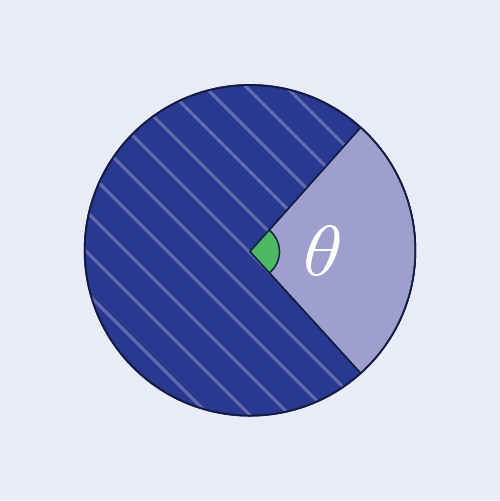
See how a circular tunnel cross-section is decomposed into a major sector and an interior triangle to find the perimeter and total cross-sectional area.
Major Sector \(ABC\)
The upper region subtends the reflex angle \(\theta_1 = 4.484\text{ rad}\). Its area is found using \(A = \dfrac{1}{2}r^2\theta\).
Triangle \(\Delta AOC\)
The lower region subtends the minor angle \(\theta_2 = 1.8\text{ rad}\). Its area is found using \(\dfrac{1}{2}ab\sin C\).
Total cross-sectional area
\(\text{Area of major sector } ABC + \text{Area of } \Delta AOC\)Chord \(AC\) is the boundary between the two regions.
Short Explanation
Combine circular measure formulae with trigonometry to solve real-world problems.
1. Fundamental Circular Measure Formulae
Arc length: \(s = r\theta\). Area of sector: \(A = \dfrac{1}{2}r^2\theta\). Angle conversion: \(1\text{ rad} = \dfrac{180^\circ}{\pi}\), using \(\pi = 3.142\).
2. Trigonometric Rules Used
Cosine rule: \(c^2 = a^2 + b^2 - 2ab\cos C\). Area of triangle: \(\text{Area} = \dfrac{1}{2}ab\sin C\).
3. Major Segment & Tunnel Cross-Section
For a tunnel with radius \(r = 4\text{ m}\) and minor angle \(1.8\text{ rad}\), the chord length is \(AC = 6.266\text{ m}\), the major arc length is \(17.94\text{ m}\), and the total cross-sectional area is \(43.66\text{ m}^2\).
4. Composite 2D and 3D Applications
For uniform solids: \(\text{Volume} = \text{cross-sectional area} \times \text{height}\). Mass and cost calculations derive proportionally from total volume.
| Quantity | Formula / Method | Example Value |
|---|---|---|
| Chord length \(AC\) | \(c^2 = a^2 + b^2 - 2ab\cos C\) | \(6.266\text{ m}\) |
| Major arc length \(ABC\) | \(s = r(2\pi - \theta)\) | \(17.94\text{ m}\) |
| Area of \(\Delta AOC\) | \(\dfrac{1}{2}ab\sin C\) | \(7.791\text{ m}^2\) |
| Area of major sector \(ABC\) | \(\dfrac{1}{2}r^2(2\pi - \theta)\) | \(35.87\text{ m}^2\) |
| Total cross-sectional area | Triangle + major sector | \(43.66\text{ m}^2\) |
Steps for Solving Real-World Circular Measure Problems
Model the problem geometrically: identify circle centres, radii, chords, and boundary arcs.
Determine the required angles. Ensure all angles used in \(s = r\theta\) and \(A = \dfrac{1}{2}r^2\theta\) are in radians.
Decompose composite areas into standard sectors and triangles. Use trigonometry to evaluate triangle segments.
Extend to 3D applications: multiply the cross-sectional area by the uniform depth, length, or thickness.
Arc length
\(s = r\theta\)\(\theta\) must be in radians.
Area of a sector
\(A = \dfrac{1}{2}r^2\theta\)\(\theta\) must be in radians.
Try to Answer First
Answer in your mind, then press "Check Answer".
A circular train tunnel has a radius of \(4\text{ m}\) and the reflex angle subtended at the centre is \(4.484\text{ rad}\). Calculate the length of the major arc \(ABC\) in metres.
In \(\Delta AOC\), \(OA = OC = 4\text{ m}\) and \(\angle AOC = 103^\circ 7'\). Calculate the area of the triangle to three decimal places.
A slice of cylindrical cake has a radius of \(11\text{ cm}\) and an angle of \(40^\circ\). If the mass of this slice is \(150\text{ g}\), what is the mass of the whole cake in grams?
Common Mistakes
- Using angle values in degrees directly inside the arc length \(s = r\theta\) or sector area \(A = \dfrac{1}{2}r^2\theta\) formulae without converting them to radians first.
- Forgetting to set the scientific calculator to degree mode when calculating trigonometric ratios if the angle has been converted to degrees, or vice versa when inputting radians directly.
- Calculating the area of a major segment by subtracting the triangle from the minor sector instead of adding the triangle to the major sector.
- Confusing the minor angle \(\theta\) with the reflex angle \((2\pi - \theta)\) when computing major arc lengths.
Concept Misunderstandings
The area of any segment can be calculated directly with one simple formula without finding both the sector and the triangle.
A segment is bounded by an arc and a chord. Its area must be found by combining the area of the corresponding sector and the area of the triangle formed by the chord and the radii.
\(2\pi\) is always equal to \(6.28\) or \(6.283\).
The textbook specifies taking \(\pi = 3.142\), which gives \(2\pi = 2(3.142) = 6.284\text{ rad}\). Using other rounded values will introduce calculation discrepancies.
Summary
- Real-world problems involving circular shapes often combine circular measures (\(s = r\theta\), \(A = \dfrac{1}{2}r^2\theta\)) with plane trigonometry (cosine rule, area of triangle).
- To find the total area of a major segment (like a train tunnel), sum the area of the major sector and the area of the triangle formed by the chord and the radii.
- Always ensure that angle \(\theta\) is in radians when applying circular measure formulae, and use \(\pi = 3.142\) as specified.
- Three-dimensional quantities for uniform shapes (cakes, pools, concrete structures) are found by multiplying the cross-sectional area by uniform height, depth, or thickness.
Short Activity
Objective: Apply circular measure formulae, trigonometry, and volume calculations to real-world problems.
A. Objective Quiz
1 The cross-section of a train tunnel forms a major segment with a radius of \(4\text{ m}\). Given that the minor angle at the centre is \(1.8\text{ rad}\) and \(\pi = 3.142\), what is the reflex angle subtended by the major arc?
2 A sector of a circle has radius \(r\) and angle \(\theta\) radians. If this sector forms the uniform cross-section of a prism of length \(h\), what is the volume of the prism?
B. Fill in the Blanks
3 In circular measure formulae such as \(s = r\theta\), the angle \(\theta\) must always be measured in ________.
4 For a major segment tunnel with centre \(O\) and chord \(AC\), the total cross-sectional area is the sum of the area of the major sector and the area of ________ \(AOC\).
C. Matching / Drag and Drop
Drag each term to the correct mathematical expression or description. On a phone, tap a term first, then tap the matching box.

