
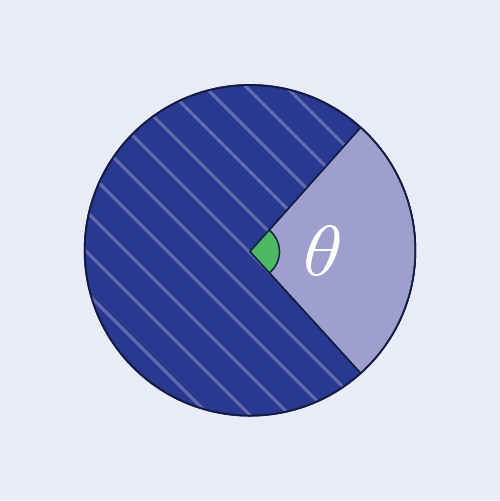
1.1 Radian
In circular measure, angles have traditionally been measured in degrees. However, in higher mathematical disciplines, measuring angles in degrees is often less suitable. To provide a natural and direct relationship between the radius and the arc length of a circle, the radian unit is introduced. This topic establishes the definition of one radian, explores how radians relate to degrees, and demonstrates conversions between radians and degrees.
Learning Objectives
- Define one radian as the angle subtended at the centre of a circle by an arc whose length is equal to the radius of the circle.
- Relate angle measurements in radians to angles in degrees (\(2\pi\text{ rad} = 360^\circ\) and \(\pi\text{ rad} = 180^\circ\)).
- Convert angles from radians to degrees and from degrees to radians, both in terms of \(\pi\) and using \(\pi = 3.142\).
Definition of 1 Radian and Conversion Cycle
See how an arc equal to the radius subtends one radian, and remember the conversion factors between degrees and radians.
One Radian: Arc Length \(s = r\)
Conversion Cycle
Radians → Degrees: multiply by \(\dfrac{180^\circ}{\pi}\)
Degrees → Radians: multiply by \(\dfrac{\pi}{180^\circ}\)
Half a full turn
Using \(\pi = 3.142\)
Short Explanation
Understand the definition of a radian and how to convert between radians and degrees.
1. Definition of One Radian
One radian is the measure of an angle subtended at the centre of a circle by an arc whose length is the same as the radius of the circle. It can be written as \(1\text{ rad}\), \(1^r\), or \(1^c\).
2. Independence of Circle Size
Whether a circle has a radius of \(10\text{ cm}\) with an arc length of \(10\text{ cm}\), or a radius of \(20\text{ cm}\) with an arc length of \(20\text{ cm}\), the subtended angle at the centre is identically \(1\text{ radian}\).
3. General Relationship
For a circle with centre \(O\) and radius \(r\): if the arc length \(AB = r\), then \(\angle AOB = 1\text{ radian}\). If \(AB = 2r\), then \(\angle AOB = 2\text{ radians}\). If \(AB = \pi r\) (semicircle), then \(\angle AOB = \pi\text{ radians}\). If \(AB = 2\pi r\) (full circumference), then \(\angle AOB = 2\pi\text{ radians}\).
4. Relating Radians to Degrees
A complete rotation around the centre subtends a full circumference of \(2\pi r\), which corresponds to \(360^\circ\). Therefore \(2\pi\text{ rad} = 360^\circ\), and dividing both sides by 2 gives \(\pi\text{ rad} = 180^\circ\).
5. Approximations
Using \(\pi = 3.142\): \(1\text{ rad} = \dfrac{180^\circ}{\pi} = \dfrac{180^\circ}{3.142} \approx 57.29^\circ\), and \(1^\circ = \dfrac{\pi}{180^\circ} = \dfrac{3.142}{180^\circ} \approx 0.01746\text{ rad}\).
6. Conversion Methods
To convert radians to degrees, multiply by \(\dfrac{180^\circ}{\pi}\). To convert degrees to radians, multiply by \(\dfrac{\pi}{180^\circ}\).
| Angle in Degrees | Angle in Radians |
|---|---|
| \(0^\circ\) | \(0\) |
| \(30^\circ\) | \(\frac{\pi}{6}\) |
| \(36^\circ\) | \(\frac{\pi}{5}\) |
| \(45^\circ\) | \(\frac{\pi}{4}\) |
| \(60^\circ\) | \(\frac{\pi}{3}\) |
| \(90^\circ\) | \(\frac{\pi}{2}\) |
| \(180^\circ\) | \(\pi\) |
| \(270^\circ\) | \(\frac{3}{2}\pi\) |
| \(360^\circ\) | \(2\pi\) |
Fundamental relation
\(\pi\text{ rad} = 180^\circ\)Half a full turn in both units.
One radian in degrees
\(1\text{ rad} = \dfrac{180^\circ}{\pi} \approx 57.29^\circ\)Using \(\pi = 3.142\).
Historical Context
Gottfried Wilhelm Leibniz, a German mathematician, developed a formula to calculate the value of \(\pi = 3.142\) without using a circle:
\[\frac{\pi}{4} = 1 - \frac{1}{3} + \frac{1}{5} - \frac{1}{7} + \frac{1}{9} - \frac{1}{11} + \dots\]
Try to Answer First
Answer in your mind, then press "Check Answer".
Convert \(\dfrac{3}{4}\pi\text{ rad}\) into degrees.
Convert \(225^\circ\) into radians in terms of \(\pi\).
Convert \(2\text{ rad}\) into degrees, using \(\pi = 3.142\).
Common Mistakes
- Multiplying by the wrong conversion ratio: multiplying by \(\dfrac{\pi}{180^\circ}\) when converting radians to degrees instead of \(\dfrac{180^\circ}{\pi}\).
- Premature substitution of \(\pi\): substituting \(\pi = 3.142\) when the question asks for the answer "in terms of \(\pi\)".
- Misinterpreting minutes of an angle: treating \(128^\circ 54'\) as \(128.54^\circ\). The symbol \('\) represents minutes of arc, where \(60' = 1^\circ\).
Concept Misunderstandings
Thinking 1 radian changes with circle size: a larger circle produces a larger angle of 1 radian.
As the radius \(r\) increases, the required arc length \(s\) increases proportionally (\(s = r\)), keeping the central angle constant at approximately \(57.29^\circ\).
Confusing \(\pi\) as a variable rather than a constant angle measure: \(\pi\) always means \(3.142\).
\(\pi\text{ rad}\) represents an exact half-turn (\(180^\circ\)). The value \(3.142\) is only an approximation of \(\pi\).
Summary
- \(1\text{ radian}\) is subtended when arc length \(s\) equals radius \(r\).
- \(2\pi\text{ rad} = 360^\circ \implies \pi\text{ rad} = 180^\circ\).
- \(1\text{ rad} = \dfrac{180^\circ}{\pi} \approx 57.29^\circ\) (using \(\pi = 3.142\)).
- \(1^\circ = \dfrac{\pi}{180^\circ} \approx 0.01746\text{ rad}\) (using \(\pi = 3.142\)).
- Conversion factor: Radians to Degrees \(= \times \dfrac{180^\circ}{\pi}\); Degrees to Radians \(= \times \dfrac{\pi}{180^\circ}\).
Short Activity
Objective: Test your understanding of radians, conversions and special angles.
A. Objective Quiz
1 What is the angle subtended at the centre of a circle of radius \(r\) when the arc length is equal to \(r\)?
2 Convert \(60^\circ\) into radians in terms of \(\pi\).
B. Fill in the Blanks
3 In circular measure, an angle of a complete rotation through \(360^\circ\) is equal to ________ radians.
4 Using \(\pi = 3.142\), the measure of 1 radian in degrees is approximately ________ degrees (to two decimal places).
C. Matching / Drag and Drop
Match each angle in degrees with its corresponding equivalent angle in radians. On a phone, tap a card first, then tap the matching box.

